
Renewable energy diversification has become essential for businesses seeking reliable, cost-effective power solutions in Southern Africa. While solar photovoltaic installations dominate the commercial landscape, water-based generation offers unique advantages for properties with suitable hydrological resources. A micro hydro system harnesses the kinetic energy of flowing water to produce electricity, providing consistent baseload power that complements intermittent renewable sources. This technology proves particularly valuable for agricultural estates, industrial facilities near water courses, and remote operations where grid connectivity remains unreliable. Understanding the engineering fundamentals, implementation requirements, and operational considerations enables informed decision-making about whether micro hydroelectricity suits your energy strategy.
Understanding Micro Hydro System Fundamentals
A micro hydro system converts the gravitational potential energy of elevated water into electrical energy through mechanical rotation. These installations typically generate between 5 kW and 100 kW, distinguishing them from larger small-scale hydro systems that produce up to 10 MW. The fundamental principle relies on directing water through a penstock pipe to a turbine, which spins a generator to produce alternating current electricity.
The power output depends on two critical variables: flow rate (volume of water per second) and head (vertical distance the water falls). This relationship follows the equation P = η × ρ × g × Q × H, where efficiency, water density, gravitational acceleration, flow rate, and head determine kilowatt production. Even modest heads of 3-10 metres combined with consistent flow rates can generate sufficient electricity for commercial operations.
Key Components and Infrastructure
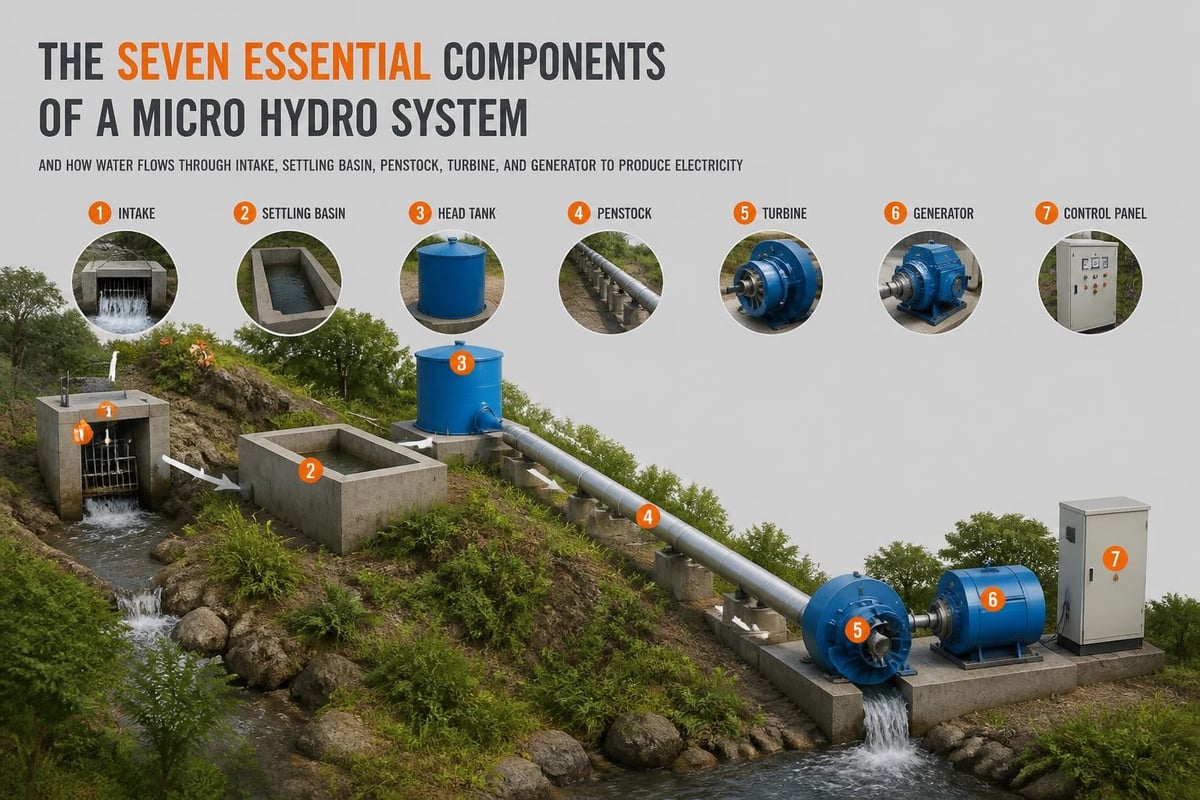
Every micro hydro system comprises several interconnected elements that work together to deliver reliable electrical generation:
- Intake structure: Diverts water from the source whilst preventing debris entry
- Settling basin: Removes sediment that could damage turbine components
- Penstock: Low-friction pipe that conveys water under pressure to the turbine
- Turbine: Converts water flow into rotational mechanical energy
- Generator: Transforms mechanical rotation into electrical current
- Electronic load controller: Manages power output and system stability
- Transmission infrastructure: Delivers electricity to the point of use
The selection of turbine type depends entirely on site-specific hydraulic conditions. Pelton wheels excel in high-head, low-flow applications, whilst crossflow turbines suit medium-head scenarios. Research into crossflow turbines driven by hydrant pump pressure demonstrates innovative approaches for locations with unconventional water sources.
Site Assessment and Feasibility Analysis
Determining whether a location can support a micro hydro system requires comprehensive hydrological and topographical evaluation. Flow measurement forms the cornerstone of feasibility assessment, necessitating data collection across seasonal variations to establish minimum guaranteed flows. Sites must maintain adequate flow during dry seasons, as this determines the reliable baseload capacity.
Topographical surveys establish the gross head available between intake and turbine house locations. Surveyors use differential GPS equipment, laser rangefinders, or traditional levelling techniques to measure elevation changes accurately. The economic viability improves dramatically with increased head, as higher vertical drops generate more power from identical flow rates.
Environmental and Regulatory Considerations
Environmental compliance represents a non-negotiable aspect of micro hydro development. Regulatory frameworks in Southern Africa require:
- Water use licencing from relevant authorities
- Environmental impact assessments for ecological protection
- Fish passage provisions where applicable
- Minimum residual flow maintenance to preserve aquatic ecosystems
- Heritage and archaeological clearances for construction sites
The Kisiizi micro hydro case study from Uganda illustrates how thoughtful planning addresses community needs whilst respecting environmental boundaries. Projects must demonstrate that water abstraction doesn't compromise downstream users or ecosystems.
| Assessment Parameter | Measurement Method | Minimum Requirement |
|---|---|---|
| Flow rate | Weir measurement / Current meter | 20 litres/second |
| Head | Differential GPS / Levelling | 3 metres |
| Water rights | Legal documentation | Confirmed allocation |
| Grid distance | Physical survey | Cost-effective transmission |
| Sediment load | Water sampling | Below turbine tolerance |
Design Engineering and Equipment Selection
Engineering a micro hydro system demands precise calculations balancing power requirements, hydraulic characteristics, and component specifications. The design process begins with load profiling to understand consumption patterns throughout daily and seasonal cycles. This informs whether the installation operates as grid-tied, off-grid, or hybrid configuration.
Turbine selection proves critical to overall system efficiency. Impulse turbines such as Pelton and Turgo designs suit high-head applications, whilst reaction turbines including Francis and propeller variants perform optimally in low-head scenarios. Crossflow turbines offer versatility across medium heads with the advantage of maintaining efficiency across varying flow rates.
Generator sizing must account for both continuous rated output and temporary surge capacity. Modern permanent magnet alternators deliver superior efficiency compared to traditional induction generators, particularly in smaller installations. The electronic load controller maintains system frequency by diverting excess power to dump loads when consumption drops below generation capacity.
Penstock Design and Materials
The penstock represents a substantial capital investment requiring careful specification. Diameter calculations balance construction costs against friction losses, with larger pipes reducing head loss but increasing material expenses. High-density polyethylene (HDPE) pipes offer excellent durability and lower installation costs compared to steel, particularly for heads below 100 metres.
Pressure rating must exceed maximum static head plus surge allowances, typically requiring a safety factor of 1.5 times working pressure. Thrust blocks at direction changes prevent pipe movement, whilst air valves at high points eliminate air locks that reduce flow. Studies on pump-as-turbine efficiency measurement highlight the importance of monitoring equipment in optimising system performance.

Integration with Renewable Energy Systems
A micro hydro system delivers exceptional value when integrated within broader renewable energy portfolios. The continuous generation characteristic contrasts sharply with solar photovoltaic variability, creating natural complementarity. Whilst solar panels produce peak output during midday hours, hydroelectric generation maintains steady baseload supply throughout day and night.
Hybrid configurations combining hydro with Battery Energy Storage Systems (BESS) enable sophisticated energy management strategies. Batteries absorb excess hydro generation during low-demand periods, then supplement supply during consumption peaks. This configuration maximises renewable energy utilisation whilst minimising grid dependency or diesel generator runtime.
Modern energy management platforms provide unified monitoring and control across diverse generation assets. Smart metering infrastructure tracks production from each source, identifies optimization opportunities, and generates performance reports supporting ESG documentation. Research into hybrid PV-micro hydro systems demonstrates how active power filters improve power quality when integrating multiple generation technologies.
Grid Connection Versus Standalone Operation
The decision between grid-tied and off-grid operation depends on location, reliability requirements, and economic factors. Grid-connected systems benefit from:
- Revenue generation through feed-in tariffs or net metering
- Grid backup during maintenance or low-flow periods
- Simplified load management without battery storage requirements
- Regulatory compliance through utility oversight
Off-grid installations suit remote locations where transmission infrastructure costs prove prohibitive. These systems require robust battery banks, comprehensive monitoring, and potentially supplementary generation sources to ensure supply security during maintenance or drought conditions.
Financial Modelling and Return on Investment
Capital expenditure for a micro hydro system varies considerably based on site conditions, with civil works often representing 40-60% of total costs. Typical investment ranges from £3,000 to £5,000 per installed kilowatt, though challenging sites with extensive penstock runs or complex intake structures may exceed these figures substantially.
The economic advantage stems from exceptional longevity and minimal operating costs. Well-maintained installations operate for 50+ years, with major component replacements limited to generators and electronic controllers at 15-20 year intervals. Annual maintenance costs typically consume just 1-2% of capital investment, primarily covering mechanical inspections and minor repairs.
| Cost Category | Percentage of Total | Typical Range (50kW system) |
|---|---|---|
| Civil works | 40-50% | £60,000 - £75,000 |
| Electromechanical equipment | 30-35% | £45,000 - £52,500 |
| Electrical installation | 10-15% | £15,000 - £22,500 |
| Professional fees | 8-12% | £12,000 - £18,000 |
| Contingency | 5-10% | £7,500 - £15,000 |
Return on investment calculations must incorporate electricity tariff escalation, system lifetime, and financing costs. Projects with favourable hydraulic conditions frequently achieve payback periods of 5-8 years when displacing grid electricity at commercial rates. Multi-objective optimization research provides frameworks for balancing energy production maximisation against capital expenditure constraints.
Financing and Incentive Structures
Various financing mechanisms support micro hydro development across Southern Africa. Commercial banks increasingly offer renewable energy loans with preferential rates, recognising the stable cash flows these installations generate. Government incentives, carbon credits, and international climate finance programmes may reduce effective capital costs for qualifying projects.
Power purchase agreements (PPAs) enable third-party ownership models where developers finance, install, and maintain systems whilst selling electricity to the host property at contracted rates. This approach eliminates upfront capital requirements whilst delivering immediate electricity cost reductions.

Operations, Maintenance and Performance Monitoring
Routine maintenance ensures micro hydro system reliability and longevity. Daily visual inspections verify normal operation, whilst monthly procedures include lubrication, vibration monitoring, and electrical testing. Seasonal maintenance coincides with low-flow periods, facilitating intake cleaning, trash rack servicing, and sediment basin flushing without generation interruption.
Turbine runner inspection requires annual shutdown to assess wear patterns and cavitation damage. Replacement intervals depend on water quality, with clean mountain streams enabling decades of operation whilst sediment-laden flows necessitate more frequent interventions. Generator servicing follows manufacturer specifications, typically involving bearing replacement and winding testing at 5-year intervals.
Remote Monitoring and Predictive Maintenance
Modern installations incorporate comprehensive monitoring systems tracking performance parameters in real-time:
- Power output and voltage quality
- Flow rate through the turbine
- Rotational speed and vibration signatures
- Temperature of bearings and electrical components
- Water levels at intake and forebay
Data analytics platforms identify degradation trends before failures occur, enabling scheduled maintenance during planned outages rather than reactive emergency repairs. Research into cascade-pumped micro-hydro storage explores advanced control strategies that optimise performance across varying hydraulic conditions.
Climate Resilience and Seasonal Variations
Understanding seasonal flow variations proves essential for realistic capacity planning. Hydrological records spanning multiple years reveal patterns of abundance and scarcity, informing conservative design assumptions. Systems designed for minimum recorded flows guarantee year-round generation, whilst those optimised for average flows require supplementary power sources during dry periods.
Climate change introduces additional uncertainty into long-term flow predictions. Historical data may not accurately represent future conditions as precipitation patterns shift. Conservative engineering approaches incorporate climate model projections, designing for reduced minimum flows whilst accommodating potential flood events through robust civil infrastructure.
Drought Contingency Planning
Commercial operations relying on micro hydro generation must develop contingency strategies for extended low-flow periods:
- Supplementary generation through diesel or solar systems
- Demand reduction protocols prioritising essential loads
- Grid connection for emergency supply where available
- Operational adjustments to match generation capacity
- Financial reserves covering alternative energy costs
Tools for assessing micro-pumped hydro storage potential offer innovative approaches to enhancing resilience through reversible systems that pump water during surplus generation periods for later release during scarcity.
Technical Specifications and Standards Compliance
Micro hydro installations must conform to relevant electrical safety standards, grid codes, and construction regulations. Equipment selection should prioritise internationally recognised certifications demonstrating compliance with performance and safety requirements. Generators must deliver stable voltage and frequency within utility tolerances, particularly for grid-connected applications.
Electrical protection systems prevent damage from faults whilst ensuring rapid disconnection during emergencies. Installation includes overcurrent protection, earth fault monitoring, and emergency shutdown mechanisms activated by abnormal vibration, temperature, or flow conditions. Regular testing verifies protection system functionality and compliance with safety regulations.
| Component | Relevant Standard | Key Requirements |
|---|---|---|
| Generator | IEC 60034 | Efficiency, insulation, temperature rise |
| Turbine | IEC 60193 | Performance guarantees, cavitation limits |
| Electrical installation | IEC 60364 | Wiring, earthing, protection devices |
| Grid connection | IEEE 1547 | Interconnection, anti-islanding, power quality |
| Control systems | IEC 61508 | Safety integrity, reliability |
Professional engineering oversight during design, construction, and commissioning ensures regulatory compliance whilst optimising system performance. Engaging experienced renewable energy consultants familiar with Southern African conditions accelerates approvals and reduces implementation risks.
Micro hydro systems offer commercial and industrial operations a proven pathway to clean, reliable electricity generation where suitable water resources exist. The technology combines exceptional longevity with minimal operating costs, delivering decades of sustainable power whilst supporting carbon reduction objectives. Whether you're exploring standalone renewable generation or seeking to diversify an existing solar portfolio, hydrological resources represent valuable energy assets warranting thorough investigation. INFOLED brings comprehensive renewable energy engineering expertise to evaluate opportunities, design integrated solutions, and deliver monitored performance across diverse generation technologies, helping Southern African businesses achieve energy resilience whilst advancing their Net Zero strategies.
Next Step
Need help with your energy strategy?
Speak to INFOLED about solar, storage, EV charging, service agreements or system performance.