
The solar panels inverter stands as the critical component that transforms direct current (DC) electricity generated by photovoltaic panels into alternating current (AC) power that homes, businesses, and the electrical grid can utilise. Without this essential device, the energy captured from South Africa's abundant sunshine would remain incompatible with standard appliances and infrastructure. Understanding how these inverters function, their various types, and how to select the right specification for your installation can significantly impact both system performance and long-term return on investment.
Understanding Solar Panels Inverter Technology
A solar panels inverter performs the fundamental task of conversion, but modern devices offer far more sophisticated capabilities than simple DC-to-AC transformation. These intelligent systems monitor performance, optimise energy harvest, communicate with grid infrastructure, and provide critical safety functions.
The conversion process involves complex power electronics that switch DC current at high frequencies to create an AC waveform matching grid specifications. In South Africa, this means producing 230V AC at 50Hz, synchronized precisely with municipal supply where grid-tied systems are deployed.
Core Functions of Modern Inverters
Beyond basic conversion, contemporary solar panels inverter units integrate multiple operational capabilities:
- Maximum Power Point Tracking (MPPT): Continuously adjusts electrical load to extract optimal power from panels under varying sunlight and temperature conditions
- Grid synchronisation: Matches voltage, frequency, and phase with utility supply for seamless integration
- Anti-islanding protection: Automatically disconnects during grid outages to protect utility workers
- Performance monitoring: Tracks generation, consumption, and system health metrics
- Remote diagnostics: Enables technicians to identify issues without site visits
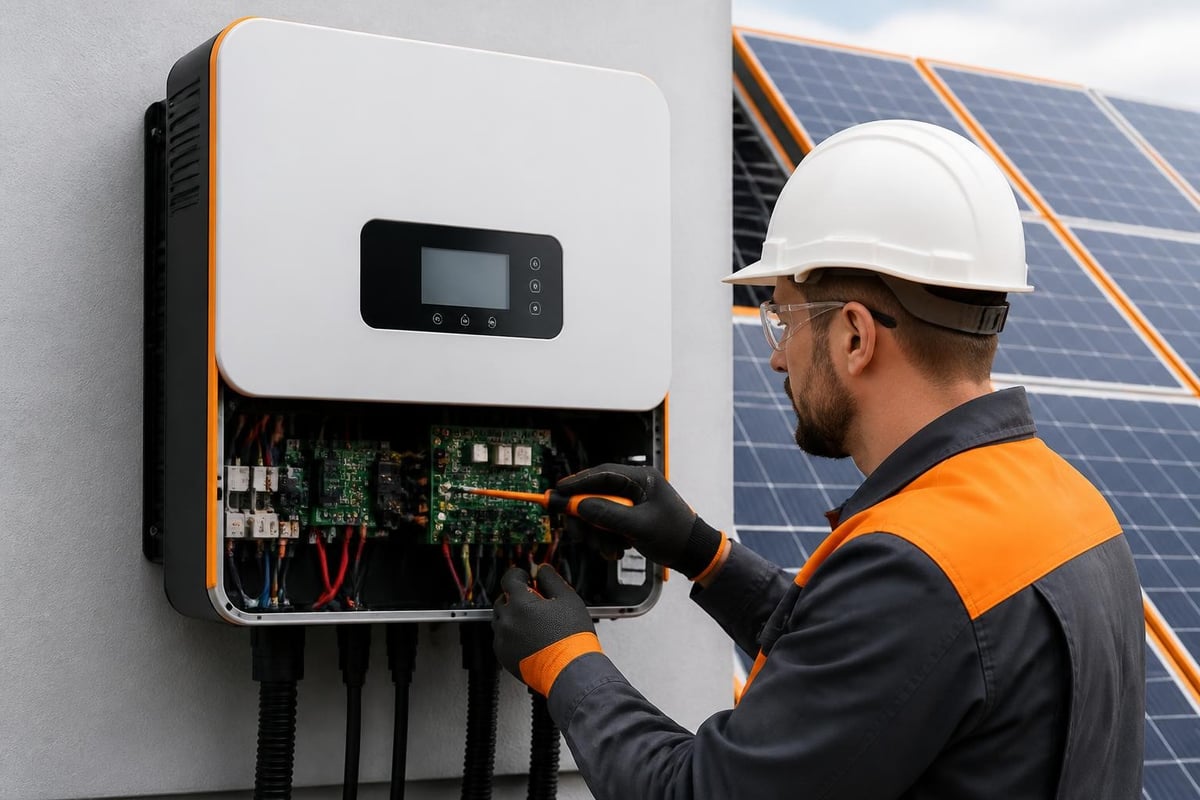
The efficiency of this conversion process directly affects how much solar energy reaches your appliances. Premium inverters achieve conversion efficiencies exceeding 98%, meaning minimal energy loss during transformation. For a 10kW system in Gauteng, the difference between 96% and 98% efficiency represents approximately 200kWh annually, worth around ZAR 400 at current electricity tariffs.
Types of Solar Panels Inverter Systems
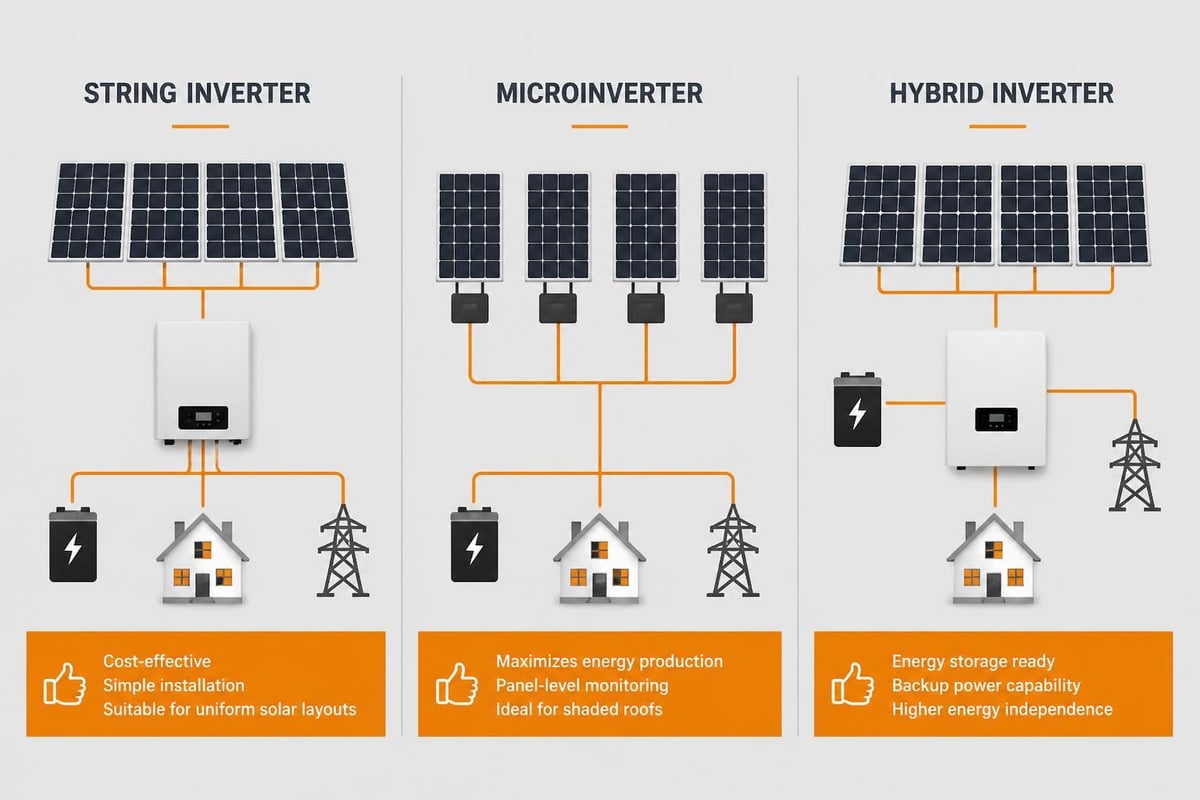
Selecting the appropriate inverter architecture depends on installation size, roof configuration, shading patterns, budget constraints, and future expansion plans. Each topology offers distinct advantages for different scenarios.
String Inverters
String inverters represent the most economical option for residential and commercial installations with uniform roof orientations and minimal shading. These units connect multiple panels in series, with one central inverter handling conversion for the entire array.
| Advantages | Disadvantages |
|---|---|
| Lower upfront cost per watt | Entire string limited by weakest panel |
| Simpler installation | Poor performance with partial shading |
| Centralized monitoring | Single point of failure |
| Proven reliability | Limited design flexibility |
String configurations work exceptionally well for industrial rooftops in provinces like KwaZulu-Natal, where large, unshaded surfaces allow straightforward panel arrangement. The cost efficiency makes them attractive for businesses pursuing commercial solar PV installations where roof space permits optimal layout.
Microinverters
Microinverters attach directly to individual panels, converting DC to AC at the module level. This distributed architecture transforms how solar panels inverter technology handles varied conditions across an array.
Commercial installations in Cape Town's variable marine climate often benefit from microinverter topology. Coastal fog patterns and chimney shadows that would compromise string performance have minimal impact when each panel operates independently. The premium typically ranges from 15% to 25% above string inverter costs, but complex roof geometries can justify this investment.
Performance advantages include:
- Panel-level optimization eliminates weak-link limitations
- Module-level monitoring identifies specific underperformance
- Enhanced safety with no high-voltage DC on rooftops
- Superior energy harvest in partial shade conditions
- Simplified system expansion without string reconfiguration
Hybrid Inverters
Hybrid units combine solar panels inverter functionality with battery management, creating integrated energy storage systems. These sophisticated devices manage power flows between panels, batteries, grid connection, and building loads.
For South African installations facing load shedding, hybrid topology provides the most elegant solution. Battery Energy Storage Systems (BESS) paired with hybrid inverters deliver backup power whilst maximizing self-consumption and enabling time-of-use optimization.
The investment ranges from ZAR 35,000 to ZAR 120,000 depending on capacity, with 5kW hybrid units typically priced around ZAR 55,000. Commercial applications in provinces with expensive peak tariffs, such as Western Cape municipalities, achieve compelling returns through demand charge reduction and energy arbitrage.
Sizing Your Solar Panels Inverter
Proper inverter sizing balances multiple technical and economic considerations. Undersized units clip peak generation, whilst oversized specifications waste capital on unused capacity.
The DC-to-AC Ratio
Most installations employ DC arrays rated 110% to 135% of inverter AC capacity. This intentional "oversizing" accounts for real-world conditions where panels rarely achieve nameplate ratings simultaneously.
A 10kW solar panels inverter might serve a 12kW DC array. On a clear Johannesburg winter day at 10°C with optimal irradiance, panels could theoretically exceed inverter capacity, triggering "clipping" where excess generation is curtailed. However, this scenario occurs infrequently enough that the additional panel investment remains economically justified.
Calculation Steps
- Determine peak load requirements: Analyze consumption patterns and critical loads
- Calculate available roof capacity: Account for shading, orientation, and structural limitations
- Select panel configuration: Choose module wattage and array topology
- Apply derating factors: Consider temperature, soiling, degradation, and system losses
- Specify inverter capacity: Match to actual AC output requirements with appropriate DC ratio
Regional Considerations
South African solar resources vary significantly by province. Upington in the Northern Cape receives approximately 2,500 kWh/m²/year, whilst Durban receives around 1,900 kWh/m²/year. These differences influence optimal DC-to-AC ratios and expected performance.
Temperature coefficients matter substantially. Johannesburg installations at 1,750m elevation experience cooler operating temperatures than coastal systems, affecting panel voltage and inverter input specifications. Summer roof temperatures in Limpopo can exceed 70°C, requiring careful voltage range verification.
Efficiency and Performance Metrics
Understanding solar panels inverter specifications helps differentiate marketing claims from meaningful performance indicators. Several metrics warrant careful evaluation during product selection.
European and CEC Efficiency
Rather than peak efficiency at optimal conditions, weighted efficiency ratings reflect real-world performance across varying load and voltage conditions. The California Energy Commission (CEC) efficiency and European efficiency both apply weighted formulas that better predict actual energy harvest.
Premium inverters achieve European efficiency ratings exceeding 98%, whilst budget options may deliver 95% to 96%. For commercial installations generating 50,000 kWh annually, this 2% difference represents 1,000 kWh, worth approximately ZAR 2,000 at current tariffs. Over a 20-year lifespan, the cumulative value exceeds ZAR 40,000.
Power Factor and Grid Support
Modern grid-integration requirements increasingly demand that solar panels inverter units provide reactive power support and voltage regulation. South African grid codes require compliance with NRS 097-2-3, specifying fault ride-through capabilities and power quality parameters.
Advanced inverters adjust power factor dynamically, supporting grid stability whilst meeting local utility requirements. This functionality becomes particularly relevant for large commercial installations where poor power factor attracts municipal penalties.
Installation and Grid Connection Requirements
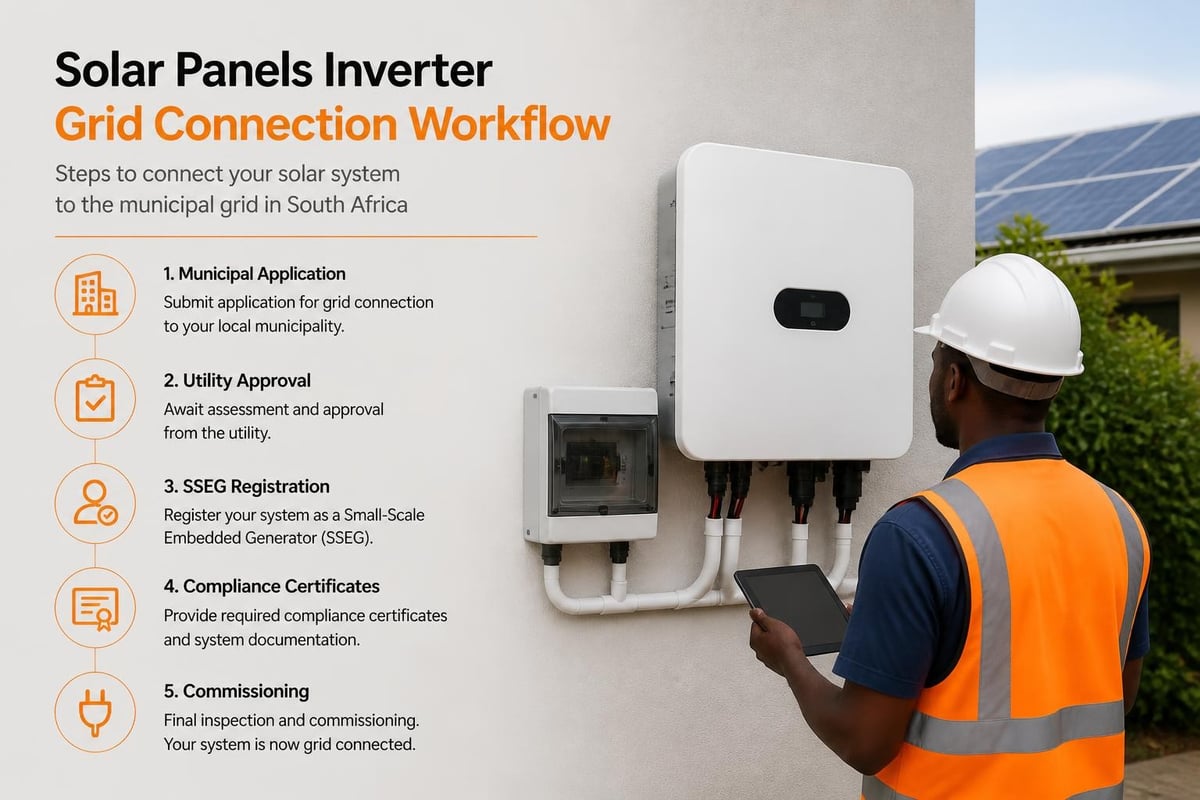
Deploying a solar panels inverter involves regulatory compliance, electrical standards adherence, and utility coordination. South African installations must navigate municipal approval processes that vary considerably by jurisdiction.
Regulatory Framework
The National Regulator for Energy (NERSA) establishes overarching policy, whilst municipalities implement local requirements. Johannesburg's registration process differs from Cape Town's SSEG (Small-Scale Embedded Generation) procedures, and Durban maintains separate protocols.
Key compliance requirements include:
- Grid-connection application with local utility
- Electrical Certificate of Compliance (CoC) from registered electrician
- SANS 10142-1 wiring standards compliance
- NRS 097-2-3 grid connection code adherence
- Notification of Occupation or municipal sign-off
Timeline expectations vary significantly. Cape Town applications may conclude within 60 to 90 days, whilst some municipalities require six months or longer. Planning these lead times prevents costly project delays.
Safety and Protection Systems
Solar panels inverter units incorporate multiple protection mechanisms:
- DC isolation: Safely disconnects panels for maintenance or emergencies
- Ground fault detection: Identifies insulation failures before hazards develop
- Arc fault protection: Detects and interrupts dangerous arcing conditions
- Temperature monitoring: Prevents thermal runaway through active cooling management
- Surge protection: Guards against lightning and grid transient damage
The growing complexity of inverter-based resources has prompted enhanced focus on cybersecurity for smart inverters, particularly for commercial installations with remote monitoring and control capabilities.
Advanced Features and Smart Capabilities
Contemporary solar panels inverter technology extends far beyond simple conversion. Intelligent features optimize performance, reduce costs, and enable participation in emerging energy markets.
Load Management and Consumption Optimization
Smart inverters coordinate with consumption patterns to maximize self-use and minimize grid dependence. Time-of-use optimization charges batteries during low-tariff periods and discharges during expensive peak windows.
For commercial operations under Megaflex or Miniflex tariffs, this capability delivers substantial savings. A manufacturing facility in Durban reduced demand charges by 35% through intelligent load shifting coordinated by hybrid inverter controls, achieving annual savings exceeding ZAR 180,000.
Grid Services and Future Revenue
Grid-forming inverter technology represents the evolution toward solar installations that actively support grid stability. Rather than simply following grid voltage and frequency, these advanced systems can establish and maintain electrical networks.
Research into inverter-based resource integration explores how distributed solar panels inverter deployments might provide ancillary services, potentially creating new revenue streams. Whilst South African regulatory frameworks haven't fully developed these opportunities, forward-looking installations should consider equipment capable of future participation.
Monitoring and Analytics
Comprehensive monitoring platforms transform raw generation data into actionable insights. Commercial systems track:
- Real-time and historical generation patterns
- Panel-level performance identification
- Fault detection and alert notifications
- Weather correlation and forecasting
- Financial performance and payback tracking
Integration with building management systems enables holistic energy optimization. A Gauteng office park connected their solar panels inverter monitoring to HVAC controls, scheduling cooling operations during peak solar generation and achieving 22% reduction in grid consumption.
Maintenance and Lifecycle Management
Proper maintenance extends solar panels inverter lifespan and preserves performance warranties. Most manufacturers specify 10-year standard warranties with optional extensions to 20 or 25 years.
Preventative Maintenance Schedule
| Interval | Activities |
|---|---|
| Monthly | Visual inspection, performance review, alert verification |
| Quarterly | Connection tightness check, ventilation cleaning, firmware updates |
| Annually | Thermal imaging, insulation testing, calibration verification |
| Bi-annually | Comprehensive inspection, protection system testing, compliance audit |
Southern African conditions present unique challenges. Coastal installations face salt air corrosion requiring enhanced protection ratings (IP65 minimum). Highveld locations contend with dust accumulation during dry winter months, necessitating more frequent cleaning.
Common Issues and Solutions
Inverter failures typically manifest through specific symptoms:
- Communication errors: Often resolved through network troubleshooting or firmware updates
- Ground fault indications: Require immediate investigation of wiring integrity and insulation resistance
- Overheating shutdowns: Address through improved ventilation, shading, or load reduction
- Grid compliance failures: May necessitate parameter adjustments or utility coordination
Professional diagnostics prevent minor issues from escalating into costly failures. Companies offering comprehensive operations and maintenance services provide value through rapid response and expert troubleshooting.
Cost Considerations and Return on Investment
Solar panels inverter investments represent 10% to 20% of total system costs. For a residential 5kW installation priced at ZAR 85,000, the inverter typically accounts for ZAR 12,000 to ZAR 18,000. Commercial systems achieve economies of scale, with 100kW inverters costing ZAR 120,000 to ZAR 180,000.
Price Ranges by Category
Budget string inverters start around ZAR 8,000 for 5kW capacity, whilst premium European brands command ZAR 20,000 to ZAR 25,000. The differential reflects build quality, efficiency ratings, warranty terms, and support infrastructure.
Microinverter systems add approximately ZAR 2,000 to ZAR 3,500 per kW to installation costs. A 10kW residential system might cost ZAR 25,000 additional compared to string architecture, though complex roofs may justify this premium through performance gains.
Hybrid inverters range from ZAR 35,000 for 5kW single-phase units to ZAR 250,000 for commercial three-phase 50kW systems. Battery integration adds substantial cost but delivers compelling value where backup power eliminates business interruption expenses.
Financial Modeling
Accurate payback calculations must account for:
- Electricity tariff escalation: Historical municipal increases average 8% to 12% annually
- Generation degradation: Panels lose approximately 0.5% efficiency yearly
- Inverter replacement: Plan for mid-life replacement around year 12 to 15
- Maintenance costs: Budget 1% to 2% of system value annually
- Opportunity cost: Compare solar investment against alternative capital deployment
A Johannesburg business investing ZAR 800,000 in a 50kW system generating 85,000 kWh annually achieves simple payback around 5.5 years at current tariffs. Incorporating load shedding backup value and demand charge reductions accelerates returns to approximately 4.2 years.
Selecting the Right Solar Panels Inverter
Matching inverter specifications to application requirements demands careful evaluation across multiple dimensions. No single product suits every installation, making systematic assessment essential.
Decision Framework
Application Type: Residential, commercial, industrial, and agricultural installations present different priorities. Home systems prioritize reliability and backup capability, whilst industrial applications emphasize performance monitoring and demand management.
Load Profile: Constant baseload operations suit string inverters, whereas variable consumption with complex tariffs favors smart hybrid systems with optimization algorithms.
Expansion Plans: Future capacity additions influence topology selection. Microinverter systems accommodate incremental growth seamlessly, whilst string configurations require careful planning to avoid mismatched arrays.
Budget Constraints: Initial capital availability versus lifecycle cost optimization presents the classic trade-off. Premium inverters deliver superior reliability and efficiency but require larger upfront investment.
Technical Support: Local service infrastructure matters significantly. International brands with established South African support networks prevent extended downtime awaiting parts or expertise.
Vendor Evaluation Criteria
Scrutinize potential suppliers across these dimensions:
- Warranty terms: Standard duration, extension options, performance guarantees
- Local presence: South African offices, certified installers, spare parts inventory
- Track record: Installations in similar applications, verifiable references
- Compliance certification: NRS 097-2-3, SANS compatibility, utility approvals
- Monitoring platform: Data accessibility, mobile applications, alert capabilities
Engaging experienced engineering firms for feasibility studies and system design ensures specifications align with actual requirements rather than generic recommendations. Professional load analysis prevents costly oversizing whilst avoiding inadequate capacity.
Integration with Energy Storage and Smart Systems
The solar panels inverter serves as the central nervous system coordinating power flows across increasingly complex energy architectures. Modern installations integrate solar generation, battery storage, grid connection, backup generators, and electric vehicle charging into unified systems.
Battery Compatibility
Not all inverters accommodate battery retrofits. AC-coupled storage systems offer flexibility but introduce additional conversion losses. DC-coupled configurations achieve superior efficiency but lock into specific battery chemistries and capacities.
Lithium-ion batteries dominate South African deployments, with capacities ranging from 5kWh residential units to 500kWh commercial installations. Recent research on optimal inverter control demonstrates that sophisticated algorithms can substantially improve system performance through coordinated solar and storage dispatch.
Smart Grid Participation
As South African utilities explore time-of-use tariffs and demand response programs, advanced solar panels inverter capabilities enable participation in these emerging mechanisms. Smart inverter coordination at scale presents both opportunities and challenges for grid operators managing distributed resources.
Forward-thinking commercial installations implement systems capable of frequency response, voltage support, and scheduled dispatch. Whilst current regulatory frameworks provide limited compensation for these services, early adopters position themselves advantageously for future market developments.
The solar panels inverter represents the technological heart of any photovoltaic installation, transforming abundant South African sunshine into usable electrical power whilst managing complex interactions between generation, consumption, storage, and grid infrastructure. Selecting appropriate technology, sizing systems correctly, and maintaining equipment properly ensures optimal performance and maximum return on investment. INFOLED delivers comprehensive renewable energy solutions across Southern Africa, from initial feasibility studies through system design, installation, and ongoing monitoring, helping commercial, industrial, and residential clients reduce electricity costs whilst advancing their sustainability objectives.
Next Step
Need help with your energy strategy?
Speak to INFOLED about solar, storage, EV charging, service agreements or system performance.