
Modern organisations face mounting pressure to reduce operational costs whilst simultaneously achieving ambitious sustainability targets. Energy management systems have emerged as the cornerstone technology enabling businesses to address both imperatives, providing the visibility, control, and intelligence required to transform energy consumption from a fixed overhead into a strategically managed asset. As electricity tariffs continue their upward trajectory across Southern Africa and environmental regulations tighten, the question is no longer whether to implement these systems, but how quickly organisations can deploy them to capture available savings.
Understanding the Architecture of Modern Energy Management Systems
An effective energy management system comprises four integrated layers that work in concert to deliver measurable outcomes. The foundation begins with monitoring infrastructure-smart meters, sensors, and data acquisition hardware that capture granular consumption data across facilities. This raw data feeds into analytics platforms that apply algorithms, machine learning, and comparative analysis to identify patterns, anomalies, and opportunities.
The third layer involves optimisation logic, where systems recommend or automatically implement load-shifting strategies, demand response actions, and equipment scheduling based on tariff structures and operational requirements. Finally, the control layer executes these decisions through integration with building management systems, renewable energy assets, and battery storage.
The EnergyIQ Framework for Intelligent Energy Solutions
The EnergyIQ model represents a holistic approach to energy management that extends beyond simple monitoring. It encompasses real-time data acquisition, advanced analytics powered by artificial intelligence, predictive demand forecasting, and automated optimisation across multiple energy assets. This framework recognises that true energy intelligence requires integration between solar photovoltaic systems, battery energy storage, electric vehicle charging infrastructure, and conventional grid supply.
By treating these components as a unified ecosystem rather than isolated technologies, organisations can unlock synergies that significantly amplify savings. For example, battery systems can store excess solar generation during off-peak periods and discharge during demand peaks, whilst smart charging protocols ensure electric vehicle fleets draw power when tariffs are lowest without compromising operational schedules.

Quantifying the Business Impact of Energy Management Systems
Financial returns from properly implemented energy management systems typically manifest across multiple dimensions. Direct electricity cost reduction represents the most visible benefit, with organisations commonly achieving 15-30% savings through improved load management, tariff optimisation, and demand charge reduction. These savings compound over time as the system's machine learning capabilities refine their understanding of consumption patterns and optimisation opportunities.
Operational resilience constitutes another critical value stream, particularly relevant in markets experiencing grid instability. By orchestrating battery storage, backup generation, and load prioritisation, these systems ensure business continuity during outages whilst minimising reliance on expensive diesel generators. The U.S. Department of Energy Federal Energy Management Program provides extensive guidance on measuring and validating these performance improvements across facility portfolios.
Sustainability and Compliance Advantages
Beyond cost considerations, energy management systems deliver measurable environmental benefits that directly support ESG reporting and Net Zero commitments. Detailed consumption data enables accurate Scope 2 emissions calculations, renewable energy tracking, and carbon intensity monitoring across operations. This granularity proves essential for compliance with emerging disclosure requirements and voluntary sustainability frameworks.
Key sustainability metrics tracked by advanced systems include:
- Carbon emissions by facility, department, or production line
- Renewable energy percentage and time-of-use patterns
- Energy intensity per unit of output or revenue
- Peak demand reduction achievements
- Grid import versus self-consumption ratios
Research published on Zenodo examining industrial energy management demonstrates how digital twin technology integrated with optimisation algorithms can reduce both energy costs and carbon footprint simultaneously, achieving 18% cost savings whilst cutting emissions by 22% in waste management operations.
Implementation Strategies for Commercial and Industrial Facilities
Successful deployment of energy management systems requires a structured approach that balances technical capabilities with organisational readiness. The implementation journey typically begins with comprehensive energy audits and load studies that establish baseline consumption patterns, identify major consumers, and quantify potential savings opportunities. This foundational analysis informs system design, sensor placement, and integration requirements.
Phased Deployment Methodology
Rather than attempting enterprise-wide implementation simultaneously, a phased approach delivers faster time-to-value whilst minimising operational disruption. Initial phases often target facilities or processes with the highest energy intensity or greatest savings potential, creating quick wins that build organisational support and funding for broader rollout.
Recommended implementation sequence:
- Discovery and audit phase – Baseline measurement, stakeholder interviews, technical assessments
- Pilot deployment – Single facility or production line to validate assumptions and refine approach
- Analytics development – Customisation of dashboards, alerts, and reporting for specific operational needs
- Optimisation activation – Gradual introduction of automated controls and demand response
- Portfolio expansion – Systematic rollout across remaining facilities with continuous improvement
Integration with existing infrastructure presents both challenges and opportunities. Modern systems must communicate with legacy building management platforms, industrial control systems, and renewable energy installations through diverse protocols. INFOLED's Energy Management solutions address this complexity through flexible architecture that accommodates multiple communication standards whilst providing unified dashboarding and analytics.

Technology Components and Integration Requirements
The hardware and software ecosystem supporting energy management systems has evolved dramatically, offering unprecedented capabilities at declining costs. Smart metering infrastructure forms the foundation, with modern devices capable of sub-second measurement intervals, power quality monitoring, and bidirectional communication. These meters deploy at main incomer points, distribution boards, and critical loads to provide comprehensive visibility.
| Component Category | Primary Functions | Key Selection Criteria |
|---|---|---|
| Smart Meters | Consumption measurement, power quality, communication | Accuracy class, sampling rate, protocol support |
| Gateway Devices | Data aggregation, edge processing, cloud connectivity | Processing power, storage capacity, cellular/ethernet options |
| Analytics Platform | Visualisation, anomaly detection, forecasting | Scalability, algorithm sophistication, user interface |
| Control Systems | Automated optimisation, demand response, asset orchestration | Integration capabilities, response speed, override protocols |
Cloud-based analytics platforms have become the standard architecture, offering advantages in computational power, automatic updates, and accessibility from any location. However, hybrid approaches incorporating edge computing deliver benefits in latency-sensitive applications and ensure continued operation during internet connectivity issues.
Data Security and Operational Technology Considerations
Energy management systems collect detailed operational data that can reveal production schedules, occupancy patterns, and business activities. Robust cybersecurity measures are therefore essential, including encrypted communications, role-based access controls, and network segmentation between energy monitoring and core business systems. The analysis of smart port energy management systems highlights cybersecurity as a critical implementation consideration, particularly for facilities managing critical infrastructure.
Interoperability standards have matured considerably, with protocols such as Modbus, BACnet, MQTT, and RESTful APIs enabling integration across diverse manufacturers and technologies. Organisations should prioritise systems supporting open standards to avoid vendor lock-in and facilitate future expansion.
Advanced Analytics and Artificial Intelligence Applications
The transformation of raw consumption data into actionable intelligence represents the core value proposition of modern energy management systems. Basic analytics provide historical consumption reporting, benchmarking against targets, and variance analysis. Advanced capabilities leverage machine learning algorithms to identify subtle patterns, predict future demand, and recommend optimisation strategies that human analysts would struggle to discover.
Artificial intelligence applications in energy management include:
- Demand forecasting – Predicting consumption patterns based on weather, production schedules, and historical trends
- Anomaly detection – Identifying equipment malfunctions, inefficiencies, or unusual consumption events
- Optimisation algorithms – Determining optimal battery charge/discharge schedules, load-shifting strategies, and tariff arbitrage
- Preventative maintenance – Detecting degrading equipment performance before failure occurs
- Automated reporting – Generating sustainability disclosures and management reports without manual intervention
The sophistication of these analytics continues to advance rapidly. Recent implementations demonstrate systems that automatically adjust HVAC setpoints based on occupancy predictions, optimise industrial process sequences to minimise peak demand charges, and coordinate electric vehicle charging with solar generation forecasts to maximise self-consumption.
Industry-Specific Applications and Case Studies
Energy management systems deliver value across diverse sectors, though implementation priorities and key performance indicators vary by industry. Manufacturing facilities typically focus on production efficiency metrics, targeting energy consumption per unit produced whilst managing demand charges from high-powered equipment. The ISO 50001 case study database provides detailed implementation examples across multiple manufacturing verticals, documenting payback periods averaging 18-24 months.
Hospitality and Commercial Real Estate
Hotels and commercial office buildings face unique challenges with highly variable occupancy and diverse energy loads spanning HVAC, lighting, hot water, and kitchen equipment. The Italian hotel sector case study demonstrates how integrated monitoring dashboards and stakeholder engagement strategies can drive 12-20% energy savings even when starting with limited baseline data. Key success factors include room-level metering, automated lighting controls tied to occupancy sensors, and optimised HVAC scheduling.
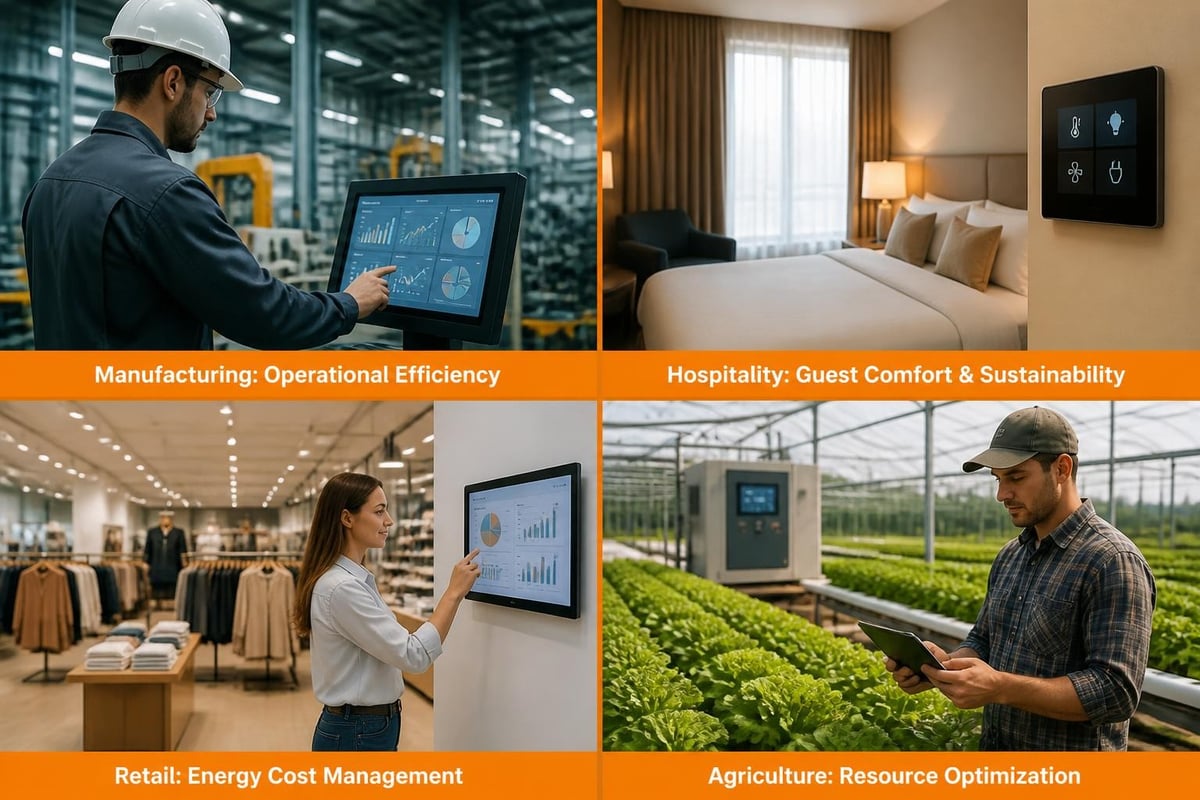
Commercial real estate portfolios benefit particularly from centralised energy management platforms that aggregate data across multiple properties, enabling comparative benchmarking and identification of underperforming assets. Automated fault detection algorithms can alert facility managers to equipment issues across dozens of buildings from a single dashboard, dramatically reducing response times and maintenance costs.
Agricultural and Industrial Operations
Agricultural facilities with irrigation pumping, cold storage, and processing equipment face steep demand charges and time-of-use tariff exposure. Energy management systems enable these operations to shift loads to off-peak periods, integrate solar generation with storage to power irrigation pumps during daylight hours, and maintain cold chain integrity whilst minimising grid dependency. The General Dynamics ammunition plant implementation illustrates how rigorous measurement and verification protocols can document continuous improvement in energy performance within heavy industrial environments.
Regulatory Frameworks and Standards Compliance
Energy management systems increasingly serve as the technical foundation for demonstrating compliance with environmental regulations and voluntary sustainability frameworks. ISO 50001 Energy Management Systems certification requires systematic monitoring, measurement, and continuous improvement of energy performance-capabilities that advanced monitoring and analytics platforms inherently provide. Organisations pursuing certification find that robust energy management systems dramatically reduce the documentation burden and provide the granular data necessary for verification audits.
| Regulatory Driver | EMS Requirements | Compliance Benefits |
|---|---|---|
| ISO 50001 | Continuous monitoring, measurement protocols, improvement documentation | Certification, systematic energy performance gains |
| Carbon Tax Legislation | Accurate emissions calculation, renewable energy tracking | Tax optimisation, reporting accuracy |
| ESG Disclosure Requirements | Scope 2 emissions, intensity metrics, renewable percentage | Stakeholder confidence, investment attractiveness |
| Building Energy Codes | Consumption limits, equipment efficiency standards | Compliance verification, performance certification |
The South African Department of Mineral Resources and Energy's energy efficiency regulations create additional compliance requirements for large energy users, including mandatory energy management plans and reporting. Integrated systems streamline these obligations whilst simultaneously delivering operational benefits that extend far beyond regulatory checkbox exercises.
Supporting Net Zero Commitments
Ambitious decarbonisation targets require detailed roadmaps, interim milestones, and transparent progress tracking. Energy management systems provide the measurement foundation for science-based targets, enabling organisations to quantify baseline emissions, model reduction scenarios, and track actual performance against commitments. Integration between renewable generation assets, storage systems, and consumption monitoring ensures accurate self-consumption calculations and grid import tracking essential for credible Net Zero claims.
For further insights on sustainability strategy development, explore additional resources covering the intersection of renewable energy technology and corporate environmental commitments.
Financial Modelling and Return on Investment Considerations
Evaluating energy management system investments requires comprehensive financial analysis that captures both direct and indirect value streams. Capital expenditure typically includes metering hardware, gateway devices, analytics software licensing, installation labour, and integration work. Operational expenses encompass ongoing software subscriptions, cellular data connectivity, calibration requirements, and support services.
Primary value streams in ROI calculations:
- Electricity cost reduction through demand management and tariff optimisation
- Avoided demand charges via peak load reduction
- Renewable energy self-consumption maximisation
- Maintenance cost reduction through predictive analytics
- Avoided downtime from improved power quality and backup orchestration
- Carbon credit value or avoided carbon tax liability
Payback periods for commercial and industrial implementations typically range from 12 to 36 months depending on facility size, energy intensity, and tariff structure. Organisations with high demand charges, significant renewable energy assets, or expensive diesel backup dependence generally achieve faster returns. The financial case strengthens considerably when incorporating medium-term electricity price escalation assumptions and the value of enhanced operational resilience.
Financing mechanisms have evolved to address upfront capital barriers, with energy-as-a-service models enabling organisations to deploy comprehensive systems with minimal initial investment. These arrangements typically structure payments as a percentage of verified savings, aligning vendor and customer interests whilst preserving capital for core business activities. To explore financing options tailored to specific operational contexts, organisations can access detailed cost calculators that model site-specific economics.
Integration with Renewable Energy and Storage Assets
The true potential of energy management systems emerges when orchestrating multiple energy assets as a coordinated ecosystem. Solar photovoltaic installations, battery energy storage systems, and electric vehicle charging infrastructure each deliver standalone benefits, but integrated control amplifies returns through sophisticated load matching and arbitrage strategies. Modern platforms continuously optimise energy flows based on real-time tariffs, weather forecasts, battery state-of-charge, and operational requirements.
During periods of high solar generation and low consumption, systems charge batteries whilst deferring discretionary loads. As clouds pass overhead, batteries seamlessly discharge to maintain grid import below demand charge thresholds. When evening peaks arrive, stored solar energy powers facilities whilst grid import remains minimised. This level of orchestration, executed automatically thousands of times daily, captures value that manual intervention could never achieve.
Electric Vehicle Integration Strategies
Electric vehicle charging presents both challenges and opportunities for facility energy management. Uncontrolled charging can create severe demand spikes that trigger expensive demand charges affecting the entire month's electricity bill. Smart charging protocols leverage vehicle-to-grid communication standards to schedule charging during off-peak periods or when excess solar generation is available, transforming potential liability into optimised load.
Advanced implementations enable vehicle batteries to provide backup power during outages or grid support during demand peaks, creating additional revenue streams. The coordination between building loads, solar generation, stationary storage, and vehicle batteries requires sophisticated optimisation algorithms that consider multiple constraints simultaneously-precisely the capability that modern energy management systems provide.
Challenges and Implementation Considerations
Despite compelling value propositions, energy management system deployments encounter predictable obstacles that organisations should anticipate and address proactively. Data quality issues represent perhaps the most common challenge, with inaccurate meter readings, communication failures, or misconfigured sensors undermining analytics reliability. Robust commissioning protocols, ongoing calibration schedules, and exception reporting help maintain data integrity over time.
Common implementation challenges and mitigation strategies:
| Challenge | Impact | Mitigation Approach |
|---|---|---|
| Incomplete baseline data | Inaccurate savings calculations | Extended measurement period, conservative assumptions |
| Staff resistance to automation | Underutilisation of capabilities | Change management, training, gradual autonomy increase |
| Legacy system integration | Limited visibility or control | Phased modernisation, protocol converters, hybrid architecture |
| Cybersecurity concerns | Deployment delays, limited connectivity | Network segmentation, encrypted communications, penetration testing |
| Budget constraints | Reduced scope or capability | Phased deployment, energy-as-a-service financing, quick-win prioritisation |
Organisational change management deserves particular attention, as successful implementations require shifts in responsibility, processes, and decision-making authority. Facility managers accustomed to manual control may initially resist automated systems, whilst finance teams require education on interpreting energy analytics and validating savings claims. Executive sponsorship and cross-functional implementation teams help navigate these cultural dimensions.
Future Trajectories in Energy Management Technology
The energy management systems landscape continues evolving rapidly, driven by advances in sensor technology, artificial intelligence, and energy market structures. Edge computing capabilities enable increasingly sophisticated analytics at the facility level, reducing latency and cloud bandwidth requirements whilst enhancing resilience. Digital twin technology creates virtual replicas of facilities that enable scenario modelling and optimisation testing without operational risk.
Blockchain-based peer-to-peer energy trading platforms may eventually enable facilities to buy and sell excess renewable generation directly with neighbours, with energy management systems automatically executing optimal trading strategies. Vehicle-to-grid integration will mature from pilot projects to mainstream capability, transforming electric vehicle fleets into distributed energy resources that provide grid services and generate revenue.
Standardisation efforts continue addressing interoperability challenges, with industry coalitions working toward universal communication protocols and data models that eliminate vendor lock-in. The convergence of energy management with broader smart building and industrial Internet of Things platforms will create integrated operational intelligence that spans energy, maintenance, security, and occupancy management.
For organisations beginning their energy management journey or seeking to expand existing capabilities, exploring proven project implementations provides practical insights into deployment approaches and achievable outcomes across diverse facility types and operational contexts.
Energy management systems have matured from optional efficiency initiatives into strategic assets that simultaneously address cost pressures, resilience requirements, and sustainability commitments. Organisations that deploy comprehensive monitoring, analytics, and control capabilities position themselves to thrive in an energy landscape characterised by escalating costs, increasing renewable penetration, and tightening environmental regulations. INFOLED combines deep engineering expertise with integrated technology solutions spanning solar, battery storage, smart metering, and EV charging to deliver intelligent energy management across Southern Africa. Contact our team to discover how tailored energy intelligence can transform your operational performance and sustainability outcomes.
Next Step
Need help with your energy strategy?
Speak to INFOLED about solar, storage, EV charging, service agreements or system performance.