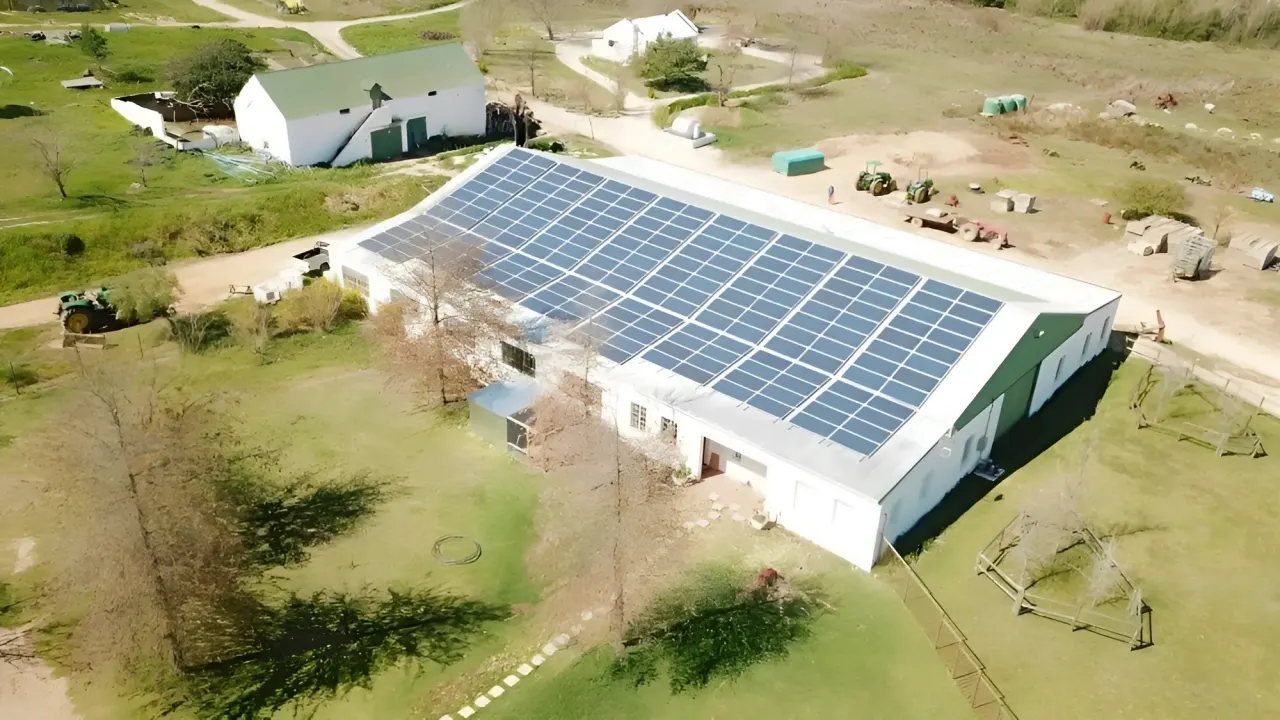
South Africa's solar energy sector has experienced remarkable growth over the past decade, with thousands of megawatts of photovoltaic (PV) capacity installed across residential, commercial, and utility-scale projects. As the country continues its transition toward renewable energy, a critical question emerges: what happens to solar panels when they reach the end of their operational life? With most PV modules designed to last 25 to 30 years, the first wave of mass solar panel retirements is approaching, making solar panel recycling an increasingly urgent consideration for businesses, installers, and policymakers across Southern Africa. Understanding the recycling process, regulatory landscape, and available solutions is essential for any organisation committed to environmental sustainability and responsible energy management.
The Growing Need for Solar Panel Recycling Infrastructure
The International Energy Agency's Photovoltaic Power Systems Programme (IEA-PVPS) projects that global cumulative PV waste could reach 78 million tonnes by 2050. South Africa, whilst representing a smaller fraction of global installations, faces its own mounting challenge. Installations from the Renewable Energy Independent Power Producer Procurement Programme (REIPPP) rounds in the early 2010s, combined with the surge in commercial and residential systems from 2020 onwards, will create a substantial volume of retired panels starting in the mid-2030s.
Without proper infrastructure, these panels risk becoming electronic waste in landfills, squandering valuable materials and contradicting the environmental benefits solar energy provides. The IEA-PVPS report on PV recycling emphasises that developing collection and processing systems now is critical to avoiding a future waste crisis.
Material Value and Resource Recovery
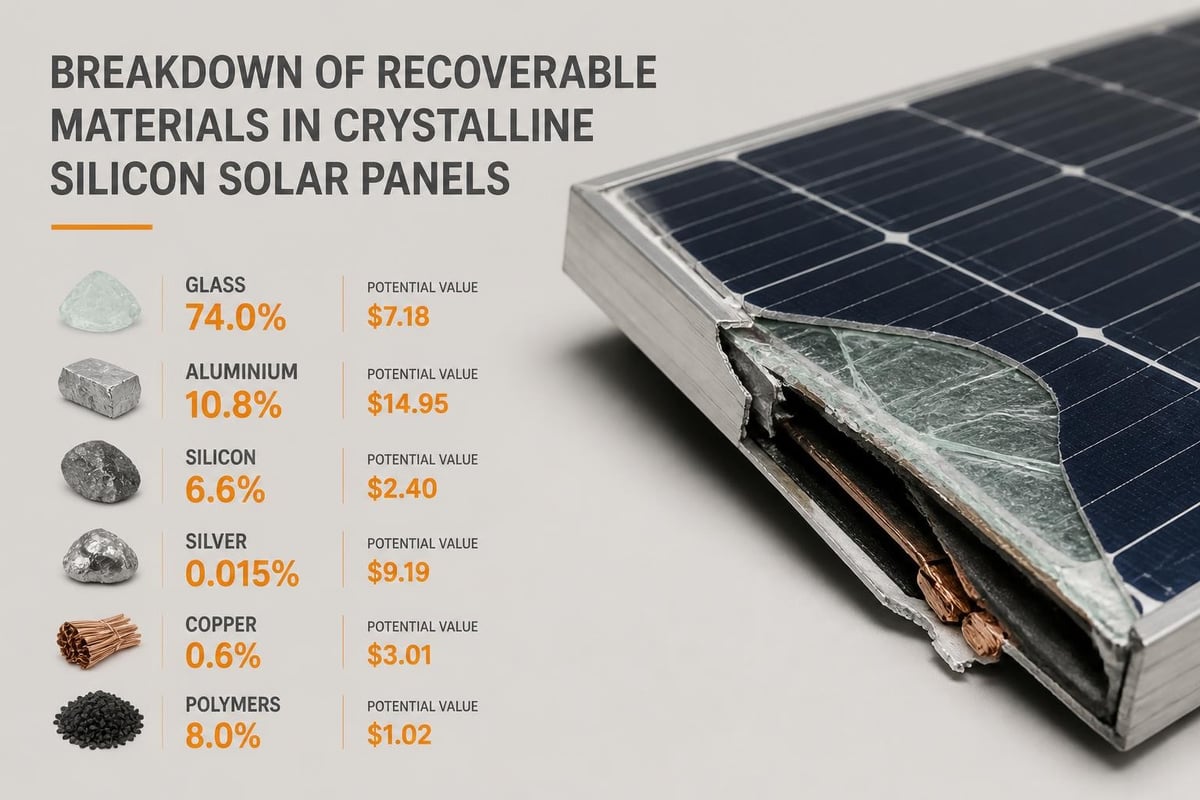
Solar panels contain numerous valuable and recoverable materials:
- Glass: Comprises 70-75% of panel weight
- Aluminium: Frames and mounting components
- Silicon: Solar cells and wafers
- Silver: Contact metallisation
- Copper: Wiring and interconnects
- Polymers: Encapsulants and backsheet materials
A single tonne of recycled solar panels can yield approximately 700 kg of glass, 150 kg of aluminium, and smaller quantities of silicon, silver, and copper. At current commodity prices in South Africa, the recovered materials from one tonne of panels can represent between ZAR 2,000 and ZAR 4,500 in value, depending on panel type and recovery efficiency.
Recycling Technologies and Processes
Solar panel recycling employs several technological approaches, each with distinct advantages for different panel types and scales of operation.
Mechanical Recycling Methods
Mechanical processes represent the most widely deployed approach globally. The method involves:
- Manual dismantling: Removing junction boxes, frames, and cables
- Shredding: Breaking panels into smaller fragments
- Separation: Using density, magnetic, and electrostatic techniques to sort materials
- Recovery: Collecting separated glass, metals, and plastic fractions
Mechanical recycling achieves recovery rates of 85-90% by weight, predominantly glass and aluminium. However, the process yields lower purity materials and often loses high-value elements like silver. Facilities in Gauteng and the Western Cape are beginning to adapt existing electronic waste infrastructure for this purpose.
Thermal and Chemical Approaches
Advanced thermal and chemical methods offer higher recovery rates and material purity:
| Method | Recovery Rate | Key Advantages | Limitations |
|---|---|---|---|
| Thermal delamination | 90-95% | Separates layers intact; preserves silicon | Energy-intensive; requires pollution controls |
| Chemical treatment | 95-98% | High-purity recovery; silver extraction | Chemical handling; wastewater management |
| Hybrid processes | 95%+ | Combines benefits of both approaches | Higher capital costs; complex operations |
Fraunhofer ISE research demonstrates that combining thermal delamination with chemical etching can recover up to 98% of silicon and 95% of silver, significantly improving the economic viability of solar panel recycling operations.
Regulatory Framework in South Africa
South Africa's approach to solar panel recycling sits within its broader waste management and Extended Producer Responsibility (EPR) framework, though specific PV regulations remain under development.
Current Waste Legislation
The National Environmental Management: Waste Act (Act 59 of 2008) governs waste management nationally, with several provisions relevant to solar panels:
- Classification of PV modules as electrical and electronic equipment
- Requirements for waste manifest documentation
- Licensing of recycling facilities
- Prohibition on landfill disposal of certain e-waste
The European Commission's WEEE Directive approach to photovoltaic recycling has informed South African policy discussions, particularly regarding producer responsibility schemes.
Extended Producer Responsibility Developments
South Africa's Department of Forestry, Fisheries and the Environment has signalled intentions to include solar panels under EPR regulations. This would require manufacturers and importers to:
Take-back obligations for end-of-life panels, finance collection and recycling systems, establish reporting mechanisms for panel sales and waste volumes, and meet minimum recycling targets once infrastructure matures.
Businesses installing solar systems should anticipate these regulatory changes when planning long-term asset management strategies. Working with providers that understand these emerging requirements, such as INFOLED's renewable energy sustainability services, ensures compliance with future EPR obligations whilst supporting circular economy principles.
Challenges Facing Solar Panel Recycling in South Africa
Despite growing awareness, several obstacles hinder the development of comprehensive solar panel recycling infrastructure across Southern Africa.
Economic Barriers
The economics of solar panel recycling remain challenging:
- Collection costs: Panels are bulky, fragile, and geographically dispersed
- Processing expenses: Advanced recycling requires significant capital investment
- Material values: Recovered materials often don't offset processing costs
- Volume thresholds: Facilities require minimum throughput for economic viability
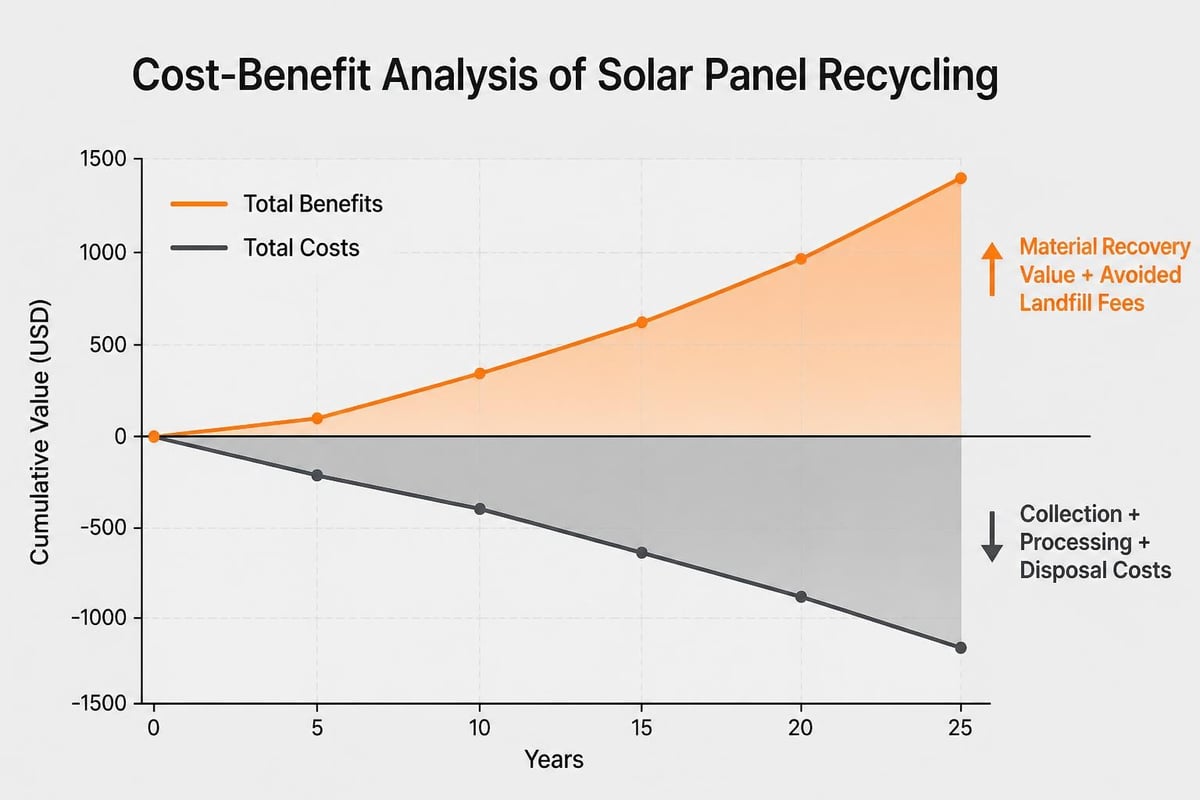
Current estimates suggest that recycling a standard 300W crystalline silicon panel costs between ZAR 150 and ZAR 350, whilst recovered materials might generate ZAR 80 to ZAR 200 in revenue. This economic gap necessitates policy support, producer funding, or integration with higher-value e-waste streams.
Infrastructure Gaps
South Africa currently lacks dedicated large-scale solar panel recycling facilities. Existing e-waste recyclers can process panels using mechanical methods, but capacity remains limited and geographically concentrated in major metros like Johannesburg, Cape Town, and Durban. Rural and agricultural installations face particular challenges accessing these services.
Technical Considerations
Different panel technologies present varying recycling challenges:
| Panel Type | Market Share | Recycling Complexity | Key Considerations |
|---|---|---|---|
| Crystalline silicon | 85-90% | Moderate | Standard processes; aluminium frame removal |
| Thin-film (CdTe) | 5-8% | High | Cadmium handling; specialised treatment required |
| Thin-film (CIGS) | 2-3% | High | Indium, gallium recovery; lower volumes |
| Perovskite/emerging | <1% | Unknown | Limited field deployment; recycling protocols developing |
The Nature Reviews article on PV recycling challenges highlights that standardising recycling protocols across technologies whilst accommodating ongoing innovation remains a significant research and policy challenge.
Best Practices for Asset Owners and Installers
Organisations with existing or planned solar installations can take proactive steps to prepare for end-of-life panel management.
Documentation and Tracking
Maintain comprehensive records throughout system lifecycle:
- Panel make, model, and serial numbers
- Installation dates and location mapping
- Performance monitoring data
- Maintenance and repair history
- Warranty and guarantee documentation
This information enables accurate forecasting of retirement timelines and facilitates efficient decommissioning when the time comes. Commercial solar PV projects implemented with proper asset management systems can streamline future recycling logistics significantly.
Design for Disassembly
When specifying new installations, consider end-of-life implications:
- Choose mounting systems that facilitate panel removal
- Document cable routing and electrical configurations
- Specify panels from manufacturers with take-back commitments
- Design access for decommissioning equipment
- Plan for safe temporary storage during bulk collection
Exploring Reuse and Repurposing Options
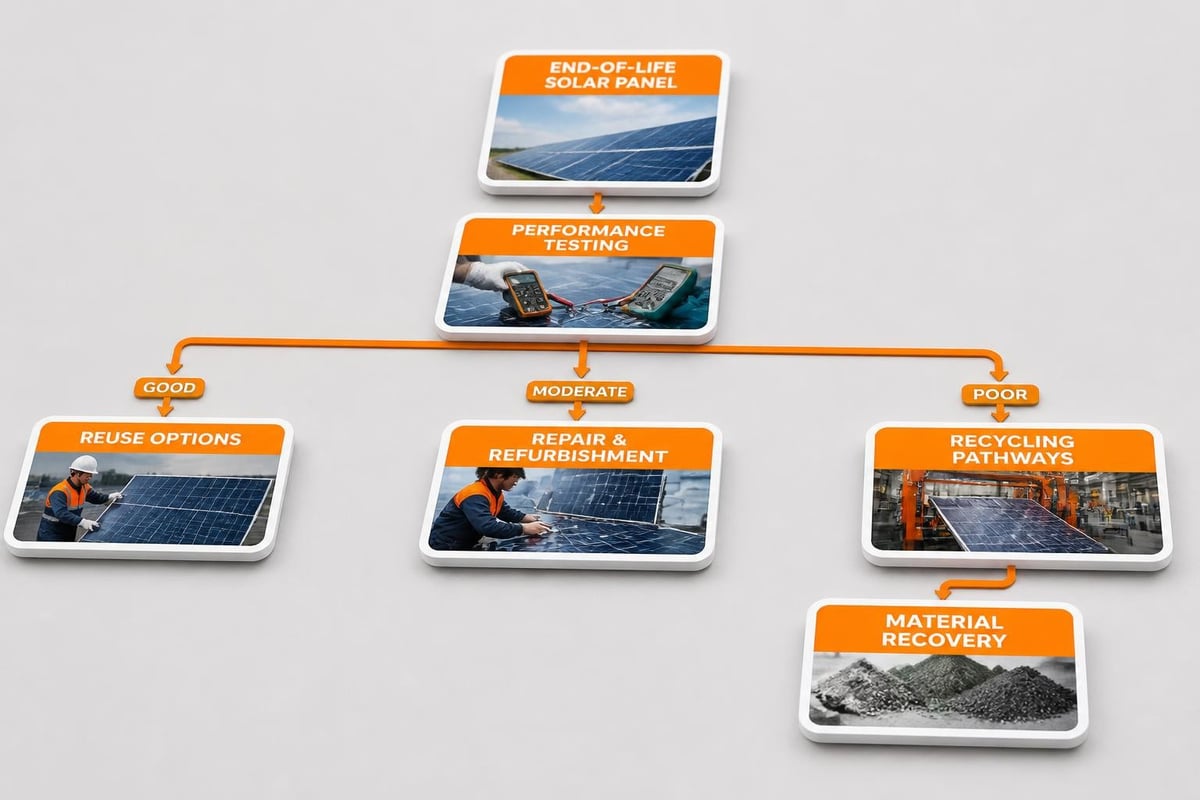
Not all retired panels require immediate recycling. The IEA-PVPS circular economy fact sheet outlines a hierarchy of options:
- Direct reuse: Panels retaining 80%+ capacity can serve lower-demand applications
- Repair and refurbishment: Replacing damaged cells or components extends useful life
- Repurposing: Degraded panels suit off-grid, educational, or demonstration projects
- Component recovery: Salvaging junction boxes, frames, and cables before recycling
- Material recycling: Final option for panels beyond functional use
Testing retired panels allows businesses to maximise asset value whilst deferring recycling costs.
Preparing for the Circular Economy Transition
Forward-thinking organisations are integrating solar panel recycling into broader sustainability and ESG strategies.
ESG Reporting and Net Zero Commitments
Responsible end-of-life management strengthens corporate environmental credentials. Companies should:
Include scope 3 emissions from panel disposal in carbon accounting, document recycling rates and material recovery in sustainability reports, align with circular economy principles in procurement policies, and engage stakeholders on responsible decommissioning practices.
The U.S. EPA's guidance on end-of-life solar panels provides frameworks adaptable to South African reporting contexts, particularly for multinational corporations operating locally.
Building Partnerships
Collaboration across the value chain accelerates recycling infrastructure development:
- Installers and developers: Establish relationships with qualified recyclers
- Manufacturers: Pressure suppliers for take-back programmes
- Industry associations: Support collective recycling schemes through SAPVIA
- Recyclers: Engage early to understand capabilities and requirements
- Government: Participate in policy consultations shaping EPR frameworks
Financial Planning
Incorporate end-of-life costs into long-term financial models:
- Establish decommissioning reserves in project finance structures
- Factor recycling costs into total cost of ownership calculations
- Explore insurance products covering decommissioning liabilities
- Consider leasing or PPA structures where provider retains disposal responsibility
For a typical 100 kW commercial system with 300 panels, businesses should budget approximately ZAR 45,000 to ZAR 105,000 for future decommissioning and recycling, adjusted for inflation over the 25-30 year asset life.
International Developments and Lessons for South Africa
Examining international approaches offers valuable insights for developing South African solutions.
European Union Leadership
The EU's WEEE Directive requires panel manufacturers to finance collection and recycling, achieving recovery rates of 85% (weight) and recycling rates of 80%. Producer responsibility organisations like PV CYCLE have collected over 150,000 tonnes of panels since 2010, establishing collection points across member states and contracting with certified recyclers.
United States Market Dynamics
The U.S. EPA's solar panel recycling overview describes a more market-driven approach, with state-level initiatives in Washington, California, and New York pioneering take-back requirements. The U.S. experience demonstrates both the potential and limitations of voluntary industry programmes without federal mandates.
Emerging Market Innovations
Countries like India and Brazil face similar challenges to South Africa: rapid solar deployment, limited recycling infrastructure, and developing regulatory frameworks. Collaborative South-South partnerships could accelerate knowledge transfer and technology adaptation suitable for emerging market contexts.
Technology Innovations on the Horizon
Research continues to improve solar panel recycling efficiency and economics.
Advanced Separation Techniques
Novel approaches under development include:
- Robotic disassembly systems using computer vision
- Laser ablation for selective material removal
- Supercritical fluid extraction for high-purity recovery
- Electrochemical processes for metal recovery
Design for Recyclability
Next-generation panels incorporate recyclability from the design stage, using water-soluble encapsulants, simplified layer structures, and standardised connection systems. These innovations could reduce future recycling costs by 40-60%.
Local Material Processing
Establishing regional mini-recycling hubs that process panels close to decommissioning sites reduces transport costs and emissions. Mobile processing units, successfully piloted in Australia, could serve South Africa's geographically dispersed installations, particularly in agricultural and rural settings.
Building a Sustainable Solar Future
The transition to comprehensive solar panel recycling in South Africa requires coordinated action from government, industry, and asset owners. Whilst challenges remain around economics, infrastructure, and regulation, the path forward is clear: integrate end-of-life planning into solar projects from inception, support development of local recycling capacity, and embrace circular economy principles that maximise resource efficiency.
For businesses, the time to act is now, rather than waiting for the first wave of mass retirements. Establishing relationships with qualified recyclers, documenting assets comprehensively, and building decommissioning provisions into financial planning positions organisations to manage this transition responsibly and cost-effectively.
Solar panel recycling represents both an environmental imperative and a business opportunity as South Africa's renewable energy sector matures. By addressing end-of-life considerations proactively, organisations demonstrate genuine commitment to sustainability whilst protecting themselves from future liabilities. INFOLED supports clients across this entire lifecycle, from initial system design and installation through ongoing monitoring and maintenance, to eventual decommissioning and recycling coordination, ensuring your renewable energy investment delivers environmental and economic benefits from day one through responsible end-of-life management.
Next Step
Need help with your energy strategy?
Speak to INFOLED about solar, storage, EV charging, service agreements or system performance.