
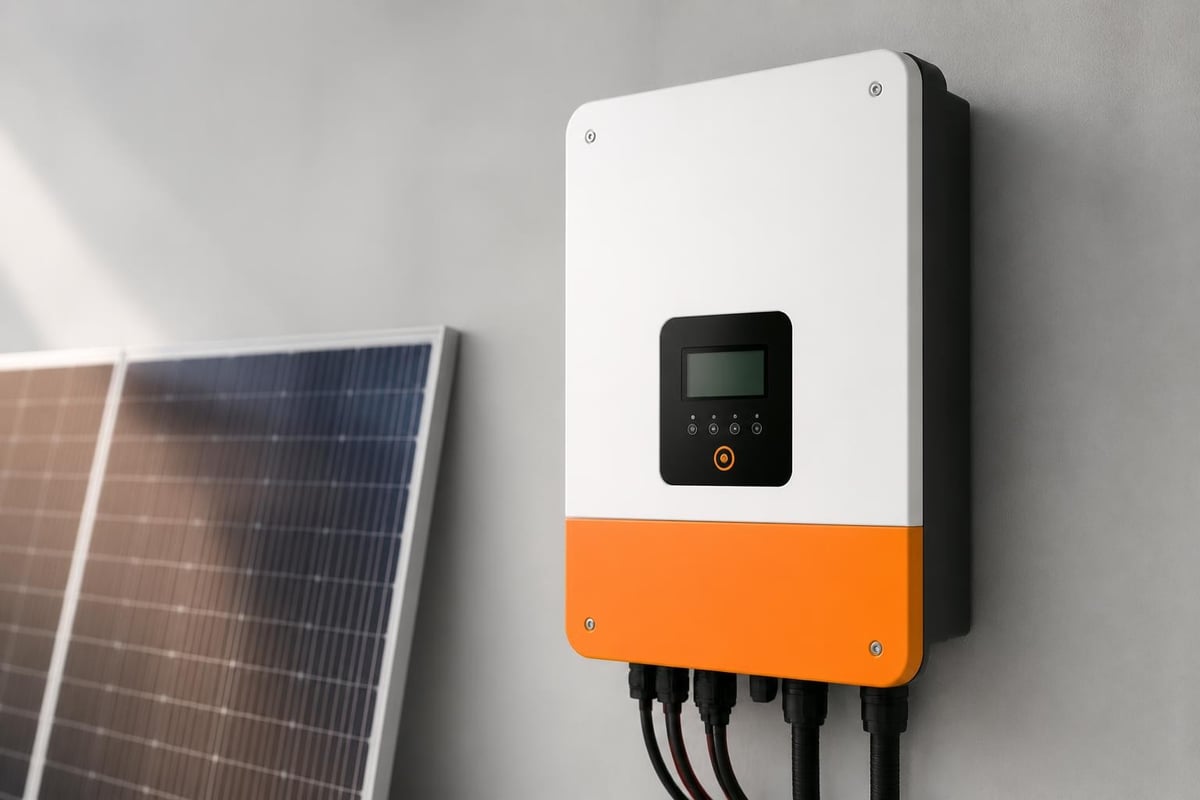
The solar panel solar inverter represents the essential bridge between your photovoltaic array and the electrical systems that power your facility. As commercial and industrial organisations across Southern Africa continue their transition to renewable energy, understanding the critical relationship between solar panels and inverters becomes paramount. This conversion technology determines not only how much of your solar energy reaches your loads but also how effectively your system integrates with batteries, the grid, and advanced energy management platforms. With Eskom tariffs continuing to escalate and load shedding remaining a persistent challenge, optimising the solar panel solar inverter pairing delivers both immediate cost savings and long-term energy resilience.
Understanding Solar Panel Solar Inverter Fundamentals
The solar panel solar inverter pairing forms the core of any photovoltaic system. Whilst panels generate direct current (DC) electricity when exposed to sunlight, virtually all commercial and residential appliances operate on alternating current (AC). The inverter performs this essential conversion, transforming the variable DC output from your solar array into stable AC power that matches the 230V, 50Hz standard across South African electrical networks.
Modern inverters do considerably more than simple DC-to-AC conversion. Advanced models integrate maximum power point tracking (MPPT) algorithms that continuously optimise panel output regardless of shading, temperature fluctuations, or changing solar irradiance. The U.S. Department of Energy overview of inverter functions details how contemporary inverters provide grid services including voltage regulation, frequency support, and reactive power compensation.
DC-AC Conversion Efficiency
Conversion efficiency determines what percentage of DC power from your panels actually becomes usable AC electricity. Premium solar panel solar inverter systems now achieve weighted efficiencies exceeding 98%, meaning minimal energy loss during conversion. However, efficiency varies across the inverter's operating range. At low power levels (early morning, late afternoon), efficiency typically drops to 90-93%, whilst peak efficiency occurs between 30-70% of rated capacity.
Key efficiency factors include:
- Component quality and thermal management design
- Transformer-based versus transformerless topology
- Operating voltage and current levels
- Ambient temperature and ventilation
- Age and maintenance condition
European weighted efficiency (Euro η) provides a more realistic performance metric than peak efficiency by averaging performance across typical operating conditions. For Southern African installations, where high ambient temperatures are common, thermal derating specifications become particularly important. Inverters must maintain efficiency whilst operating in harsh conditions without throttling output.
Solar Panel Solar Inverter Types and Selection
Selecting the appropriate inverter architecture profoundly impacts system performance, reliability, and expandability. The three primary categories-string inverters, microinverters, and power optimisers-each offer distinct advantages depending on installation characteristics, roof complexity, and performance requirements.
| Inverter Type | Capacity Range | Best Application | Typical Efficiency | Relative Cost |
|---|---|---|---|---|
| String Inverter | 3-350 kW | Simple roof layouts, minimal shading | 96-98.5% | Lowest |
| Microinverter | 250-500 W | Complex roofs, significant shading | 95.5-97% | Highest |
| Power Optimiser | Panel-level + central inverter | Moderate complexity, partial shading | 97-98.8% | Medium |
| Central Inverter | 500 kW-5 MW | Ground-mount, utility-scale | 98-98.9% | Varies |
String Inverter Systems
String inverters remain the most common choice for commercial and industrial solar installations across South Africa. These units connect series strings of panels (typically 8-12 modules per string) to a centralised inverter. For facilities with unshaded, south-facing rooftops, string inverters deliver excellent performance at the lowest installed cost per watt.
Modern string inverters incorporate multiple MPPT channels, allowing different roof sections or orientations to operate independently. A commercial installation might deploy a 50 kW string inverter with four MPPT inputs, each optimising a separate array segment. This flexibility proves essential for facilities with east-west roof orientations or multiple roof planes.
Module-Level Power Electronics
Microinverters attach directly to individual solar panels, converting DC to AC at the module level. This distributed architecture eliminates string-level losses from shading or module mismatch. Whilst capital costs run 15-25% higher than string systems, microinverters excel in complex residential installations or facilities with significant shading challenges from trees, neighbouring structures, or rooftop equipment.
Power optimisers offer a hybrid approach. These DC-DC converters attach to each panel, performing MPPT at the module level before sending optimised DC power to a central string inverter. This architecture combines the shading mitigation of microinverters with the proven reliability and lower cost of string inverters. Research from Sandia National Laboratories on power-electronics examines reliability improvements in both centralised and distributed architectures.
Sizing Your Solar Panel Solar Inverter Configuration
Proper inverter sizing directly impacts system economics and performance. Whilst conventional wisdom suggests matching inverter capacity to peak array output, optimal sizing typically involves 10-20% DC-to-AC oversizing. This strategic undersizing-called inverter loading ratio or DC:AC ratio-accounts for real-world conditions and improves return on investment.
Southern African solar installations rarely achieve nameplate capacity simultaneously across all panels. Temperature coefficients reduce panel output by 10-15% at typical operating temperatures of 55-65°C. Soiling from dust and pollen, particularly during dry winter months, further diminishes performance. Inverter loading ratios of 1.15:1 or even 1.25:1 allow systems to reach inverter capacity during optimal conditions whilst reducing inverter capital costs.
- Calculate total panel nameplate capacity (e.g., 150 panels × 450W = 67.5 kWp)
- Apply temperature and soiling derating (67.5 kW × 0.88 = 59.4 kW expected peak)
- Determine acceptable clipping losses (typically <3% annual energy)
- Select inverter with 10-20% less AC capacity than DC array (55-60 kW inverter)
- Verify string voltage remains within inverter MPPT range across temperature extremes
Critical sizing considerations:
- Future expansion plans and available inverter capacity
- Battery integration requirements and charge/discharge paths
- Grid export limitations and export control settings
- Harmonic distortion limits for sensitive manufacturing equipment
- Three-phase balance requirements for commercial networks

The IEA PVPS report on system reliability provides detailed methodologies for evaluating inverter performance under varying environmental conditions and partial shading scenarios.
Integration With Battery Energy Storage Systems
The solar panel solar inverter configuration becomes more complex when integrating battery storage. Energy storage systems require bidirectional power flow: solar charges the battery during the day, whilst the battery discharges to supply loads during peak tariff periods or grid outages. This bidirectional capability demands careful consideration of system architecture.
AC-Coupled Storage Systems
AC-coupled systems pair a standard solar inverter with a separate battery inverter (also called a storage inverter or hybrid inverter). Solar panels feed AC power into your facility's distribution board, where it either supplies loads, charges batteries through the battery inverter, or exports to the grid. This architecture offers maximum flexibility, allowing battery systems to charge from both solar and grid sources.
AC coupling proves ideal for retrofitting storage to existing solar installations. Commercial facilities implementing Battery Energy Storage Systems can add batteries without replacing functioning solar inverters. The separation also simplifies warranty management and allows independent optimisation of solar and storage components.
DC-Coupled Hybrid Inverters
DC-coupled systems use hybrid inverters that manage both solar panels and battery banks through a common DC bus. Solar DC power can flow directly to batteries without intermediate AC conversion, improving round-trip efficiency by 3-5%. This architecture reduces component count and simplifies installation for new systems designed from the outset to include storage.
Hybrid inverters typically include:
- Multiple MPPT inputs for solar strings
- Integrated battery charge controller with sophisticated algorithms
- Automatic backup switching for load-shedding resilience
- Smart energy management coordinating solar, battery, grid, and loads
- Remote monitoring and control capabilities
For industrial facilities pursuing energy arbitrage (charging batteries during off-peak Eskom periods, discharging during peak times), hybrid inverters streamline system control. Single-unit management simplifies demand-side management and tariff optimisation strategies essential for maximising savings under Megaflex and other time-of-use tariff structures.
Grid Interconnection and Advanced Inverter Functions
Contemporary solar panel solar inverter systems provide sophisticated grid-support capabilities beyond basic power conversion. As renewable energy penetration increases across municipal and Eskom networks, grid operators increasingly require inverters to support voltage regulation, frequency stabilisation, and reactive power compensation.
The UL 1741 SA standard for advanced inverters defines certification requirements for grid-interactive inverters. Whilst South Africa follows NRS 097-2-1 and SANS 10142 standards for grid connection, understanding international advanced inverter capabilities helps specify systems compatible with emerging local requirements.
| Grid Function | Description | Commercial Benefit |
|---|---|---|
| Volt-VAR | Automatic reactive power injection for voltage support | Improved power quality, reduced equipment stress |
| Frequency-Watt | Power curtailment during over-frequency events | Grid stability contribution, compliance |
| Anti-Islanding | Rapid disconnection when grid fails | Safety, regulatory compliance |
| Soft-Start | Gradual reconnection after grid restoration | Reduced inrush, protection of sensitive equipment |
| Export Limiting | Precise control of grid export levels | Compliance with municipal restrictions |
Export Control and Grid Compliance
Many South African municipalities impose zero-export or limited-export conditions on embedded generation connections. Inverters must incorporate precise export control, typically using bidirectional energy meters or CT clamps to monitor grid connection points. When generation exceeds consumption, the inverter throttles output or diverts excess energy to batteries rather than exporting.
Advanced export control strategies include:
- Zero export: Inverter ensures net export never exceeds 0W
- Limited export: Caps export at specified level (e.g., 25% of connection capacity)
- Dynamic export: Adjusts limits based on time-of-day or grid conditions
- Frequency shifting: Uses grid frequency to signal export acceptability
Properly configured export control proves essential for commercial solar installations navigating municipal interconnection requirements whilst maximising self-consumption.
Monitoring, Maintenance and Performance Optimisation
The solar panel solar inverter generates extensive performance data that enables proactive maintenance and continuous optimisation. Modern inverters communicate via Ethernet, Wi-Fi, cellular, or RS485 connections, streaming real-time and historical data to cloud platforms or building management systems.
Comprehensive monitoring reveals:
- Production metrics: Daily, monthly, and lifetime energy generation
- String performance: Individual string current, voltage, and power
- Efficiency tracking: Conversion efficiency across operating conditions
- Environmental data: Panel temperature, irradiance, ambient conditions
- Fault detection: Detailed error codes and diagnostic information
- Grid parameters: Voltage, frequency, and power quality metrics
String-level monitoring quickly identifies underperforming arrays caused by shading, soiling, or module failures. When one string produces 15-20% less than parallel strings, investigation typically reveals accumulated dust, damaged panels, or loose connections. Early detection prevents minor issues from escalating into major losses.
Multi-layered monitoring approach from individual panel optimization through string performance to complete system analytics and grid integration metrics
Professional operations and maintenance programmes combine remote monitoring with scheduled inspections. Thermal imaging identifies hot spots indicating failing bypass diodes or poor connections. Renewable Energy Operations and Maintenance services ensure inverters maintain peak performance across their 10-15 year design life through firmware updates, ventilation maintenance, and component replacement before failures occur.
Predictive Maintenance Strategies
Machine learning algorithms now analyse inverter performance data to predict component failures before they occur. By comparing actual output against modelled expectations based on weather data, predictive systems identify gradual performance degradation. A 2% monthly decline in efficiency might indicate capacitor ageing, prompting proactive replacement during scheduled maintenance rather than emergency callout.
Environmental monitoring proves equally important. Inverters operating consistently above 50°C ambient experience accelerated component ageing. Installations in harsh industrial environments benefit from IP65-rated inverters with active cooling, whilst coastal facilities require corrosion-resistant enclosures designed for saline atmospheres.
Advanced Inverter Technologies and Future Developments
The solar panel solar inverter landscape continues evolving rapidly. Silicon carbide (SiC) and gallium nitride (GaN) semiconductors replace conventional silicon IGBTs, enabling higher switching frequencies, reduced losses, and smaller component sizes. These wide-bandgap devices operate efficiently at higher temperatures, critical for Southern African installations where ambient temperatures regularly exceed 35°C.
Research documented in the Fraunhofer ISE annual report highlights medium-voltage string inverters that eliminate low-voltage to medium-voltage transformers in utility-scale installations. These innovations reduce conversion stages and associated losses whilst simplifying installation.
Emerging inverter capabilities include:
- AI-driven MPPT algorithms that learn site-specific shading patterns
- Blockchain integration for peer-to-peer energy trading platforms
- Vehicle-to-grid (V2G) coordination for EV charging optimisation
- Harmonic filtering protecting sensitive industrial processes
- Cybersecurity hardening against grid-level threats
- Enhanced islanding capabilities for extended backup operation
Inverters increasingly function as energy management platforms rather than simple conversion devices. Integration with smart metering, building automation, and demand-response programmes positions the solar panel solar inverter as the intelligent hub coordinating distributed energy resources. The SEIA Standards programme develops consensus standards ensuring interoperability across manufacturers and systems.
Warranty, Reliability and Total Cost of Ownership
Inverter warranties typically range from 5-10 years standard, with extended coverage available to 20-25 years. However, warranty duration tells only part of the reliability story. Mean time between failures (MTBF), serviceability, and manufacturer longevity significantly impact total cost of ownership.
String inverters generally outlast microinverters due to fewer total units and less exposure to harsh rooftop environments. A 100 kW commercial installation might deploy two 50 kW string inverters versus 250 individual microinverters. Statistically, systems with fewer components experience fewer failures. However, string inverter failures impact entire array sections, whilst microinverter failures affect only single panels.
Economic Analysis Framework
Total cost of ownership calculations must account for:
- Capital cost: Initial equipment and installation expense
- Operating costs: Monitoring fees, scheduled maintenance
- Efficiency losses: Value of energy lost to conversion inefficiency
- Downtime: Revenue loss during failures and repairs
- Replacement reserves: Funds set aside for end-of-life replacement
- Disposal costs: Proper recycling of electronic components
For a 500 kW commercial installation in Johannesburg generating 750,000 kWh annually, a 1% efficiency improvement delivers roughly 7,500 kWh additional production. At a Megaflex peak avoided cost of ZAR 2.50/kWh, this represents ZAR 18,750 additional annual value. Over a 25-year system life, efficiency differences significantly impact project economics.
Inverter reliability directly affects availability-the percentage of time your system produces energy. A system averaging 99% availability loses 87 hours of production annually. During South African summer months when daily generation reaches 6-7 hours, even 99% availability means missing 3-4 peak production days yearly. Premium inverters achieving 99.5% availability reduce these losses substantially.
Thermal Management and Environmental Considerations
Southern Africa's climate challenges solar panel solar inverter performance. Gauteng installations face temperature extremes from below freezing winter mornings to 40°C summer afternoons. Coastal KwaZulu-Natal facilities contend with high humidity and salt-laden air. Free State agricultural installations deal with persistent dust and minimal rainfall for extended periods.
Inverters incorporate multiple thermal management strategies. Natural convection cooling suits residential and light commercial applications, whilst forced-air cooling handles higher power densities in commercial string inverters. Liquid cooling appears in some utility-scale central inverters, though the added complexity suits only the largest installations.
Environmental protection requirements:
- Ingress protection: Minimum IP65 for outdoor installations
- Corrosion resistance: Stainless steel or coated enclosures for coastal zones
- UV resistance: Materials stable under intense Southern African solar radiation
- Altitude derating: Performance specifications at high-altitude sites
- Seismic compliance: Mounting suitable for local building codes
Installation location profoundly impacts inverter longevity. External wall-mounted inverters experience direct solar heating, potentially reaching 70-80°C enclosure temperatures. Where possible, locate inverters on south-facing walls (shaded during peak sun hours) or in ventilated plant rooms. Avoid installing inverters in roof spaces where summer temperatures exceed equipment ratings.
Proper ventilation clearances-typically 500 mm on all sides-allow adequate cooling airflow. Inverters installed in series along a wall must maintain spacing to prevent one unit from drawing another unit's heated exhaust. For facilities implementing energy management systems, integrating inverter temperature monitoring enables proactive intervention when thermal conditions approach critical thresholds.
System Integration and Communication Protocols
Modern solar panel solar inverter systems communicate using multiple protocols depending on application requirements. Residential systems typically use Wi-Fi or cellular connections for cloud-based monitoring. Commercial installations integrate via Modbus RTU/TCP, enabling connection to building management systems, SCADA platforms, or industrial control networks.
Communication enables sophisticated control strategies. A manufacturing facility might programme inverters to curtail production during demand charges risk periods, preventing expensive peak demand penalties. Agricultural operations coordinate irrigation pump loads with available solar generation. Shopping centres balance HVAC, lighting, and refrigeration loads against solar and battery resources to minimise grid dependence during peak tariff windows.
Common communication interfaces:
- Modbus RTU (RS485): Industrial standard, reliable over long cable runs
- Modbus TCP (Ethernet): Higher speed, easier integration with IT networks
- SunSpec Alliance protocols: Standardised monitoring and control across manufacturers
- Proprietary APIs: Manufacturer-specific cloud platform integration
- MQTT: Lightweight messaging for IoT and energy management platforms
Cybersecurity considerations become critical as inverters connect to corporate networks. Implement network segmentation, placing inverters on dedicated VLANs isolated from business systems. Change default passwords immediately after commissioning. Enable encrypted communications and apply firmware updates promptly to address security vulnerabilities. Industrial facilities should conduct periodic cybersecurity audits of renewable energy systems alongside traditional IT infrastructure.
Regulatory Compliance and Standards Adherence
South African embedded generation installations must comply with NRS 097-2-1 grid connection standards and SANS 10142-1 wiring regulations. Inverters require approval from the South African Bureau of Standards (SABS) or demonstrate compliance with IEC 62109 (safety) and IEC 61727 (grid interconnection) through acceptable international certification.
Municipal interconnection processes vary significantly across South Africa. Johannesburg, Cape Town, and eThekwini maintain distinct application procedures, technical requirements, and approval timelines. Many municipalities require:
- Professional electrical engineer design and certification
- Inverter compliance documentation and certificates
- Anti-islanding test reports and specifications
- Export limitation configuration details
- Insurance certificates with specified coverage levels
- SSEG (Small-Scale Embedded Generation) registration
Processing times range from 4 weeks in streamlined municipalities to 6+ months in understaffed departments. Early engagement and complete documentation submission accelerate approvals. Working with experienced engineering firms familiar with local processes reduces delays and ensures first-time compliance.
The Electricity Regulation Act and subsequent amendments continue evolving, potentially introducing wheeling frameworks, feed-in tariffs, or revised technical standards. Solar panel solar inverter specifications should accommodate anticipated regulatory changes, ensuring systems remain compliant across their operational life. Following industry guidance from organisations like SAPVIA (South African Photovoltaic Industry Association) keeps installations aligned with emerging requirements.
Selecting and configuring the optimal solar panel solar inverter system requires balancing technical performance, economic value, and future expandability against specific site conditions and operational requirements. From conversion efficiency and thermal management to grid compliance and communication protocols, every specification influences long-term system success. INFOLED provides comprehensive engineering, design, and installation services across commercial, industrial, and agricultural solar projects throughout Southern Africa, ensuring your renewable energy investment delivers maximum returns whilst supporting your energy resilience and sustainability objectives.
Next Step
Need help with your energy strategy?
Speak to INFOLED about solar, storage, EV charging, service agreements or system performance.