
South African businesses face unprecedented electricity challenges in 2026. Rolling blackouts, escalating tariffs, and unreliable grid supply have pushed organisations across Johannesburg, Cape Town, and Durban to seek permanent solutions. Solar and battery storage systems have emerged as the most viable pathway to energy independence, combining photovoltaic generation with intelligent energy storage to deliver 24-hour power security. This integrated approach addresses both the intermittent nature of solar generation and the persistent threat of load shedding, whilst simultaneously reducing operating costs and supporting environmental, social, and governance commitments.
Understanding Solar and Battery Storage Integration
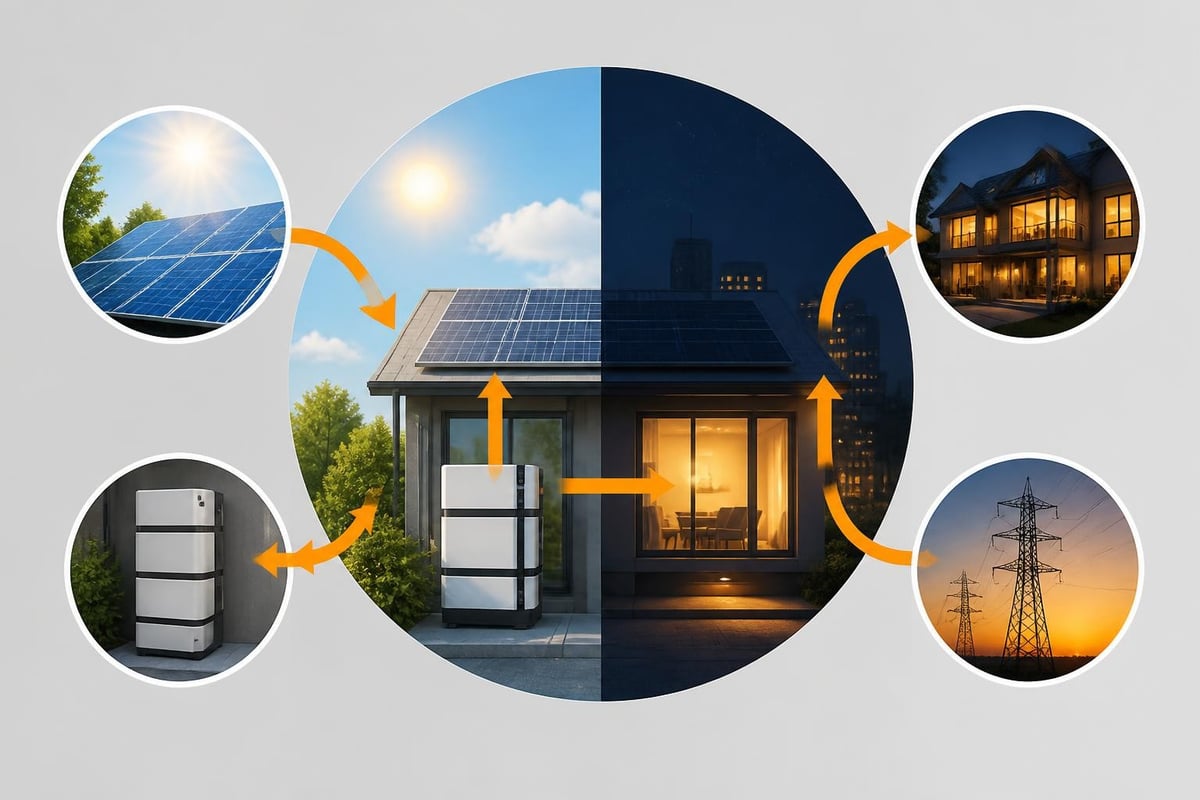
The marriage of solar panels with battery energy storage systems represents a fundamental shift in how commercial and industrial facilities manage electricity. Solar photovoltaic arrays generate direct current electricity when sunlight strikes their semiconductor cells. This energy can either power immediate loads, feed excess back to the grid, or charge batteries for later use.
Battery systems store surplus solar generation during peak production hours, typically between 9:00 and 15:00 when panels operate at maximum efficiency. This stored energy becomes available during evening peaks, overnight periods, or grid outages. The synchronization between generation and storage creates a self-sufficient energy ecosystem that dramatically reduces reliance on municipal supply.
Technical Components of Solar and Battery Storage
Modern systems comprise several integrated elements working in concert:
- Solar photovoltaic arrays converting sunlight to electricity
- Inverters managing DC to AC conversion and system logic
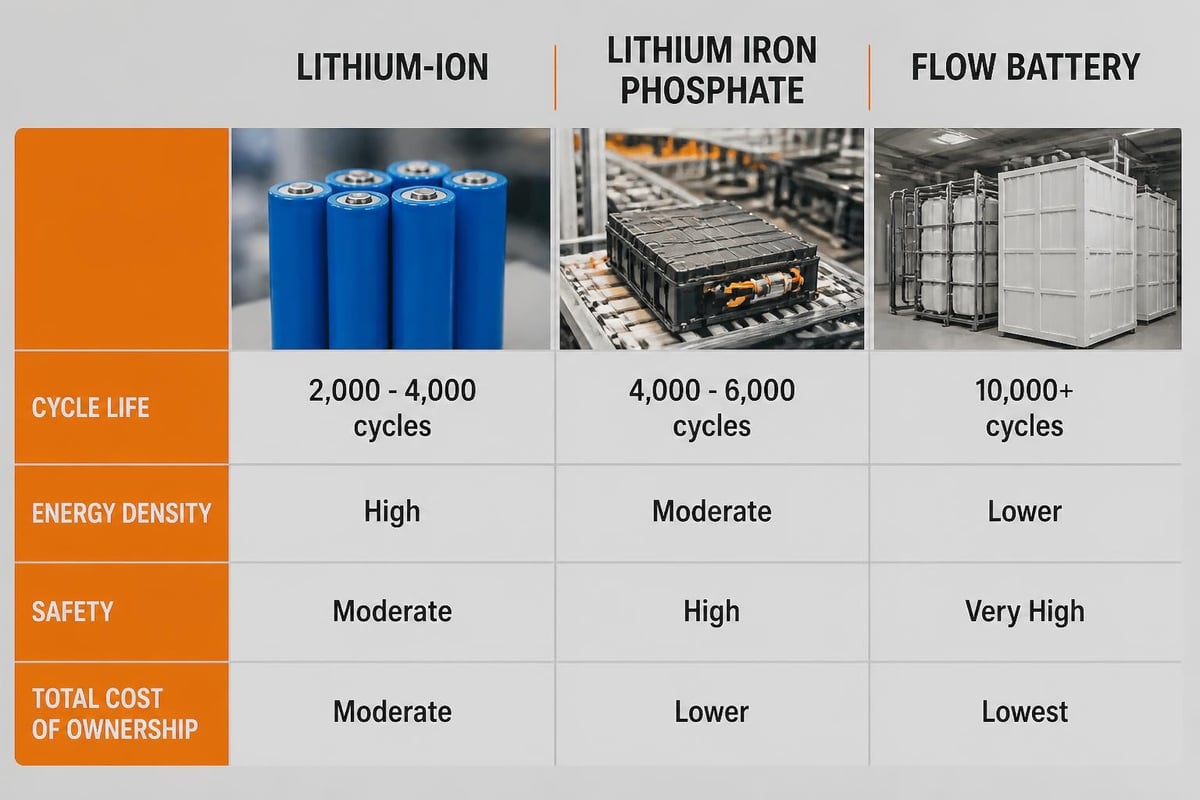
- Battery banks storing energy in lithium-ion, lithium iron phosphate, or flow battery chemistries
- Battery management systems optimizing charge cycles and cell health
- Energy management software coordinating generation, storage, and consumption
The inverter serves as the system's brain, determining when to charge batteries, when to discharge stored energy, and when to draw from or export to the grid. Advanced hybrid inverters can manage multiple energy sources simultaneously, prioritizing the most economical option at any given moment.
Economic Benefits Driving Adoption in South Africa
Financial considerations dominate solar and battery storage decision-making for South African enterprises. Eskom's tariff increases have averaged well above inflation for the past decade, with further escalations expected through 2027. Industrial users paying between R2.50 and R3.50 per kilowatt-hour face compelling return-on-investment scenarios when installing renewable systems.
Immediate Cost Reductions
Solar and battery storage delivers measurable savings through several mechanisms:
- Peak demand reduction by discharging batteries during expensive Time-of-Use periods
- Diesel generator displacement eliminating fuel costs during outages
- Demand charge management through strategic load shaping
- Maximum demand reduction lowering monthly capacity charges
- Energy arbitrage by storing cheap off-peak grid electricity when solar is insufficient
Manufacturing facilities in KwaZulu-Natal report electricity cost reductions exceeding 60% within the first year of operation. Warehousing operations in Gauteng typically achieve payback periods between three and six years, depending on consumption patterns and system sizing.
| Cost Component | Before Solar & Battery | After Installation | Typical Saving |
|---|---|---|---|
| Energy charges | R450,000/month | R180,000/month | 60% |
| Demand charges | R85,000/month | R40,000/month | 53% |
| Diesel backup | R35,000/month | R0/month | 100% |
| Total | R570,000/month | R220,000/month | 61% |
Financial modelling must account for the Section 12B tax incentive, which allows businesses to claim a 125% deduction on renewable energy investment in the year of commissioning. This accelerates effective payback significantly for profitable enterprises.
Battery Technologies and Selection Criteria
Choosing appropriate storage technology requires understanding the trade-offs between different chemistries. Battery technologies for grid-scale energy storage vary considerably in performance characteristics, lifecycle costs, and suitability for specific applications.
Lithium-Ion Variants
Lithium nickel manganese cobalt (NMC) batteries offer high energy density and moderate costs, making them popular for space-constrained installations. Typical installations achieve 5,000 to 7,000 cycles at 80% depth of discharge.
Lithium iron phosphate (LFP) batteries sacrifice some energy density for superior safety, longer lifecycles exceeding 10,000 cycles, and better thermal stability in South African heat. Most commercial battery installations in the region now specify LFP chemistry for industrial applications.
Alternative Technologies
Flow batteries using vanadium electrolytes provide effectively unlimited cycling without degradation, though higher upfront costs limit adoption primarily to very large installations above 500 kWh. High-temperature sodium-nickel-chloride batteries suit specialized industrial applications requiring thermal resilience.
System Sizing and Design Considerations
Proper sizing determines system effectiveness and financial returns. Undersized arrays fail to meet energy requirements, whilst oversized installations waste capital. Professional design begins with comprehensive load analysis examining:
- Historical consumption patterns across seasons and operational schedules
- Peak demand profiles identifying maximum simultaneous loads
- Load shedding vulnerability during critical production periods
- Future expansion plans affecting energy requirements
- Available installation area for panel mounting
Industrial facilities typically size solar arrays between 80% and 120% of average daily consumption. Battery capacity commonly ranges from two to six hours of average load, balancing cost against desired autonomy. Agricultural operations with seasonal variation require more nuanced approaches accounting for planting, harvesting, and dormant periods.
Configuration Options
Solar and battery storage systems deploy in several topologies:
AC-coupled systems connect solar and batteries to the building's AC distribution through separate inverters, offering flexibility and easier retrofitting to existing solar installations.
DC-coupled systems integrate batteries on the solar array's DC side, improving round-trip efficiency by eliminating conversion losses and enabling more sophisticated energy management.
Hybrid configurations combine both approaches, particularly beneficial for large installations requiring specific power quality or redundancy characteristics.
The optimal configuration depends on existing infrastructure, expansion intentions, and operational priorities. Facilities with legacy solar installations typically favour AC coupling, whilst new builds often specify DC-coupled or hybrid designs.
Regulatory and Grid Interconnection Requirements
Navigating South African electricity regulations requires understanding municipal requirements, NERSA stipulations, and Eskom grid codes. Systems under 1 MW typically fall under small-scale embedded generation provisions, though specific requirements vary by municipality.
Municipal Registration and Approval
Most metros including City of Cape Town, eThekwini, and City of Johannesburg mandate formal application processes for grid-connected solar and battery storage:
- Submit technical drawings and single-line diagrams
- Provide equipment specifications and compliance certificates
- Pay application fees ranging from R2,500 to R15,000
- Await approval before commissioning (typically 6-12 weeks)
- Complete final inspection with municipal electrician
Some municipalities require additional insurance coverage or bank guarantees, particularly for systems exceeding 500 kW. Working with experienced engineering firms familiar with local compliance requirements streamlines the approval process considerably.
Grid Connection Standards
NRS 097-2-3 specifies technical requirements for small-scale embedded generation connecting to distribution networks. Critical provisions address:
- Anti-islanding protection preventing energization of dead grid sections
- Voltage regulation maintaining supply within acceptable ranges
- Harmonic limits ensuring power quality standards
- Fault ride-through capabilities for grid stability
- Remote monitoring and control enabling utility oversight
Systems must disconnect from the grid within specified timeframes when detecting voltage or frequency deviations. These protection mechanisms ensure both personnel safety during maintenance and grid stability during disturbances.
Load Shedding Resilience Through Intelligent Storage
Load shedding remains the primary driver of solar and battery storage adoption across South Africa in 2026. Businesses cannot tolerate the productivity losses, equipment damage, and customer dissatisfaction caused by unpredictable outages. Battery systems provide seamless transition to stored energy within milliseconds of grid failure, maintaining critical operations without interruption.
Manufacturing facilities prioritize uninterruptible power for CNC machinery, robotic systems, and process control equipment where sudden shutdowns cause material waste, tool damage, and lengthy restart procedures. Retail operations maintain point-of-sale systems, refrigeration, and security throughout outages, preventing revenue loss and spoilage.
Strategic Load Management
Advanced battery systems implement sophisticated load shedding strategies beyond simple backup:
- Load prioritization maintaining critical circuits whilst shedding non-essential loads
- Generator integration coordinating battery and diesel backup for extended outages
- Predictive charging using load shedding schedules to pre-charge before expected cuts
- Remote monitoring enabling facility managers to track system status and adjust settings
Healthcare facilities employ particularly nuanced approaches, maintaining life-safety systems indefinitely whilst managing comfort loads based on available capacity. Breaking regulatory and grid barriers to distributed energy adoption enables more facilities to achieve this level of resilience.
Performance Monitoring and Optimization
Real-time monitoring transforms solar and battery storage from passive infrastructure into actively managed assets. Modern systems provide granular visibility into generation, storage, consumption, and grid interaction through cloud-based platforms accessible via smartphone, tablet, or computer.
Key performance indicators tracked include:
| Metric | Typical Target | Business Value |
|---|---|---|
| Solar capacity factor | 18-22% | Generation efficiency |
| Battery round-trip efficiency | 88-94% | Storage losses |
| Grid export ratio | <10% | Revenue opportunity |
| Load shedding coverage | 100% | Operational continuity |
| System availability | >98% | Reliability assurance |
Monthly performance reviews identify optimization opportunities such as adjusting charge/discharge schedules, recalibrating inverter settings, or addressing underperforming panels. Quarterly analytics examine seasonal trends and verify financial projections remain on track.
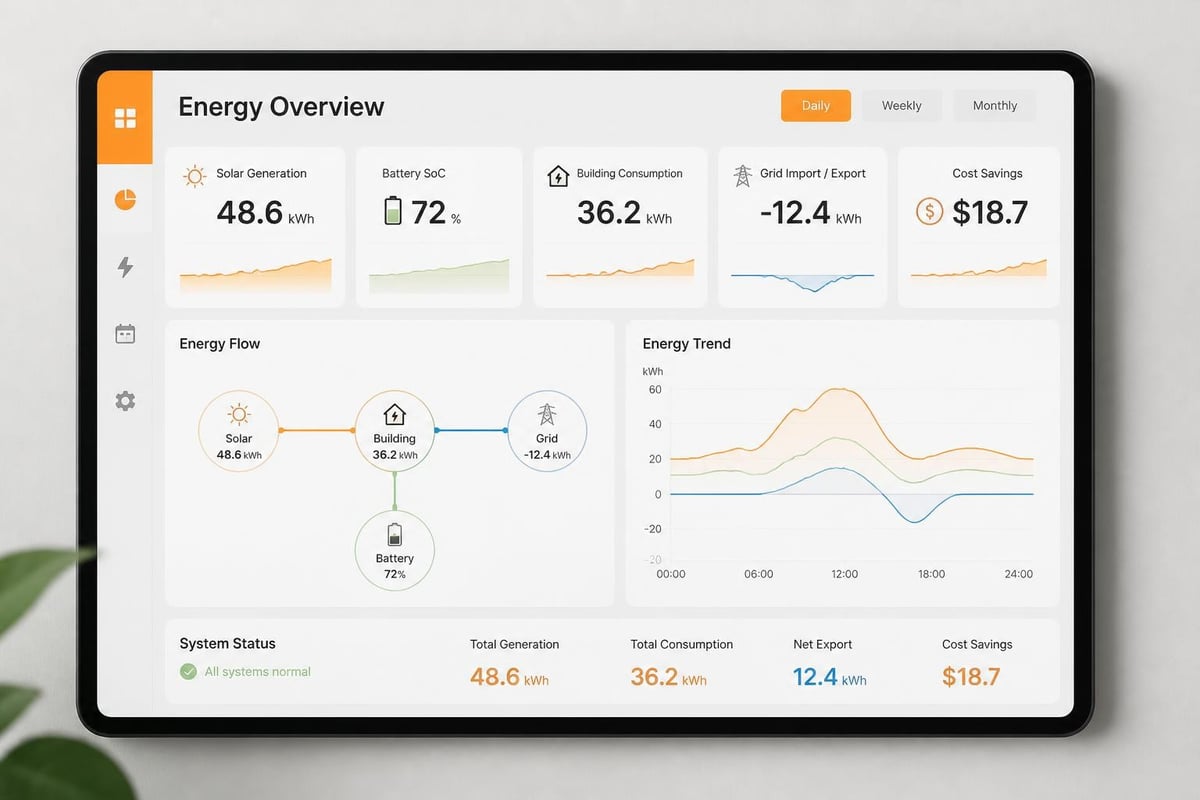
Proactive maintenance based on monitoring data extends system lifespan and maintains warranty compliance. Thermal imaging detects failing solar cells before they impact production, whilst battery management systems identify cells requiring balancing or replacement.
Integration with Broader Energy Strategies
Solar and battery storage forms one component of comprehensive energy management programmes. Forward-thinking organizations integrate renewable generation with demand-side interventions, energy efficiency improvements, and smart building technologies.
Building management systems coordinate HVAC, lighting, and process loads with available solar generation and battery capacity. Thermal loads like water heating shift to midday solar peaks, whilst cold storage pre-cools during excess generation periods.
Electric vehicle charging infrastructure increasingly incorporates solar and battery storage, charging fleet vehicles with renewable energy during optimal production windows. This integration supports corporate sustainability initiatives whilst managing electricity costs.
Combined heat and power systems in industrial settings can complement solar and battery storage, providing both electrical and thermal energy for processes requiring substantial heat input. The hybrid approach maximizes overall energy efficiency.
Environmental and ESG Considerations
Corporate environmental commitments drive solar and battery storage adoption alongside financial motivations. Organizations pursuing carbon neutrality, Net Zero targets, or specific ESG reporting frameworks require quantified emissions reductions from verifiable sources.
Carbon Accounting Benefits
Each kilowatt-hour generated by solar panels displaces grid electricity with an average carbon intensity around 0.95 kg CO₂ equivalent in South Africa's coal-heavy generation mix. A 500 kW solar installation producing 800,000 kWh annually prevents approximately 760 tonnes of carbon emissions.
Battery storage amplifies these benefits by enabling greater solar utilization. Without storage, excess midday generation often feeds back to the grid at minimal tariffs. Batteries capture this surplus for evening use, displacing grid consumption during periods when coal and diesel generation dominate the supply mix.
Annual sustainability reports quantify these reductions using established methodologies:
- Scope 2 emissions (purchased electricity) decrease directly through grid displacement
- Scope 3 emissions reduce when clean energy powers company vehicles or employee facilities
- Renewable energy certificates document generation for voluntary or compliance programmes
- TCFD reporting demonstrates climate risk mitigation through energy resilience
International frameworks including CDP, GRI, and SASB increasingly expect detailed renewable energy disclosures. Solar and battery storage provides concrete, measurable progress toward stated climate commitments.
Future-Proofing Energy Infrastructure
Energy markets continue evolving rapidly in South Africa and globally. Solar and battery storage systems installed in 2026 must anticipate regulatory changes, tariff restructuring, and technological advancement over 20-25 year operating lifespans.
Anticipated Market Developments
Several trends will reshape the solar and battery storage landscape through 2030:
Time-of-use tariff expansion across more municipalities will enhance battery economics by widening spreads between peak and off-peak rates. Systems designed with adequate capacity to avoid all peak consumption will achieve superior returns.
Feed-in tariffs and wheeling may become more widespread as municipalities recognize distributed generation's grid benefits. Utility-scale storage policies in developed markets demonstrate revenue potential from multiple value streams including energy arbitrage, frequency regulation, and capacity services.
Vehicle-to-grid capabilities will enable electric vehicles to function as mobile storage, discharging to buildings during peaks and charging during solar surplus. Preparatory installation of appropriate inverters and software platforms positions facilities to capitalize on this convergence.
Aggregated systems creating virtual power plants will allow commercial installations to participate in grid services markets, generating revenue whilst supporting grid stability. Early adoption positions organizations advantageously as these programmes mature.
Financing and Procurement Models
Capital requirements for solar and battery storage installations range from R15,000 per kW for smaller systems to below R10,000 per kW for large commercial arrays. Battery costs add R7,000 to R12,000 per kWh depending on chemistry and scale. A 500 kW solar array with 2 MWh of storage typically requires R11 million to R13 million investment.
Available Financing Structures
Organizations access solar and battery storage through various models:
Capital purchase provides full ownership, maximum tax benefits through Section 12B deductions, and complete operational control. This suits profitable entities with available capital or credit facilities.
Power purchase agreements allow third-party developers to own and maintain systems whilst customers purchase generated electricity at contracted rates below municipal tariffs. Zero upfront cost appeals to organizations prioritizing balance sheet preservation.
Leasing arrangements combine aspects of both models, with monthly payments covering system cost and maintenance over defined terms. End-of-term purchase options enable eventual ownership.
Energy-as-a-Service bundles equipment, installation, monitoring, and maintenance into performance-based contracts guaranteeing specific savings or availability levels. This model transfers technical and operational risk to experienced renewable energy specialists.
Selection depends on financial position, accounting preferences, operational capabilities, and strategic priorities. Many organizations lacking in-house technical expertise prefer turnkey solutions with comprehensive service level agreements ensuring long-term performance.
Operational Considerations and Maintenance
Solar and battery storage systems require minimal but important ongoing attention. Panel cleaning, inverter firmware updates, battery health monitoring, and connection inspections maintain optimal performance throughout system lifespans.
Preventative Maintenance Schedules
Quarterly activities include visual inspections, connection torque verification, and performance benchmarking against design expectations. Thermal imaging identifies hot spots indicating failing components.
Annual servicing encompasses comprehensive electrical testing, cleaning programmes tailored to local soiling rates, and detailed battery analytics including capacity testing and cell balancing.
Major overhauls at 10-15 year intervals may include inverter replacement, electrical component upgrades, and mounting structure rehabilitation. Battery replacement typically occurs between years 10 and 15, depending on chemistry and cycling intensity.
Maintenance costs average 1-2% of initial system investment annually. Organizations can self-perform basic tasks or engage specialist firms offering comprehensive programmes. Professional maintenance ensures warranty compliance, optimizes performance, and extends equipment lifespan.
Case Applications Across South African Sectors
Solar and battery storage deployments span diverse industries, each with unique requirements and optimization strategies:
Manufacturing facilities in automotive, food processing, and chemical production require high reliability and substantial energy capacity. Systems typically exceed 1 MW solar with 3-6 hours battery storage, engineered for complete load shedding immunity.
Commercial property including office parks, shopping centers, and hotels prioritize tenant satisfaction and operational continuity. Medium-scale systems (200-800 kW solar with 400-2,000 kWh batteries) handle common area loads and provide backup for critical services.
Agricultural operations processing crops, running irrigation systems, and maintaining cold storage benefit from solar's alignment with growing seasons. System sizing accounts for dramatic load variation between planting and harvest periods.
Residential estates deploy community-scale systems providing backup power to multiple homes whilst reducing collective electricity costs. Shared infrastructure spreads capital costs across numerous beneficiaries.
Each application requires tailored engineering considering load profiles, available space, budget constraints, and operational priorities. Achieving firm power generation with high renewable penetration demands careful system design balancing generation, storage, and demand management.
Installation and Project Timelines
Implementing solar and battery storage follows structured processes from initial feasibility through commissioning:
- Site assessment and feasibility (2-4 weeks) evaluating roof conditions, electrical infrastructure, and consumption patterns
- Detailed design and engineering (3-6 weeks) producing specifications, drawings, and financial models
- Procurement and permitting (6-12 weeks) ordering equipment and obtaining municipal approvals
- Installation and construction (4-12 weeks) depending on system size and complexity
- Testing and commissioning (1-2 weeks) verifying performance and training operators
- Performance monitoring (ongoing) tracking generation, savings, and system health
Total project durations range from four months for smaller installations to eight months for complex industrial systems. Municipal approval timelines represent the primary variable, with some jurisdictions processing applications within weeks whilst others require months.
Experienced engineering firms maintain relationships with approval authorities, stock common equipment, and employ proven installation methodologies that compress timelines whilst maintaining quality standards. For businesses requiring urgent load shedding protection, expedited programmes can achieve commissioning within 10-12 weeks.
Solar and battery storage has transitioned from emerging technology to essential infrastructure for South African businesses seeking energy security and cost control. The integration of photovoltaic generation with intelligent storage delivers measurable financial returns whilst supporting operational resilience and environmental commitments. INFOLED designs, finances, installs, and maintains comprehensive renewable energy solutions tailored to commercial, industrial, and residential requirements across Southern Africa, helping organizations achieve energy independence and Net Zero objectives through proven engineering and long-term performance partnerships.
Next Step
Need help with your energy strategy?
Speak to INFOLED about solar, storage, EV charging, service agreements or system performance.