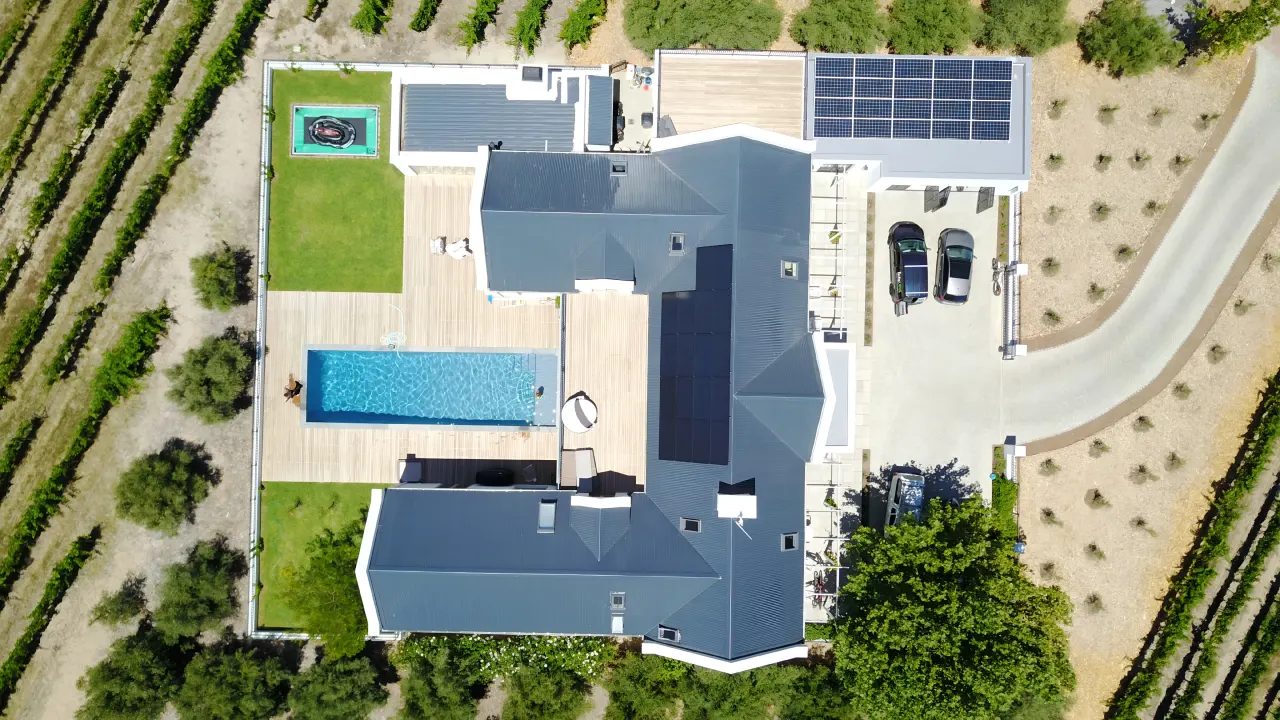
The transition to renewable energy has become an economic imperative for businesses across Southern Africa, yet the upfront capital required for solar installations remains a significant barrier. Solar funding mechanisms have evolved considerably, offering commercial, industrial, and residential clients pathways to adopt photovoltaic technology without depleting capital reserves. Among these financing solutions, structured five-year models have emerged as particularly attractive, balancing affordability with rapid asset ownership whilst delivering immediate operational savings.
Understanding Modern Solar Funding Structures
Solar funding encompasses a diverse ecosystem of financial instruments designed to remove the capital barrier to renewable energy adoption. These mechanisms range from traditional loans and leases to innovative power purchase agreements and performance-based contracts. Each model serves different client needs, risk profiles, and balance sheet considerations.
The fundamental shift in solar financing approaches reflects broader changes in how businesses view renewable energy investments. What was once considered a long-term capital expenditure with uncertain returns has transformed into a strategic operational decision with quantifiable financial benefits from day one.
Capital Purchase versus Financed Solutions
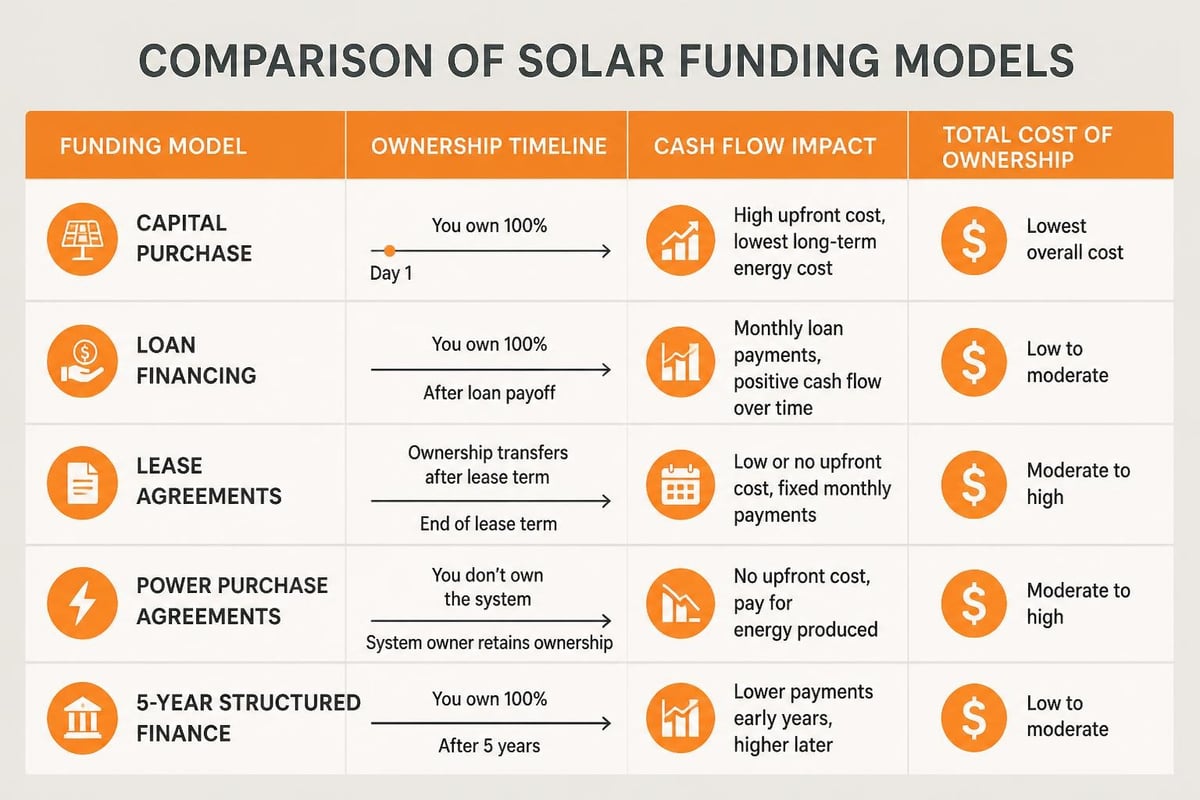
The traditional capital purchase model requires full upfront payment, providing immediate asset ownership and maximum long-term savings. However, this approach ties up significant working capital that many businesses prefer to allocate elsewhere. For organisations with strong balance sheets and available cash reserves, outright purchase delivers the lowest total cost of ownership over a system's 25-year lifespan.
Financed solutions fundamentally alter this equation by converting large capital expenditure into manageable operational expenses. Monthly payments replace the upfront investment, preserving liquidity whilst delivering immediate electricity cost reductions. The key advantage lies in positive cash flow from month one, as solar-generated savings typically exceed financing costs.
| Funding Model | Upfront Cost | Monthly Payment | Ownership Timeline | Tax Benefits | Best For |
|---|---|---|---|---|---|
| Capital Purchase | 100% | None | Immediate | Full depreciation | Cash-rich entities |
| 5-Year Finance | Minimal deposit | Fixed installment | 5 years | Depreciation | Growth businesses |
| Lease | None | Fixed rental | Never (lease only) | Lessor claims | Capex-constrained |
| PPA | None | Per-kWh charge | Optional buyout | Developer claims | Risk-averse clients |
The Five-Year Funding Model Explained
The five-year solar funding model represents an optimal middle ground between affordability and rapid ownership. This structure typically requires a modest initial deposit, followed by 60 equal monthly payments that cover both the system cost and financing charges. Upon completion, the client owns the asset outright with potentially 20 years of maintenance-free electricity generation remaining.
What distinguishes this model is its alignment with business planning cycles and tax depreciation schedules. Most commercial solar systems qualify for accelerated depreciation, allowing businesses to claim significant tax benefits whilst simultaneously reducing operational costs. The combination creates a compelling financial case that improves return on investment considerably.
How Structured Financing Works in Practice
A typical five-year solar funding arrangement begins with a comprehensive energy audit and feasibility study. Engineers assess the client's electricity consumption patterns, roof or ground space availability, grid connection requirements, and anticipated energy savings. This analysis forms the basis for system sizing and financial modelling.
Once the proposal is accepted, the client pays an initial deposit, often between 10% and 20% of the total project cost. The financing institution funds the balance, enabling immediate installation. From day one, the solar system generates electricity, reducing grid consumption and lowering utility bills.
The monthly financing payment remains fixed throughout the term, providing budget certainty. Crucially, commercial solar installations are designed to ensure that monthly savings exceed the financing cost, delivering positive cash flow immediately. After 60 months, all payments cease whilst the system continues generating free electricity for decades.
Cash Flow Advantages for Commercial Clients
The financial dynamics of five-year solar funding create multiple cash flow benefits. Consider a manufacturing facility with monthly electricity costs of R150,000. A solar installation might reduce this by 60%, saving R90,000 monthly. If the financing payment is R65,000 monthly, the net monthly benefit is R25,000 in positive cash flow from installation.
Over five years, this generates R1.5 million in cumulative savings whilst paying off the system. From year six onwards, the full R90,000 monthly saving flows directly to the bottom line. Over 25 years, total savings could exceed R20 million, far outweighing the financed system cost.
This cash flow structure proves particularly valuable for growth-oriented businesses that need to preserve working capital for core operations whilst still reducing overhead costs. The model eliminates the opportunity cost of large upfront investments whilst accelerating payback periods through tax benefits and energy savings.
Comparing Solar Funding Options Across Markets
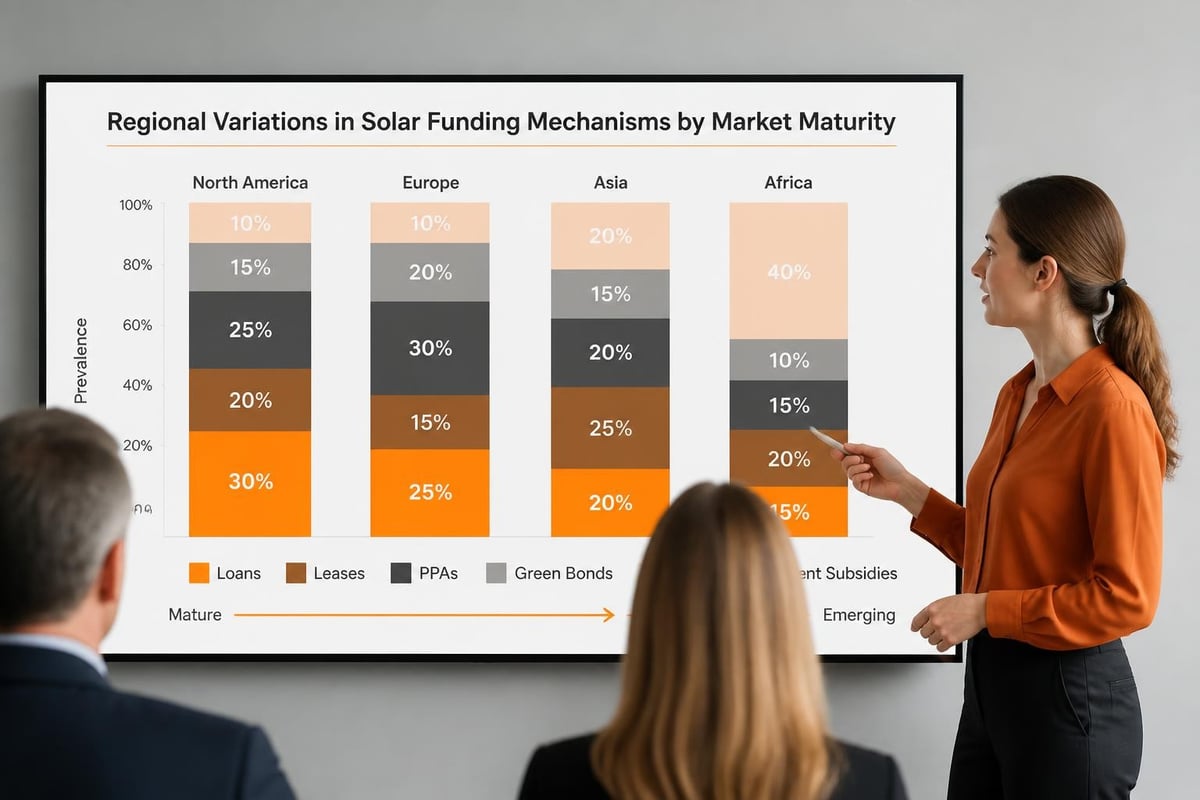
Global investment in solar projects exceeded $400 billion in 2025, reflecting the maturation of diverse financing mechanisms worldwide. Different markets have developed distinct preferences based on regulatory environments, tax structures, and capital availability.
In developed markets, loan financing has increasingly displaced third-party ownership models as consumers and businesses recognise the value of asset ownership. In emerging markets, power purchase agreements remain popular due to limited access to affordable credit and risk aversion among potential adopters.
Innovative Financial Instruments Supporting Solar
Beyond traditional loans and leases, innovative financial mechanisms are mobilising unprecedented capital for solar deployment. Green bonds have emerged as a significant funding source, particularly for large-scale utility projects and commercial portfolios. These debt instruments specifically finance environmentally beneficial projects, attracting ESG-focused investors seeking both returns and impact.
Public-private partnerships blend government support with private capital, reducing project risk and improving returns for developers. In Southern Africa, these structures are increasingly common for large commercial installations and community solar initiatives. Government subsidies, tax credits, and feed-in tariffs further enhance project economics, though these vary considerably by jurisdiction.
Blended finance models combine concessional capital from development finance institutions with commercial investment, making solar viable in markets where traditional financing remains expensive or unavailable. International financial institutions have deployed billions in green bonds to support renewable energy projects across developing economies, including numerous solar installations.
Risk Mitigation in Solar Funding Arrangements
Financial institutions evaluate solar funding applications through multiple risk lenses: technology performance risk, counterparty creditworthiness, regulatory changes, and equipment warranty reliability. Understanding these considerations helps clients structure proposals that secure favourable terms.
Technology and Performance Guarantees
Modern solar panels carry 25-year performance warranties, typically guaranteeing 80-85% of original output at end of life. Inverters, the system's other critical component, usually include 10-year warranties with optional extensions. These manufacturer commitments provide lenders with confidence in long-term system performance.
Many funding arrangements include performance guarantees from the installer, ensuring minimum energy production levels. If the system underperforms, the installer compensates the client for lost savings. This transfers performance risk from the client to the engineering company, further de-risking the investment.
- Equipment warranties: Panel manufacturers guarantee 25-year performance
- Installation quality: Workmanship warranties typically extend 5-10 years
- Performance guarantees: Installers commit to minimum energy production
- Insurance coverage: Property and liability insurance protect asset value
- Monitoring systems: Real-time performance tracking identifies issues early
Creditworthiness and Approval Criteria
Solar funding providers assess client creditworthiness similarly to other commercial lending. Strong financial statements, consistent revenue, manageable debt levels, and positive credit history all improve approval odds and financing terms. However, solar-specific factors also influence decisions.
The presence of a long-term power purchase agreement or committed offtake arrangement significantly de-risks the investment. If a client can demonstrate stable electricity demand and operational continuity, lenders gain confidence that financing payments will be met. Property ownership where the system is installed also provides security.
For clients with less established credit histories, larger deposits or guarantees may be required. Some funders offer graduated payment structures that align with business growth trajectories, starting with lower payments that increase over time as the business expands and savings accumulate.
Tax Incentives and Depreciation Benefits
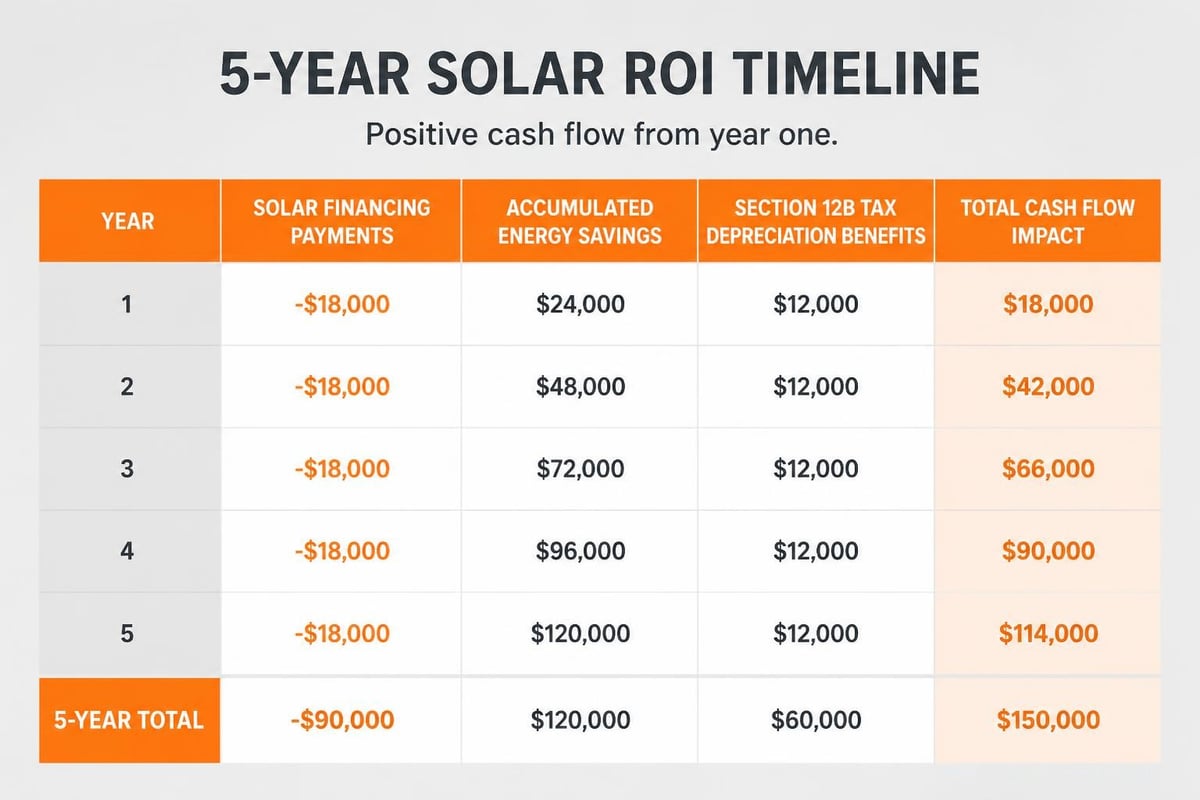
Solar investments qualify for various tax benefits that significantly enhance returns. In South Africa, businesses can claim accelerated depreciation under Section 12B of the Income Tax Act, allowing 50% of the asset value to be depreciated in year one, with the balance spread over the remaining useful life.
This creates substantial tax savings in the early years of ownership, improving cash flow precisely when financing payments are highest. For a R5 million solar system, the first-year depreciation deduction could reduce taxable income by R2.5 million, saving R700,000 in corporate tax at the 28% rate.
When combined with ongoing energy savings and financing payments, the tax benefit can transform marginal projects into highly attractive investments. Comprehensive financial modelling should incorporate these benefits to present the true cost of ownership and payback period.
Integration with ESG and Net Zero Strategies
Solar funding decisions increasingly align with broader environmental, social, and governance commitments. Organisations pursuing Net Zero targets require substantial renewable energy capacity, and financed solutions enable faster deployment than waiting to accumulate capital reserves.
Reporting on ESG metrics and carbon reduction has become essential for many businesses, particularly those with international supply chains or investor obligations. Solar installations deliver quantifiable carbon avoidance, providing concrete evidence of climate action that strengthens sustainability reports and stakeholder confidence.
The five-year funding model supports ambitious renewable energy targets by enabling parallel deployment across multiple sites or facilities. Rather than installing solar capacity sequentially as capital becomes available, businesses can finance installations simultaneously, accelerating their transition timeline and multiplying carbon reduction impacts.
Selecting the Right Solar Funding Partner
Not all solar funding providers offer equivalent terms, service levels, or technical expertise. Selecting the right partner requires evaluating several critical factors beyond headline interest rates.
Comprehensive Service Integration
The most valuable solar funding arrangements integrate financing with engineering, installation, monitoring, and maintenance services. This single-point accountability ensures that system performance meets expectations and that any issues are resolved quickly without disputes between separate contractors.
Companies offering comprehensive renewable energy solutions including financial modelling, grid applications, project management, and ongoing operations provide superior value. Their intimate understanding of system performance enables more accurate financial projections and faster issue resolution.
When financing, installation, and maintenance sit under one roof, clients benefit from aligned incentives. The provider succeeds only when the system performs as promised, creating natural motivation to deliver quality workmanship, optimal component selection, and responsive service.
Transparency in Pricing and Terms
Solar funding proposals should clearly itemise all costs: equipment, installation labour, grid connection fees, commissioning, monitoring systems, and financing charges. Hidden fees, escalating payment structures, or unclear ownership transfer terms signal potential problems.
Request detailed cash flow projections showing monthly electricity savings, financing payments, net cash flow, cumulative savings, and tax benefits. Compare multiple proposals on a total-cost-of-ownership basis over 25 years, not just monthly payment amounts.
Understand what happens if the business relocates or requires system expansion. Quality funding agreements include provisions for early settlement, system transfers, and capacity additions without punitive charges.
Implementation Timeline and Milestones
A typical five-year funded solar project progresses through several distinct phases, each with specific milestones and approval requirements.
- Initial consultation and energy audit (1-2 weeks): Analyse consumption patterns and site suitability
- System design and financial proposal (1-2 weeks): Engineer optimal configuration and prepare funding application
- Financing approval and deposit payment (2-4 weeks): Secure credit approval and remit initial payment
- Grid application and regulatory approvals (4-8 weeks): Submit applications to utility and municipal authorities
- Procurement and installation (4-8 weeks): Order equipment and complete physical installation
- Commissioning and handover (1 week): Test system performance and train client personnel
- Monthly operation (60 months): Generate electricity, monitor performance, make financing payments
The entire process from initial consultation to operational system typically spans three to six months, depending primarily on grid application processing times. Once operational, systems require minimal intervention beyond periodic cleaning and annual inspections.
Maintenance and Performance Optimisation
Five-year funded systems benefit from comprehensive maintenance programmes that protect both the client's investment and the lender's security. Structured maintenance ensures optimal performance, maximising energy generation and financial returns throughout the financing period and beyond.
Professional maintenance includes regular cleaning to remove dust and debris that reduces panel efficiency, thermal imaging to identify failing cells before they impact output, inverter health monitoring, and electrical testing to verify safe operation.
Many funding arrangements bundle maintenance costs into the monthly payment, providing predictable expenses and ensuring the system receives professional care. This approach typically proves more cost-effective than ad-hoc maintenance whilst guaranteeing consistent performance.
- Quarterly cleaning: Maintains panel efficiency at optimal levels
- Annual inspections: Comprehensive health checks and electrical testing
- Real-time monitoring: Immediate alerts for performance deviations
- Thermal imaging: Identifies potential failures before they impact output
- Warranty management: Processes claims efficiently when issues arise
Future-Proofing Your Solar Investment
The five-year funding model creates natural opportunities to reassess and expand renewable energy capacity as technology advances and business needs evolve. By year five, panel efficiency will have improved, battery storage costs will have declined further, and new technologies may offer additional optimisation opportunities.
Many businesses use the financing completion milestone to evaluate system expansion, adding capacity to cover growth in electricity consumption or integrating battery storage for enhanced resilience. Because the original system is paid off, it generates free electricity that can fund additional investments without requiring new capital.
The modular nature of solar technology enables staged expansion aligned with business growth. Rather than over-sizing initial installations, businesses can right-size for current needs then add capacity as requirements increase, optimising capital efficiency whilst maintaining continuous coverage.
Solar funding through structured five-year models has transformed renewable energy from a capital-intensive luxury into an accessible operational decision that improves cash flow from day one whilst supporting ESG commitments. By understanding the financial mechanics, tax benefits, and service integration options available, businesses can select solutions that optimise both environmental and economic returns. INFOLED offers comprehensive solar financing alongside engineering, installation, monitoring, and maintenance services, enabling commercial, industrial, and residential clients across Southern Africa to reduce electricity costs and improve energy resilience through intelligent renewable solutions tailored to their specific operational requirements.
Next Step
Need help with your energy strategy?
Speak to INFOLED about solar, storage, EV charging, service agreements or system performance.