
South African businesses face mounting pressure from escalating electricity tariffs, persistent load shedding, and growing environmental responsibility. A solar hybrid system offers a compelling solution that combines photovoltaic generation, battery energy storage, and grid connectivity to deliver reliable, cost-effective power whilst supporting sustainability goals. This integrated approach has become increasingly vital as commercial and industrial operations seek energy independence without sacrificing reliability or breaking budgets.
Understanding the Solar Hybrid System Architecture
A solar hybrid system represents an intelligent integration of multiple power sources designed to optimise energy availability, cost, and resilience. Unlike purely off-grid installations that rely solely on solar generation and batteries, or simple grid-tied systems that offer no backup capability, hybrid configurations leverage the strengths of each component.
The core architecture typically includes solar photovoltaic arrays, battery energy storage systems, inverter technology, and grid connection infrastructure. These elements work together through sophisticated control systems that determine the most economical and reliable power source at any given moment.
Key Components and Their Roles
Solar photovoltaic arrays generate electricity during daylight hours, with production varying based on weather conditions, panel orientation, and seasonal changes. In Gauteng, Johannesburg businesses might experience different generation profiles compared to coastal facilities in Cape Town due to climatic variations.
Battery energy storage systems store excess solar generation for use during evening peaks, load shedding events, or periods when grid electricity costs reach premium time-of-use tariff bands. Modern lithium-ion batteries provide excellent cycle life and depth of discharge capabilities.
Hybrid inverters manage the flow of electricity between solar arrays, batteries, grid connection, and facility loads. These intelligent devices determine whether to charge batteries, export power, or draw from the grid based on programmed priorities and real-time conditions.
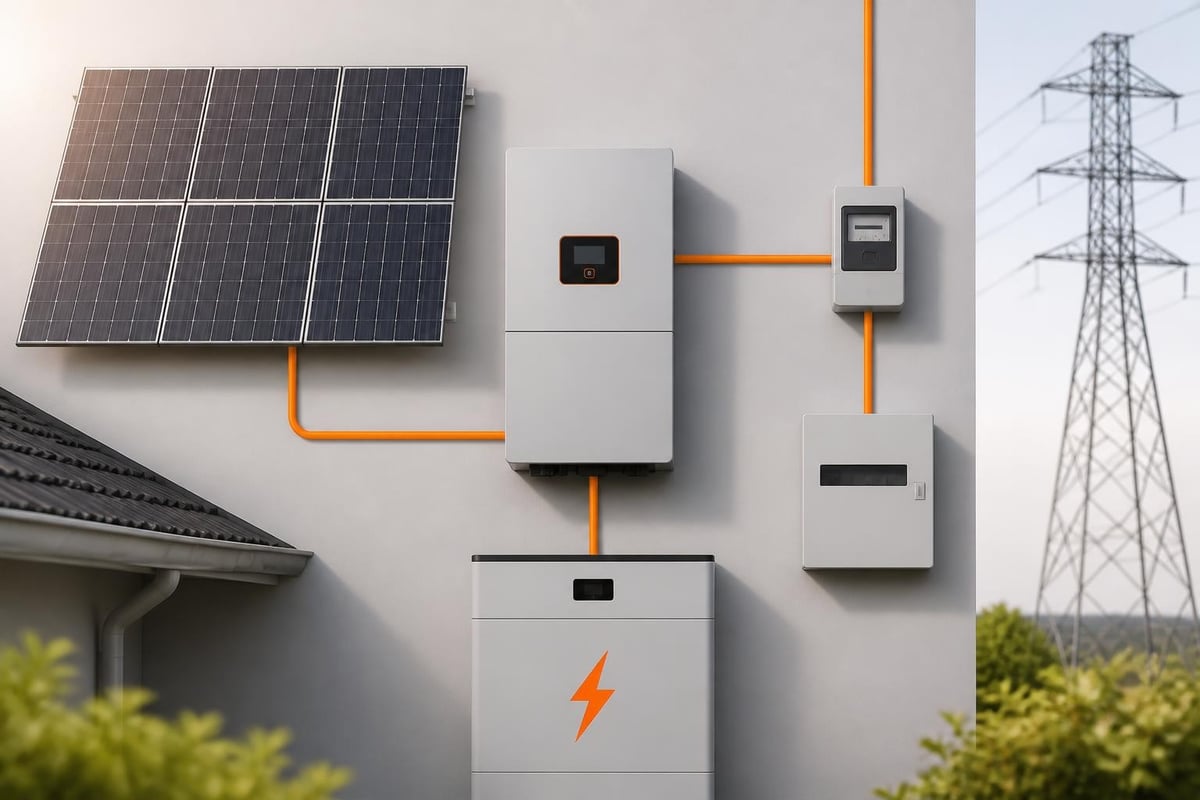
The integration of solar systems requires careful consideration of electrical infrastructure, protection equipment, and control strategies to maintain system stability and safety.
Operational Modes and Energy Management
Solar hybrid systems operate across multiple modes, automatically transitioning based on availability, demand, and economic factors. This flexibility distinguishes hybrid configurations from simpler renewable energy installations.
Primary Operating Modes
| Operating Mode | Energy Source Priority | Typical Application |
|---|---|---|
| Solar Direct | Solar → Load → Battery → Grid | Daytime generation periods |
| Battery Support | Battery → Solar → Grid | Evening peak demand |
| Grid Backup | Grid → Battery → Solar | Night-time or low generation |
| Load Shedding | Battery → Solar → Isolated | Utility outage protection |
During standard operation with adequate solar generation, the system powers facility loads directly from photovoltaic production. Excess generation charges batteries or exports to the grid if net metering agreements exist. This maximises the utilisation of free solar energy whilst minimising grid dependence.
When solar production diminishes in late afternoon but facility demand remains high, batteries discharge to cover loads, avoiding expensive peak-period grid electricity. This demand management capability delivers substantial savings for operations on Eskom's Megaflex or time-of-use tariff structures.
Intelligent Energy Optimisation
Advanced solar hybrid systems incorporate predictive algorithms that analyse weather forecasts, historical consumption patterns, and tariff structures. These systems pre-charge batteries during low-cost periods, reserve capacity for anticipated load shedding, and optimise export decisions based on feed-in tariff rates.
For manufacturing facilities in KwaZulu-Natal's industrial corridors or distribution centres in the Western Cape, this intelligent management translates to reduced demand charges, lower energy costs, and uninterrupted operations during grid instability.
The design and application of solar hybrid systems requires detailed load analysis, generation modelling, and financial optimisation to achieve optimal performance and return on investment.
Financial Benefits and Return on Investment
The economic case for solar hybrid systems in South Africa has strengthened considerably as technology costs decline, electricity tariffs escalate, and load shedding impacts business continuity. Understanding the complete financial picture requires examining both direct savings and avoided costs.
Direct Cost Reduction
Solar generation displaces grid electricity consumption, with savings calculated against applicable tariff rates. A commercial facility consuming 50,000 kWh monthly at an average rate of ZAR 2.20 per kWh faces monthly electricity costs exceeding ZAR 110,000. A properly sized solar hybrid system might offset 60-70% of this consumption, generating savings of ZAR 66,000 to ZAR 77,000 monthly.
Battery storage enhances these savings by time-shifting solar generation to peak periods when electricity costs reach ZAR 3.50 per kWh or higher. This arbitrage opportunity adds incremental value beyond simple grid displacement.
- Reduced energy purchases from utility providers
- Lower demand charges through peak shaving capabilities
- Minimised time-of-use premium costs via battery discharge
- Decreased diesel generator expenses during outages
- Potential revenue from excess generation export
Avoided Costs and Business Continuity
Load shedding imposes substantial hidden costs on South African businesses through production losses, equipment damage, and operational disruption. A solar hybrid system with adequate battery capacity maintains critical loads during outages, protecting revenue streams and preventing costly downtime.
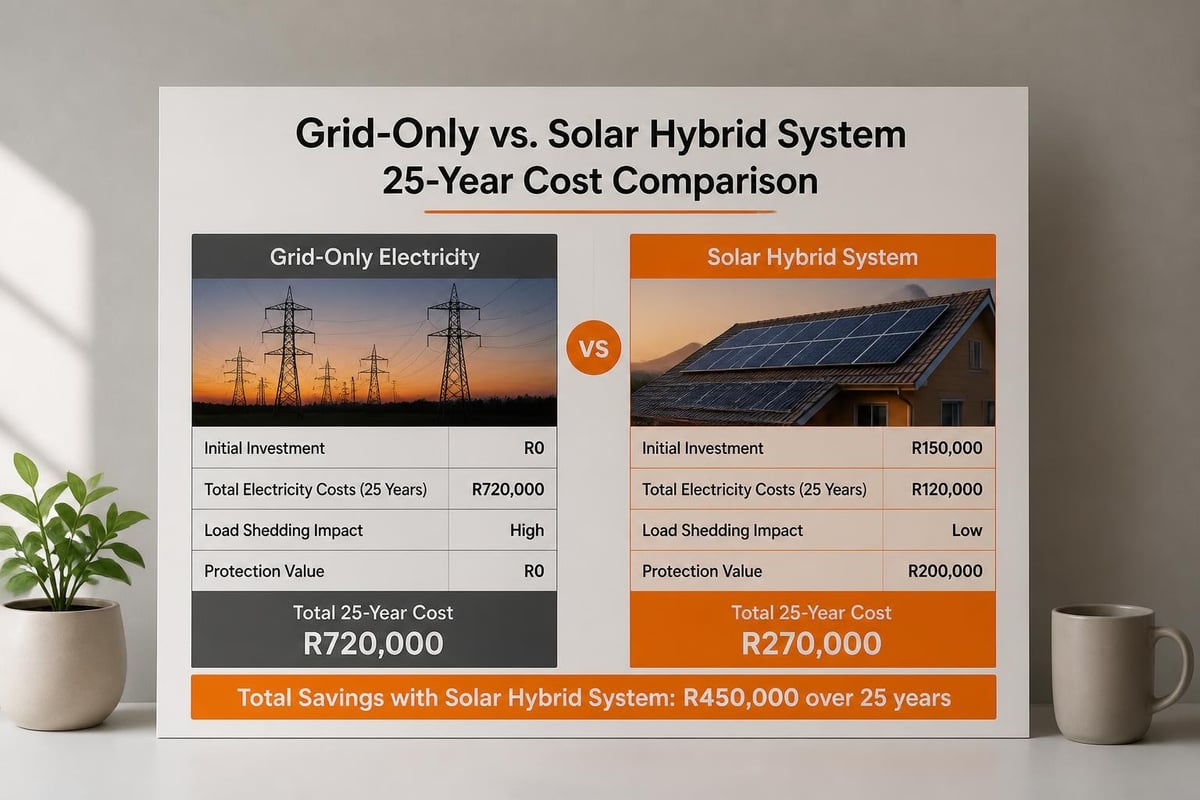
Manufacturing operations might lose ZAR 50,000 to ZAR 200,000 per hour during unplanned shutdowns. Retail facilities experience point-of-sale failures, refrigeration losses, and customer dissatisfaction. Data centres and server rooms face catastrophic risks from sudden power interruptions.
The payback period for solar hybrid installations typically ranges from 4 to 7 years depending on electricity consumption patterns, system sizing, and available incentives. Companies leveraging the Section 12B tax allowance for renewable energy assets can accelerate returns through first-year depreciation benefits.
Design Considerations for Commercial Applications
Successful solar hybrid system implementation requires thorough planning, accurate sizing, and integration with existing electrical infrastructure. Commercial and industrial projects demand different approaches compared to residential installations due to scale, complexity, and operational requirements.
Load Profile Analysis
Understanding consumption patterns forms the foundation of effective system design. Detailed interval data reveals peak demands, base loads, seasonal variations, and opportunities for optimisation. Facilities with daytime-heavy consumption achieve better solar utilisation than those with predominantly evening or night shifts.
Agricultural operations pumping irrigation water during daylight hours represent ideal solar hybrid candidates. Cold storage facilities with 24-hour refrigeration loads benefit from battery storage to manage overnight consumption. Office buildings typically show strong alignment between solar generation and occupancy-driven demand.
Professional renewable energy engineering services conduct comprehensive load studies using smart metering data, identifying consumption patterns and designing systems that maximise financial returns whilst ensuring adequate backup capacity.
System Sizing Parameters
- Solar array capacity based on available roof or ground space, shading analysis, and energy offset targets
- Battery storage duration determined by critical load requirements and desired autonomy
- Inverter rating sized for peak loads with appropriate safety margins
- Grid connection capacity considering existing infrastructure and utility requirements
The table below illustrates sizing considerations for different facility types:
| Facility Type | Typical Solar Size | Battery Capacity | Primary Benefit |
|---|---|---|---|
| Manufacturing Plant | 250-500 kWp | 500-1000 kWh | Demand reduction, continuity |
| Distribution Centre | 150-300 kWp | 300-600 kWh | Peak shaving, backup |
| Office Complex | 100-200 kWp | 200-400 kWh | Cost savings, ESG |
| Agricultural Operation | 50-150 kWp | 100-300 kWh | Daytime pumping, resilience |
Space constraints often limit rooftop solar installations, particularly in urban areas where building footprints may not accommodate desired system sizes. Ground-mounted arrays, carport structures, or hybrid solar configurations across multiple buildings can overcome these limitations.
Technical Integration and Grid Compliance
Installing a solar hybrid system involves more than mounting panels and connecting batteries. South African regulations, utility requirements, and electrical standards govern system design, protection schemes, and grid interconnection procedures.
Regulatory Framework
The National Energy Regulator of South Africa (NERSA) oversees embedded generation registration for systems exceeding 1 MVA. Smaller installations still require utility notification and compliance with grid connection codes. Municipal electricity departments maintain varying requirements, with some metros implementing streamlined approval processes whilst others impose more complex bureaucratic procedures.
Grid connection applications must demonstrate adequate protection against islanding, voltage fluctuations, and fault conditions. Anti-islanding protection prevents solar systems from energising grid infrastructure during outages, protecting utility workers and maintaining system stability.
Protection and Safety Systems
Solar hybrid systems incorporate multiple protection layers:
- AC and DC isolation enabling safe maintenance and emergency disconnection
- Overcurrent protection preventing equipment damage from fault currents
- Earth fault monitoring detecting insulation failures and ground faults
- Arc fault detection identifying dangerous arcing conditions in DC circuits
- Surge protection safeguarding against lightning and switching transients
These protection systems must coordinate with existing facility electrical infrastructure and utility protection schemes. Proper selectivity ensures that faults isolate only affected circuits rather than causing widespread shutdowns.
The solar photovoltaic system design basics established by international standards provide frameworks for safe, reliable installations that meet both performance and safety objectives.
Performance Monitoring and Optimisation
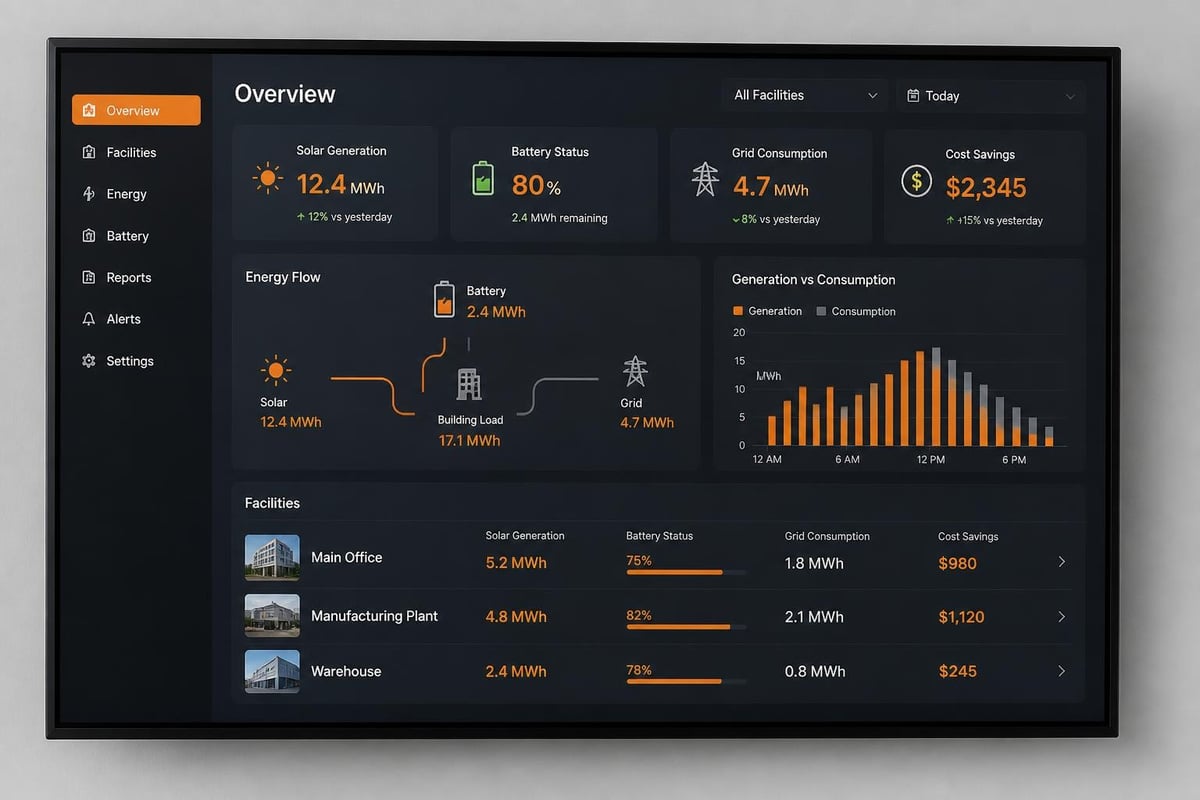
A solar hybrid system represents a significant capital investment requiring ongoing monitoring to ensure optimal performance, identify degradation, and validate financial returns. Modern monitoring platforms provide real-time visibility into generation, consumption, battery state, and grid interaction.
Key Performance Indicators
Effective monitoring tracks multiple metrics that reveal system health and economic performance:
Energy production metrics compare actual generation against modelled predictions, identifying underperformance from shading, soiling, or equipment issues. Performance ratios above 80% indicate well-designed, properly maintained installations.
Battery performance indicators monitor cycle counts, depth of discharge patterns, state of health, and charging efficiency. Lithium-ion batteries typically maintain 80% capacity after 5,000 to 10,000 cycles depending on chemistry and usage patterns.
Financial metrics calculate cost per kWh, grid offset percentages, demand charge savings, and return on investment tracking. These measurements validate business case assumptions and identify optimisation opportunities.
Predictive Maintenance and Optimisation
Advanced monitoring systems leverage artificial intelligence to predict component failures, optimise battery cycling strategies, and recommend operational adjustments. Thermal imaging inspections identify hot spots in panel strings or connection points before failures occur.
Hybrid power systems benefit from sophisticated control algorithms that continuously adapt to changing conditions, learning from historical patterns to improve future decision-making and maximise economic returns.
South African conditions present unique challenges including dust accumulation from mining activities, coastal salt corrosion, and extreme temperature variations. Regular maintenance schedules addressing these factors preserve system performance and extend equipment lifespan.
Environmental Impact and Sustainability Benefits
Beyond financial returns, solar hybrid systems deliver measurable environmental benefits that support corporate sustainability objectives, ESG reporting requirements, and South Africa's climate commitments under the Paris Agreement.
Carbon Emission Reductions
South Africa's electricity grid remains heavily dependent on coal-fired generation, producing approximately 0.95 kg of CO₂ per kWh. A commercial solar hybrid system offsetting 500,000 kWh annually prevents roughly 475 tonnes of carbon dioxide emissions, equivalent to removing 100 passenger vehicles from roads for one year.
These reductions contribute directly to Scope 2 emissions decreases in corporate carbon accounting frameworks. Companies pursuing net zero targets or participating in the Carbon Disclosure Project find solar hybrid systems essential for demonstrating credible decarbonisation progress.
Resource Conservation and Circular Economy
Solar energy generation consumes no water during operation, contrasting sharply with coal and nuclear power plants requiring substantial water resources for cooling. In water-scarce South Africa, this advantage carries particular significance for sustainable development.
Modern solar panels and batteries incorporate recyclable materials including aluminium, glass, silicon, and lithium. End-of-life management programmes ensure responsible disposal and material recovery, supporting circular economy principles and reducing mining impacts.
The complementarity of renewable energy sources demonstrates how hybrid systems optimise resource utilisation whilst minimising environmental footprints across the complete energy value chain.
Future Developments and Technology Trends
Solar hybrid system technology continues evolving rapidly, with emerging innovations promising enhanced performance, reduced costs, and expanded capabilities. South African businesses considering investments should understand these developments to future-proof installations.
Battery Technology Advancements
Next-generation battery chemistries including lithium iron phosphate (LFP) and sodium-ion technologies offer improved safety, longer cycle life, and reduced dependence on scarce materials like cobalt. These developments will likely decrease storage costs by 30-40% over the coming five years.
Solid-state batteries promise even greater energy density and safety improvements, though commercial availability for stationary storage applications remains several years distant. Current lithium-ion technology continues improving incrementally through manufacturing optimisation and economies of scale.
Vehicle-to-Grid Integration
Electric vehicle adoption creates opportunities for bidirectional charging systems that leverage vehicle batteries as distributed storage assets. Commercial fleets transitioning to electric vehicles might integrate these mobile batteries into facility energy management strategies, effectively expanding storage capacity without dedicated battery investments.
The technical specifications for solar integration continue evolving to accommodate emerging technologies and use cases, ensuring standards keep pace with innovation whilst maintaining safety and reliability.
Artificial Intelligence and Optimisation
Machine learning algorithms increasingly drive solar hybrid system operation, predicting generation patterns, anticipating consumption needs, and optimising battery dispatch decisions. These systems learn from weather patterns, occupancy data, and grid conditions to maximise economic returns automatically.
Predictive capabilities extend to maintenance scheduling, component replacement timing, and performance degradation forecasting. This intelligence reduces operational costs whilst improving reliability and extending asset lifespans.
Implementation Strategies for Commercial Facilities
Transitioning to a solar hybrid system requires careful planning, stakeholder alignment, and phased implementation strategies that minimise disruption whilst delivering early wins. Commercial organisations should approach these projects systematically to ensure successful outcomes.
Project Development Phases
Feasibility assessment establishes technical viability, financial returns, and alignment with organisational objectives. Energy audits quantify consumption patterns, identify efficiency opportunities, and determine appropriate system sizing parameters.
Financial structuring explores capital purchase, operating leases, power purchase agreements, and alternative funding mechanisms. South African businesses increasingly leverage third-party ownership models that eliminate upfront capital requirements whilst delivering immediate savings.
Design and engineering translates conceptual layouts into detailed electrical drawings, structural calculations, and procurement specifications. Professional engineering ensures compliance with regulations, optimal performance, and safe integration with existing infrastructure.
Installation and commissioning requires coordinated execution across electrical, structural, and communications disciplines. Experienced contractors minimise installation timeframes whilst maintaining safety standards and quality control.
Ongoing operation encompasses monitoring, maintenance, and optimisation activities that preserve performance and maximise investment returns throughout 25-year system lifespans.
Various renewable energy solutions support organisations through each project phase, from initial feasibility through ongoing asset management and performance optimisation.
Selecting the Right Partner and Service Provider
Solar hybrid system success depends heavily on partner selection, with significant variation in capability, experience, and service quality across the South African renewable energy sector. Commercial organisations should evaluate potential providers across multiple dimensions.
Critical Evaluation Criteria
- Engineering capability including in-house design resources and technical expertise
- Installation experience with similar facility types and system scales
- Financial strength ensuring long-term viability for warranty and service obligations
- Monitoring and maintenance capabilities supporting ongoing performance
- Track record evidenced by operational installations and client references
Request detailed case studies from similar applications, reviewing actual performance data rather than theoretical projections. Site visits to operating installations provide valuable insights into installation quality, component selection, and real-world performance.
Service Level Agreements and Performance Guarantees
Comprehensive service level agreements establish clear expectations for system availability, response times, and performance thresholds. Performance guarantees tie contractor compensation to actual generation and savings delivery, aligning incentives between buyer and seller.
Review warranty structures carefully, understanding distinctions between manufacturer component warranties, workmanship guarantees, and performance warranties. Quality providers stand behind installations with robust warranty programmes backed by insurance and financial reserves.
The systematic review of solar-driven systems highlights the importance of proper design, installation quality, and ongoing maintenance in achieving projected performance and financial returns.
Solar hybrid systems represent a transformative opportunity for South African commercial and industrial facilities to achieve energy independence, reduce operating costs, and advance sustainability objectives whilst protecting against grid instability. The combination of proven technology, compelling economics, and operational resilience makes these installations increasingly essential for forward-thinking organisations. INFOLED brings comprehensive renewable energy engineering expertise to help businesses across Southern Africa design, finance, install, and maintain optimised solar hybrid solutions that deliver measurable results aligned with strategic objectives.
Next Step
Need help with your energy strategy?
Speak to INFOLED about solar, storage, EV charging, service agreements or system performance.