

The transition towards electric vehicles across South Africa has accelerated dramatically in 2026, creating unprecedented demand for charging infrastructure that aligns with the nation's renewable energy goals. A solar power ev charger represents the convergence of two transformative technologies: sustainable transportation and clean energy generation. For commercial, industrial, and residential property owners throughout Southern Africa, this integration offers a pathway to significantly reduce operational costs whilst contributing to carbon reduction targets. The ability to generate electricity from photovoltaic panels and direct it immediately to vehicle charging eliminates reliance on grid power during peak tariff periods, creating both financial and environmental benefits.
Understanding Solar Power EV Charger Technology
A solar power ev charger system combines photovoltaic arrays with electric vehicle supply equipment to create an independent or grid-integrated charging solution. The fundamental architecture includes solar panels, inverters, charge controllers, optional battery storage, and the charging station itself.
Core System Components
The photovoltaic array forms the foundation of any solar charging installation. Panel selection depends on available roof or ground space, energy requirements, and budget constraints. Modern monocrystalline panels deliver efficiency ratings exceeding 22%, making them ideal for space-constrained commercial properties in Johannesburg, Cape Town, or Durban.
Inverter technology converts direct current from solar panels into alternating current suitable for EV charging equipment. String inverters suit larger commercial installations, whilst microinverters offer advantages for residential applications or sites with shading challenges.
Key components include:
- Solar photovoltaic panels (monocrystalline or polycrystalline)
- Solar inverters (string, micro, or hybrid)
- Charge controllers for battery integration
- Battery energy storage systems (optional but recommended)
- EV charging equipment (AC Level 2 or DC fast chargers)
- Monitoring and management systems
- Electrical protection and safety equipment
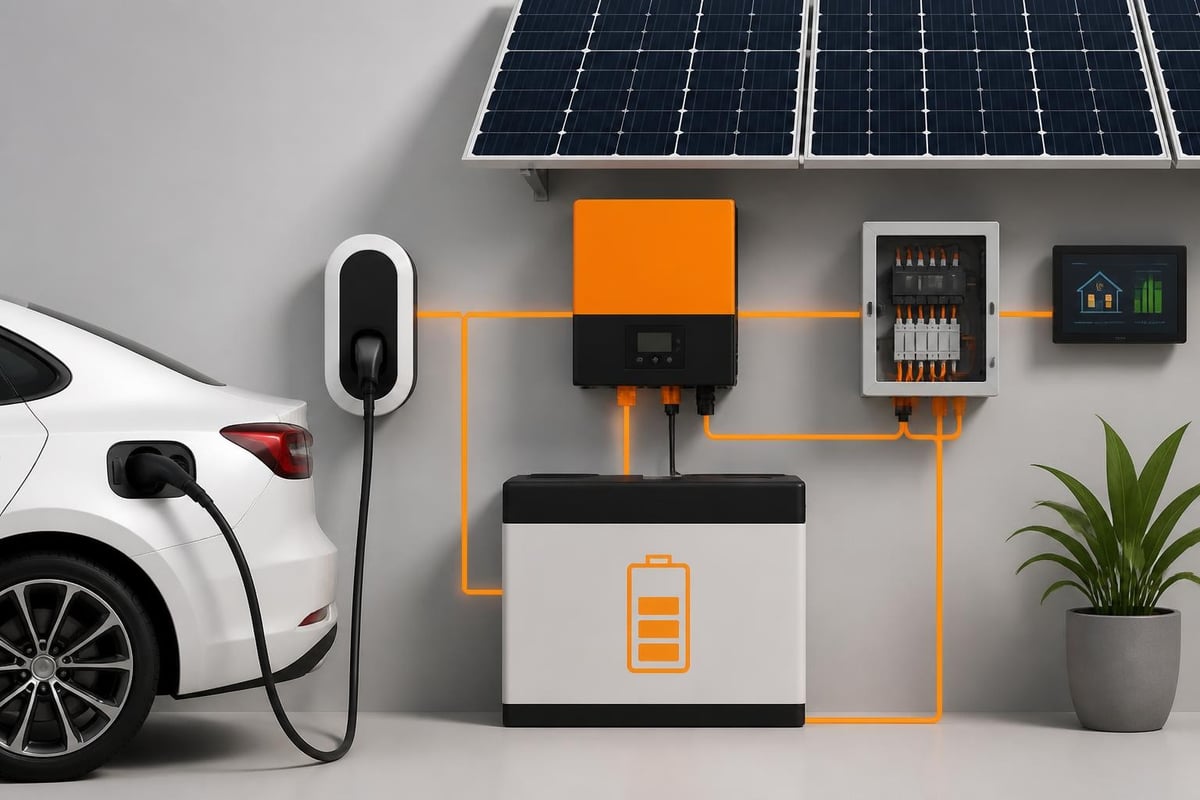
The integration of battery energy storage transforms a basic solar charging setup into a sophisticated energy management platform. Storage capacity allows charging to continue after sunset and provides backup power during load shedding, a critical consideration for South African installations.
Financial Benefits for South African Businesses
The economic case for implementing a solar power ev charger extends beyond simple electricity cost savings. Commercial and industrial facilities face escalating municipal tariff structures, with demand charges and time-of-use pricing creating substantial monthly expenses.
Return on Investment Analysis
| System Size | Initial Investment (ZAR) | Annual Savings (ZAR) | Payback Period |
|---|---|---|---|
| 10 kW Solar + 1 Charger | 180,000 - 250,000 | 35,000 - 48,000 | 4.5 - 6 years |
| 25 kW Solar + 3 Chargers | 420,000 - 580,000 | 85,000 - 115,000 | 4.8 - 6.5 years |
| 50 kW Solar + 6 Chargers | 780,000 - 1,050,000 | 165,000 - 225,000 | 4.7 - 6.4 years |
These figures assume current Eskom and municipal tariff structures as of 2026, with electricity costs continuing to escalate at approximately 8-12% annually. The payback periods improve substantially when factoring in avoided grid infrastructure upgrades and reduced demand charges.
Solar charging installations qualify for accelerated depreciation under Section 12B of the Income Tax Act, allowing businesses to write off renewable energy assets over three years rather than the standard depreciation schedule. This tax benefit significantly improves cash flow during the initial investment period.
Research from the Nature journal on hybrid EV charging stations demonstrates that properly sized solar installations can meet 65-85% of daytime charging demand, with battery storage extending this coverage to 24-hour operations. For fleet operators managing delivery vehicles, shuttles, or service vehicles, this energy independence translates directly to predictable operational costs.
Commercial Implementation Strategies
Deploying a solar power ev charger at commercial facilities requires strategic planning that balances current needs with future expansion capacity. Office parks, shopping centres, and industrial complexes represent ideal candidates for solar charging infrastructure.
Site Assessment and Design Considerations
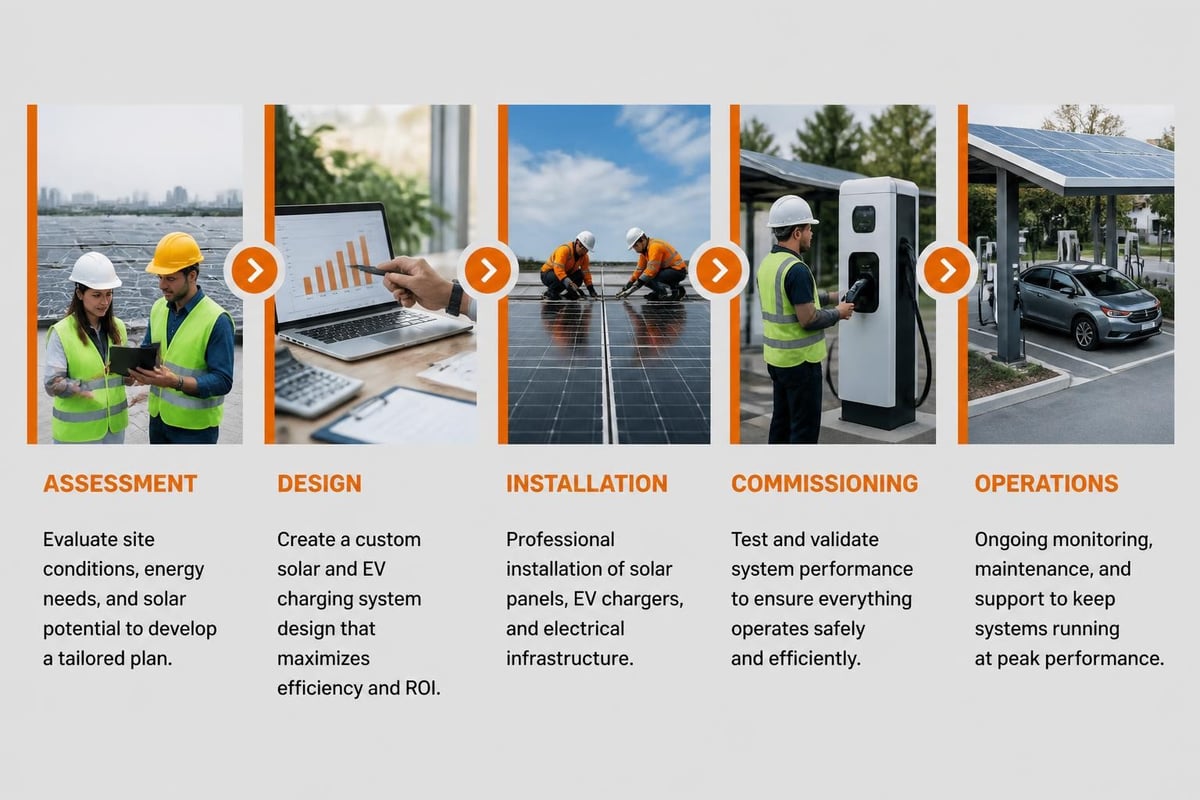
Comprehensive renewable energy engineering services begin with detailed site analysis, including structural assessments for rooftop solar, shading studies, electrical capacity evaluation, and load profiling. Understanding peak charging demand patterns ensures proper system sizing.
Workplace charging programs create employee value propositions whilst optimizing asset utilization. Vehicles typically remain parked for 8-10 hours during business days, allowing slower Level 2 charging that perfectly matches solar generation profiles.
- Conduct energy audit to establish baseline consumption
- Analyse parking patterns and vehicle dwell times
- Evaluate roof or ground-mount solar potential
- Size battery storage based on load shedding frequency
- Select appropriate charging equipment (AC or DC)
- Design electrical infrastructure and grid connection
- Obtain necessary approvals and grid applications
- Install and commission the integrated system
- Implement monitoring systems for performance tracking
- Establish maintenance schedules and service agreements
Multi-tenant commercial properties benefit from smart metering integration that allocates charging costs accurately amongst users. This capability supports revenue generation models where building owners monetize charging infrastructure whilst maintaining transparent billing.
The development of solar-powered charging for heavy-duty trucks along South African freight corridors demonstrates the scalability of this technology beyond passenger vehicles. Logistics companies operating electric delivery fleets can establish charging depots that operate independently of grid constraints.
Residential Solar EV Charging Solutions
Homeowners across Gauteng, Western Cape, and KwaZulu-Natal increasingly view electric vehicles as practical alternatives to petrol or diesel transport. Integrating a solar power ev charger with existing or new residential solar installations creates energy self-sufficiency.
Home Charging System Design
Typical residential EV charging requires 7-11 kW of power delivery, easily accommodated by Level 2 charging equipment. A household solar installation of 8-12 kW capacity can support both home consumption and vehicle charging, particularly when coupled with battery storage.
Time-of-use optimization becomes critical for maximizing solar utilization. Advanced research into domestic EV charging prioritizing solar energy consumption shows that smart scheduling algorithms can increase direct solar charging from 35% to over 75%, dramatically reducing grid dependence.
| Charging Scenario | Grid Electricity Cost | Solar Charging Cost | Monthly Savings |
|---|---|---|---|
| 1,500 km/month (grid only) | R1,850 | - | - |
| 1,500 km/month (70% solar) | R555 | R450 | R845 |
| 1,500 km/month (90% solar) | R185 | R600 | R1,065 |
These calculations assume residential electricity tariffs of R2.85/kWh, vehicle efficiency of 6 km/kWh, and amortized solar generation costs of R0.65/kWh over system lifetime.
Bidirectional charging capability represents an emerging opportunity for residential installations. Field testing of bidirectional EV chargers for demand response demonstrates that vehicles can function as mobile battery storage, feeding power back to homes during peak demand periods or load shedding events.
Grid Integration and Load Management
Sophisticated solar power ev charger installations incorporate grid-interactive capabilities that optimize energy flows between solar generation, battery storage, grid connection, and charging loads. This orchestration maximizes self-consumption whilst maintaining grid stability.
Smart Load Management Technologies
Modern charging infrastructure employs dynamic load balancing that adjusts charging rates based on available solar generation, battery state of charge, grid tariffs, and facility demand. When solar production peaks during midday, charging rates increase automatically. As generation declines or facility loads rise, charging power reduces to prevent grid imports.
The challenge of equitable EV charging infrastructure deployment highlights the importance of accessible public charging networks. Solar-powered public chargers in township areas, shopping districts, and transport hubs can democratize electric vehicle adoption across socioeconomic boundaries.
Grid application requirements for commercial solar EV installations vary by municipality and connection capacity. Properties exceeding 1 MW of combined solar and charging load typically require detailed grid impact studies and utility approval processes.
Essential load management features include:
- Real-time monitoring of solar generation
- Battery state of charge tracking
- Dynamic charging rate adjustment
- Demand response integration
- Time-of-use tariff optimization
- Grid export limitation (where required)
- Load shedding protection protocols
Integration with Battery Energy Storage
Combining a solar power ev charger with battery energy storage creates a resilient microgrid capable of sustained operations during grid outages. This integration proves particularly valuable in South African contexts where load shedding remains an operational reality.
Sizing Battery Capacity
Battery capacity should accommodate typical charging demand during non-solar hours plus essential facility loads during outages. A commercial property with three EV chargers operating simultaneously requires minimum battery capacity of 30-45 kWh to provide two hours of uninterrupted charging.
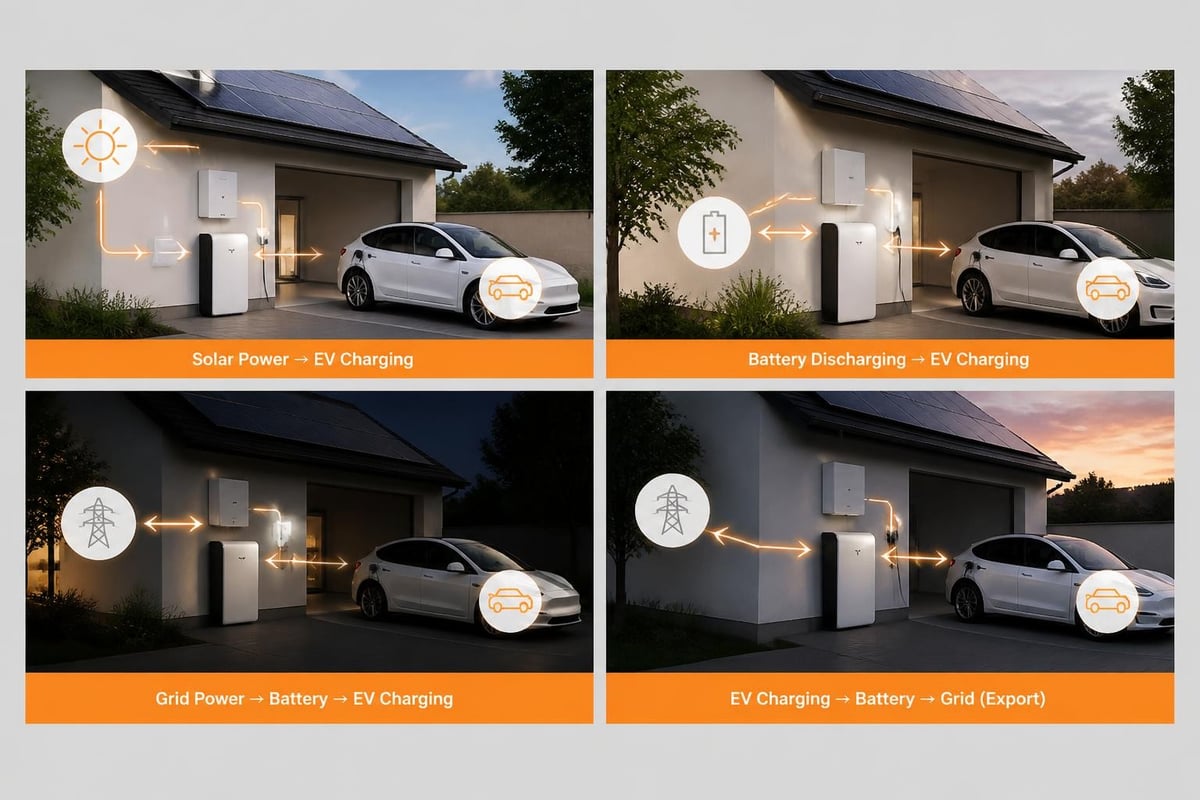
Advanced battery management systems prioritize charging schedules based on predicted solar generation, historical usage patterns, and grid conditions. Machine learning algorithms continuously refine these predictions, improving system efficiency over time.
Peak shaving strategies reduce demand charges by using battery storage and solar generation to flatten facility load profiles. This approach delivers savings beyond direct energy cost reductions, often accounting for 30-40% of total financial benefits.
| Battery Size | EV Charging Capacity | Load Shedding Duration | Investment (ZAR) |
|---|---|---|---|
| 20 kWh | 2 vehicles (partial) | 2-3 hours | 145,000 - 185,000 |
| 50 kWh | 4-5 vehicles (full) | 5-6 hours | 320,000 - 395,000 |
| 100 kWh | 8-10 vehicles (full) | 10-12 hours | 580,000 - 710,000 |
These battery costs include lithium iron phosphate (LFP) technology, which offers superior cycle life and safety characteristics compared to alternative chemistries. LFP batteries typically achieve 6,000-8,000 cycles at 80% depth of discharge, translating to 15-20 years of operational life.
Operational Considerations and Maintenance
Maintaining optimal performance from a solar power ev charger installation requires proactive monitoring and scheduled maintenance protocols. Solar panel degradation, inverter performance, battery health, and charging equipment functionality all demand regular attention.
Monitoring and Performance Optimization
Comprehensive monitoring platforms track system performance in real-time, identifying inefficiencies or component failures before they impact operations. Key performance indicators include solar generation versus prediction, charging session data, battery cycling patterns, and grid interaction metrics.
Professional maintenance programs should encompass:
- Quarterly solar panel cleaning (more frequently in dusty industrial areas)
- Biannual electrical connection inspections
- Annual thermal imaging of all electrical components
- Battery health assessments every six months
- Charging equipment calibration annually
- Software updates for control systems
- Performance audits comparing actual versus expected generation
For businesses seeking comprehensive support, exploring commercial solar maintenance services ensures systems operate at peak efficiency whilst maintaining warranty compliance. Professional service providers offer remote monitoring, preventative maintenance, and rapid response to system faults.
Public Charging Infrastructure Development
The expansion of public solar power ev charger networks across South Africa creates business opportunities for property owners, municipalities, and energy service companies. Shopping centres, fuel station conversions, and municipal parking facilities represent prime locations.
Revenue Generation Models
Public charging installations can operate under various business models. Pay-per-use charging generates direct revenue whilst attracting customers who spend money at retail tenants during charging sessions. Subscription models provide predictable income streams for workplace or residential charging networks.
Spatial optimization research on EV charger deployment strategies suggests that placement decisions should balance coverage maximization, grid capacity constraints, and demographic accessibility. Solar integration reduces grid infrastructure requirements, enabling charger installation in locations where traditional grid connections prove economically unviable.
Charging-as-a-Service models eliminate upfront capital requirements for property owners. Energy service companies install, own, and operate charging infrastructure, sharing revenue with property owners based on utilization rates.
Municipalities exploring public charging networks should prioritize locations serving:
- High-density residential areas without private parking
- Transport interchanges and taxi ranks
- Tourist destinations and hospitality districts
- Government facilities and public buildings
- Retail centres and entertainment venues
Environmental and Sustainability Benefits
Beyond financial returns, implementing a solar power ev charger delivers measurable environmental benefits that support corporate sustainability objectives and contribute to national climate commitments.
Carbon Emissions Reduction
Each kilowatt-hour of solar-generated electricity used for vehicle charging avoids approximately 0.95 kg of CO₂ emissions compared to grid electricity from South Africa's coal-dominated generation mix. A commercial installation supporting 10,000 km of monthly EV travel prevents roughly 1,300 kg of CO₂ emissions monthly, or 15.6 tonnes annually.
These reductions contribute directly to ESG reporting requirements and Net Zero transition plans. Companies tracking Scope 2 emissions find that solar EV charging creates verifiable renewable energy certificates whilst reducing carbon footprint calculations.
Circular economy considerations extend throughout system lifecycles. Modern solar panels maintain 85-90% efficiency after 25 years, whilst lithium batteries can be repurposed for stationary storage applications after automotive use. Responsible recycling programs recover valuable materials from decommissioned components.
Future Developments and Technology Trends
The solar power ev charger sector continues evolving rapidly, with emerging technologies promising enhanced performance and new capabilities. Vehicle-to-grid (V2G) integration, artificial intelligence optimization, and ultra-fast charging represent key development areas.
Emerging Technologies
V2G functionality transforms electric vehicles into mobile energy storage assets that can support grid stability, provide backup power, and generate revenue through ancillary services. South African pilot programs testing V2G capabilities demonstrate potential for reducing peak demand whilst compensating vehicle owners for grid services.
Artificial intelligence applications optimize charging schedules based on weather forecasts, electricity pricing, facility load patterns, and user preferences. These systems learn from historical data to predict optimal charging windows that maximize solar utilization whilst ensuring vehicles achieve required charge levels.
Ultra-fast DC charging powered by oversized solar arrays and substantial battery buffers enables rapid charging comparable to conventional fuel station experiences. These installations require 150-350 kW charging equipment supported by megawatt-scale solar and battery systems.
| Technology | Current Status (2026) | Projected Adoption (2030) | Impact on Solar Integration |
|---|---|---|---|
| Bidirectional Charging | Early deployment | Widespread availability | Increases solar value 25-40% |
| AI Load Management | Commercially available | Standard feature | Improves solar usage 15-25% |
| Ultra-Fast Solar Charging | Pilot installations | Common at public sites | Requires larger solar arrays |
| Wireless EV Charging | Research phase | Niche applications | Simplifies installation |
Advanced forecasting combines meteorological data, satellite imagery, and machine learning to predict solar generation with 95%+ accuracy 48 hours ahead. This precision enables sophisticated pre-conditioning strategies that charge batteries in anticipation of expected demand.
Regulatory Framework and Compliance
Successfully deploying a solar power ev charger in South Africa requires navigating municipal regulations, utility requirements, electrical compliance standards, and safety certifications. Understanding these frameworks prevents costly delays and ensures safe operations.
Permitting and Approvals
Most municipalities require building plan approval for solar installations exceeding 1 kW capacity, with additional requirements for structural modifications or ground-mounted arrays. EV charging equipment installation demands electrical Certificate of Compliance from a registered electrician.
Grid-connected systems require utility notification or formal grid application depending on capacity. Systems exporting excess solar generation to the grid face additional technical requirements including approved inverters, anti-islanding protection, and metering infrastructure.
Safety standards governing solar EV charging installations include SANS 10142-1 for wiring of premises, SANS 10089 for standalone power systems, and IEC 61851 for EV charging equipment. Compliance ensures insurance validity and operational safety.
For detailed guidance on navigating these requirements, the INFOLED articles resource provides insights into regulatory processes and compliance obligations across Southern African jurisdictions.
Professional engineering support streamlines approval processes whilst ensuring installations meet all technical specifications and safety requirements. This expertise proves particularly valuable for complex commercial installations requiring grid impact studies or municipal negotiations.
Implementing a solar power ev charger represents a strategic investment that delivers financial returns, operational resilience, and environmental benefits for South African businesses and property owners. The convergence of declining solar costs, rising electricity tariffs, and expanding electric vehicle adoption creates compelling economics for integrated charging infrastructure. INFOLED designs, finances, installs, and maintains complete solar EV charging solutions tailored to commercial, industrial, and residential applications across Southern Africa, helping clients reduce energy costs whilst advancing sustainability objectives through proven renewable energy technologies.
Next Step
Need help with your energy strategy?
Speak to INFOLED about solar, storage, EV charging, service agreements or system performance.