

The transition to electric vehicles is accelerating across Southern Africa, creating unprecedented demand for commercial EV charging infrastructure. Businesses that deploy charging facilities today position themselves at the forefront of this transformation, capturing new revenue streams whilst supporting sustainability objectives. Whether you operate a retail centre in Sandton, manage a logistics fleet in Durban, or own commercial property in Cape Town, understanding commercial EV charging is no longer optional-it is a strategic imperative for 2026 and beyond.
Understanding Commercial EV Charging Infrastructure
Commercial EV charging encompasses any electric vehicle supply equipment (EVSE) installed at business premises, retail locations, hospitality venues, fleet depots, or multi-tenant properties. Unlike residential charging, which primarily serves individual homeowners, commercial installations must balance multiple stakeholders, higher power demands, and more complex regulatory requirements.
The infrastructure landscape divides into several distinct categories:
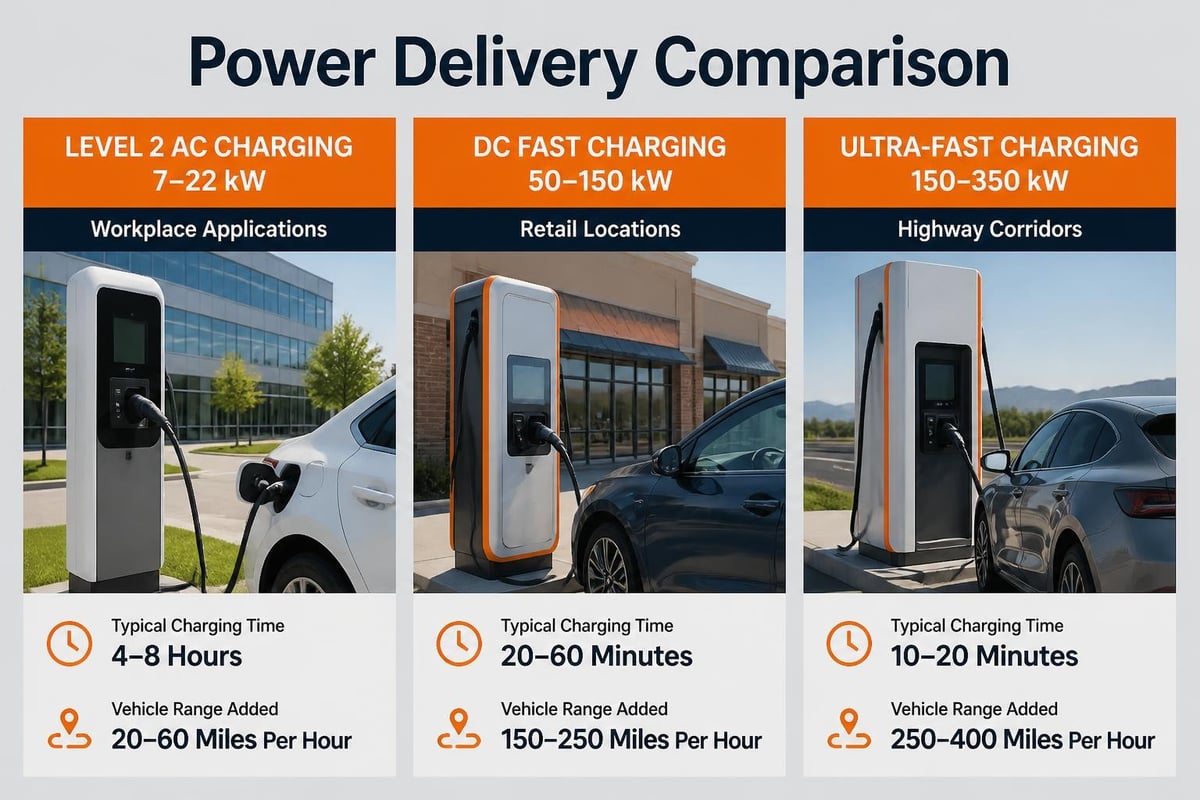
- Workplace charging serves employees during business hours, typically offering Level 2 (AC) charging at 7-22 kW
- Fleet depot charging supports commercial vehicle operations with scheduled high-power charging overnight or during shift changes
- Public retail charging attracts customers to shopping centres, restaurants, and entertainment venues whilst generating ancillary revenue
- Destination charging at hotels, conference centres, and tourist attractions enhances guest experience and competitive positioning
- En-route fast charging provides rapid top-ups for travellers along major corridors, typically 50-350 kW DC installations
Each application demands different technical specifications, business models, and operational strategies. Fleet operators prioritise reliability and cost-per-kilometre, whilst retail venues emphasise customer dwell time and brand perception.
Technical Specifications and Power Requirements
Commercial EV charging systems operate across a spectrum of power levels, each suited to specific use cases and vehicle types. Level 2 AC charging, the workhorse of workplace and destination charging, delivers 7-22 kW through single or three-phase connections. A typical installation adds 40-90 kilometres of range per hour, ideal for vehicles parked for 3-8 hours.
DC fast charging transforms the equation for high-turnover applications. Systems ranging from 50 kW to 350 kW can replenish 80% of battery capacity in 20-45 minutes, depending on vehicle acceptance rates and ambient conditions. The National Fire Protection Association's Article 625 requirements govern safe installation practices, covering conductor sizing, overcurrent protection, disconnecting means, and ventilation considerations for enclosed installations.
Power demand calculations require careful analysis of simultaneous usage patterns. A 20-bay employee car park rarely sees all chargers operating at full capacity simultaneously. Diversity factors typically range from 0.4 to 0.7 for workplace charging, meaning a 20-charger installation rated at 11 kW each requires 88-154 kW of supply capacity rather than the theoretical 220 kW maximum.
Business Models and Revenue Opportunities
Commercial EV charging presents multiple paths to positive returns, extending far beyond simple per-kWh pricing. The optimal model depends on your primary business activity, customer demographics, and strategic objectives.
Employee benefit model: Companies install workplace charging as a recruitment and retention tool, offering free or subsidised charging to staff. This approach supports corporate sustainability commitments whilst avoiding complex billing infrastructure. The cost appears in operational budgets alongside other facilities expenses.
Customer amenity model: Retail venues, restaurants, and hospitality businesses provide complimentary charging to enhance customer experience and extend dwell time. Research indicates EV drivers spend 20-35% longer at locations offering charging facilities, translating to measurably higher transaction values.
Direct revenue model: Charging-as-a-Service operations monetise electricity delivery through per-kWh charges, time-based fees, or subscription packages. Pricing typically ranges from ZAR 3.50 to ZAR 8.50 per kWh at public chargers, depending on power level and location. Fast charging commands premium rates given the convenience factor and capital intensity.
| Business Model | Revenue Source | Typical ROI Period | Best Application |
|---|---|---|---|
| Employee Benefit | Indirect (retention/attraction) | Not applicable (strategic investment) | Corporate offices, business parks |
| Customer Amenity | Increased sales/dwell time | 3-5 years | Retail, hospitality, entertainment |
| Direct Revenue | Per-kWh or subscription fees | 4-7 years | Public sites, fleet services |
| Fleet Operations | Cost savings vs diesel | 2-4 years | Logistics, delivery, transport |
INFOLED's Electric Vehicle Charging Infrastructure solutions integrate load management technology that optimises power distribution across multiple charge points, reducing infrastructure costs whilst maximising utilisation rates and protecting existing electrical systems from overload conditions.
Fleet Electrification Considerations
Commercial fleet operators face unique charging requirements that distinguish them from public or workplace installations. Fleet depot charging strategies must account for predictable route schedules, known daily energy consumption, and the opportunity for managed charging during off-peak periods.
A delivery fleet returning to depot each evening presents ideal conditions for optimised charging. Smart scheduling algorithms can:
- Prioritise vehicles with early morning departures
- Leverage time-of-use tariff structures to minimise electricity costs
- Integrate renewable energy generation when solar PV systems are present
- Coordinate with battery storage to buffer peak demand charges
- Monitor vehicle-specific consumption patterns to identify maintenance issues
The financial case for fleet electrification strengthens considerably when total cost of ownership replaces simple capital comparisons. Electric commercial vehicles eliminate expenditure on diesel (currently averaging ZAR 23-25 per litre across South Africa), reduce scheduled maintenance by 40-50%, and qualify for various incentive programmes.
Grid Integration and Load Management
Successful commercial EV charging deployment requires sophisticated coordination with electrical infrastructure and utility services. Unmanaged charging installations can trigger demand charges exceeding ZAR 600 per kVA monthly, transforming a revenue opportunity into a financial liability.
Load management systems employ real-time monitoring and dynamic power allocation to prevent infrastructure overload. When grid capacity constrains total available power, intelligent controllers adjust individual charger output to maintain safe operation whilst serving maximum vehicles.
Smart Charging Protocols and Interoperability
The Open Charge Point Protocol (OCPP) has emerged as the industry standard for charge point management system communications. OCPP 2.0.1 and the forthcoming 2.1 specification enable sophisticated features including:
- Remote diagnostics and firmware updates
- Transaction authorisation and billing integration
- Smart charging with renewable energy optimisation
- Vehicle-to-grid (V2G) bidirectional power flow
- Plug & Charge authentication via ISO 15118
Interoperability ensures businesses avoid vendor lock-in whilst future-proofing investments. An OCPP-compliant installation can integrate with multiple network operators, payment processors, and energy management platforms as requirements evolve.
ISO 15118 and Plug & Charge capabilities eliminate the need for RFID cards or smartphone applications. The vehicle and charger exchange authentication credentials via the charging cable, automatically initiating sessions and routing payments to pre-registered accounts. This seamless experience mirrors conventional refuelling convenience.
Installation Planning and Site Assessment
Commercial EV charging projects succeed or fail during the planning phase, long before equipment arrives on site. A comprehensive site assessment evaluates electrical capacity, physical layout, access patterns, and regulatory compliance requirements.
Begin with detailed electrical infrastructure analysis:
- Review existing service capacity - Document main switchboard ratings, available breaker positions, and current maximum demand
- Calculate charging load requirements - Determine simultaneous usage factors based on expected vehicle mix and parking duration
- Assess upgrade costs - Identify whether installations require service upgrades, transformer replacement, or utility supply modifications
- Map cable routing - Plan trenching, conduit pathways, and above-ground cable management from distribution boards to charge point locations
- Evaluate earthing and protection - Verify earth electrode systems meet requirements for DC charging installations
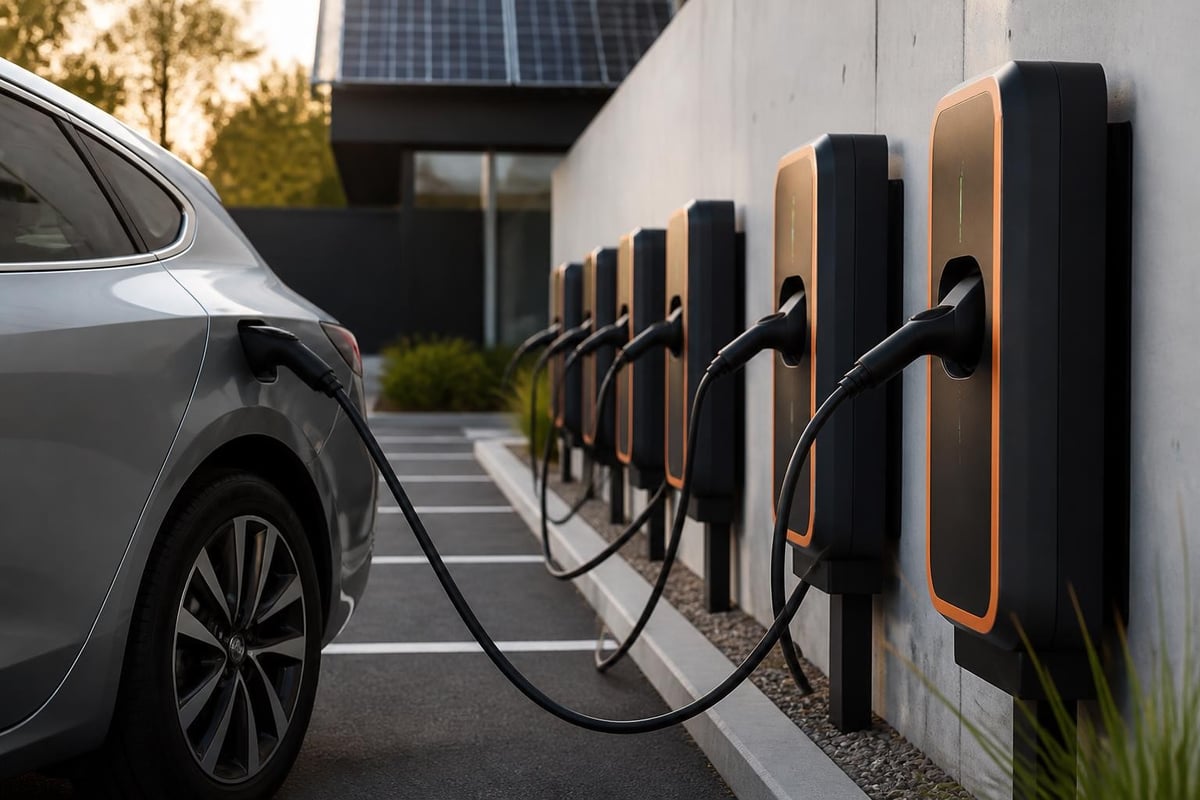
Physical site factors influence both user experience and operational efficiency. Parking bay dimensions must accommodate charging cables whilst maintaining accessible parking compliance. Ideally, chargers mount on bollards or pedestals 0.5-1.2 metres from parking bay edges, preventing vehicle damage whilst ensuring cable reach.
Consider placement relative to building entrances, particularly for customer-focused installations. Visible, well-lit locations near main thoroughfares attract usage and enhance security perceptions. Conversely, fleet charging often benefits from discrete back-of-house positioning that maximises available space for vehicle manoeuvring.
Regulatory Compliance and Permitting
South African commercial EV charging installations intersect multiple regulatory frameworks. The Occupational Health and Safety Act mandates safe electrical work practices, whilst municipal by-laws govern parking facility modifications and signage requirements.
Electrical installations require Certificates of Compliance (CoC) issued by registered electricians. DC fast charging installations exceeding 50 kW typically trigger additional requirements for professional engineer sign-off and municipal plan approvals. Budget 8-16 weeks for complete permitting cycles in major metropolitan areas.
The National Regulator for Compulsory Specifications (NRCS) requires that all EVSE sold in South Africa comply with IEC 61851 standards for safety and performance. Verify equipment specifications include NRCS approval before procurement to avoid costly compliance issues during commissioning.
Financial Incentives and Tax Considerations
Commercial EV charging infrastructure attracts various incentive mechanisms that materially improve project economics. The United States offers instructive precedents that South African policymakers increasingly reference when developing local programmes.
The Alternative Fuel Vehicle Refueling Property Credit in the US provides tax credits covering up to 30% of installation costs (capped at USD 100,000 per location). Whilst South Africa lacks direct equivalents in 2026, the Section 12B energy efficiency allowance potentially applies to qualifying installations that reduce grid electricity consumption when paired with solar PV.
Municipal incentive programmes deserve investigation. Several metros offer expedited permitting for renewable energy installations or rebates for grid-supportive technologies. Cape Town's Energy Services programme, for instance, has piloted various demand-side management incentives that could encompass smart charging systems.
The VAT treatment of commercial EV charging services remains subject to standard 15% rates. However, businesses registered as VAT vendors reclaim input tax on equipment and installation costs, improving cash flow during deployment phases.
| Cost Category | Typical Range (ZAR) | Key Variables |
|---|---|---|
| Level 2 AC Charger (7-22 kW) | 15,000 - 45,000 | Power rating, smart features, weatherproofing |
| DC Fast Charger (50-150 kW) | 450,000 - 1,200,000 | Power output, simultaneous connectors, brand |
| Installation Labour | 8,000 - 35,000 per unit | Distance from distribution board, civil works required |
| Network Connectivity (annual) | 1,200 - 4,500 per charger | Data plan, management platform, support level |
| Electrical Infrastructure Upgrades | 50,000 - 500,000+ | Existing capacity, required upgrades, trenching distance |
Renewable Energy Integration
Commercial EV charging presents exceptional synergy with on-site renewable energy generation. Solar PV installations offset charging electricity costs whilst supporting corporate sustainability narratives and ESG reporting requirements.
Grid coordination strategies enable businesses to leverage utility programmes for renewable energy integration, demand response participation, and time-of-use optimisation. Smart charging systems schedule vehicle charging to coincide with peak solar production hours, maximising self-consumption and minimising grid dependency.
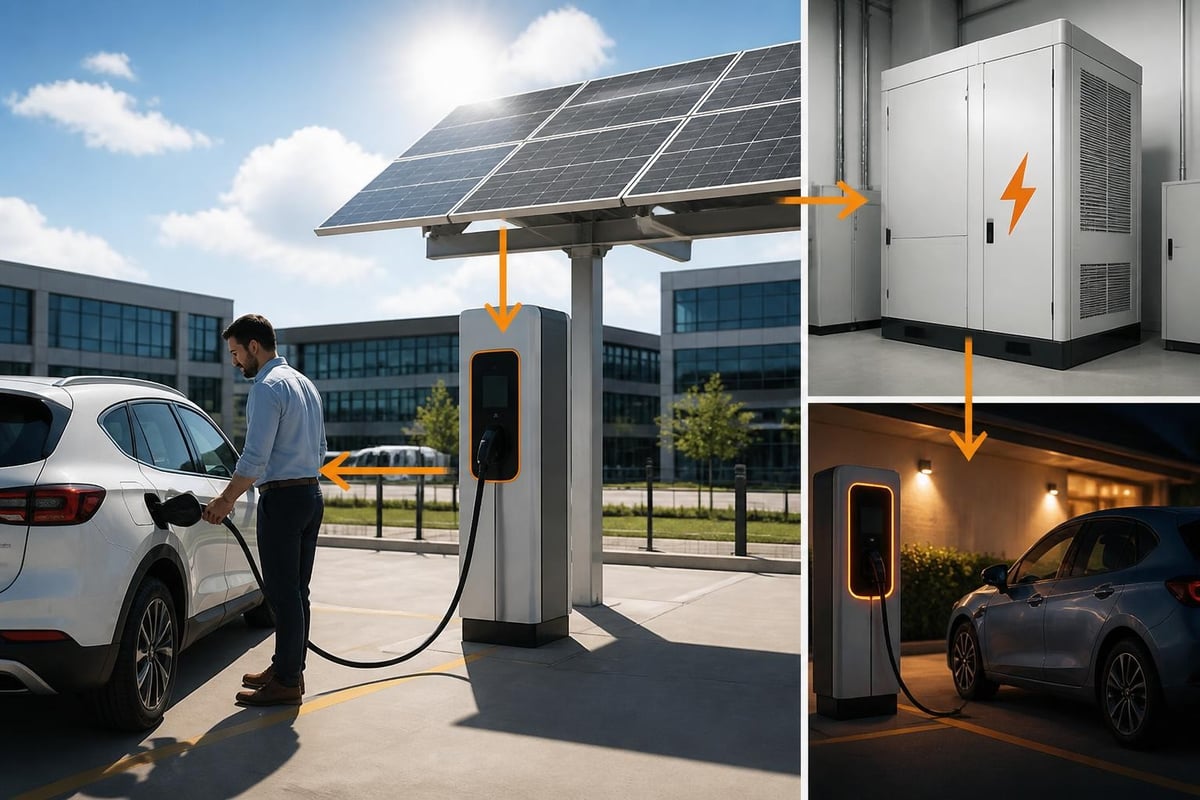
Battery energy storage systems (BESS) complete the integrated energy solution. Batteries charge from solar production during off-peak periods, then discharge to support EV charging during high-demand windows or grid outages. This configuration delivers multiple value streams simultaneously-demand charge reduction, backup power resilience, and renewable energy maximisation.
The economics become compelling for businesses with existing solar installations. A 100 kW rooftop array generates approximately 450-550 kWh daily across most South African regions. This production supports 20-30 vehicles receiving workplace charging, effectively monetising solar capacity that might otherwise export to the grid at unfavourable rates.
Maintenance and Operations Management
Commercial EV charging infrastructure requires systematic maintenance protocols to ensure reliability, safety, and positive user experiences. Unlike passive electrical installations, networked chargers demand ongoing software updates, performance monitoring, and preventative servicing.
Establish scheduled inspection routines covering:
- Physical condition checks - Cable damage, connector wear, enclosure integrity, bollard stability
- Electrical testing - Earth continuity, insulation resistance, RCD functionality, connection torque verification
- Software monitoring - Firmware currency, communication link status, transaction success rates, error log analysis
- User interface maintenance - Display functionality, payment terminal operation, RFID reader performance
Network-connected chargers enable remote diagnostics that identify issues before users encounter problems. Monitoring platforms track utilisation patterns, energy throughput, peak demand periods, and fault frequencies. This data informs capacity planning decisions and highlights underperforming assets requiring attention.
Consider service level agreements with installation partners or specialist maintenance providers. Response time guarantees become particularly critical for revenue-generating installations where downtime directly impacts income. For those interested in exploring comprehensive energy solutions, additional resources on renewable energy projects provide valuable context on integrated system planning.
User Experience and Customer Service
Commercial EV charging success hinges on friction-free user experiences that encourage repeat usage and positive brand associations. Every interaction point-from initial discovery to payment completion-shapes perceptions and utilisation rates.
Effective wayfinding starts before drivers arrive on site. List chargers on popular navigation applications (PlugShare, Google Maps, Waze) with accurate location data, connector types, power ratings, and pricing information. Update availability status in real-time to prevent frustration when drivers arrive to find occupied chargers.
On-site signage must clearly identify charging locations, direct traffic flow, and communicate usage policies. Dedicated EV parking bays prevent internal combustion vehicles from blocking chargers (so-called "ICE-ing"), whilst clear time limits at high-turnover locations maximise throughput.
Payment flexibility accommodates diverse user preferences. Offer multiple options including:
- Contactless credit/debit card terminals
- Mobile application payments
- RFID membership cards for regular users
- QR code scanning for ad-hoc sessions
- Fleet account billing for commercial users
Provide visible customer support contact information at each charger. Users experiencing technical difficulties appreciate immediate assistance rather than navigating complex troubleshooting procedures independently. Telephone support lines, WhatsApp channels, or live chat facilities demonstrate customer-centric operations.
Future-Proofing Your Investment
Commercial EV charging technology evolves rapidly, presenting both opportunities and obsolescence risks. Strategic deployment considers not only current requirements but anticipated developments across vehicles, electrical infrastructure, and regulatory landscapes.
Vehicle manufacturers increasingly adopt higher-voltage architectures enabling faster charging acceptance. Models launching in 2026 commonly support 800-volt systems accepting 200-350 kW, compared to 400-volt platforms limited to 50-150 kW. Installations at high-visibility public locations benefit from specifying chargers capable of serving next-generation vehicles.
Bidirectional charging capabilities enable vehicle-to-grid (V2G) and vehicle-to-building (V2B) applications where EVs function as mobile energy storage. Commercial facilities could leverage parked fleet vehicles to reduce demand charges, provide backup power during outages, or participate in grid stabilisation programmes. Whilst nascent in 2026, these applications justify consideration when evaluating long-term infrastructure strategies.
Over-specify electrical infrastructure capacity during initial installations. Adding circuit capacity later requires expensive retrofits involving trenching, switchboard modifications, and operational disruptions. Installing oversized conduits, distribution boards with spare capacity, and transformer ratings exceeding immediate requirements costs marginally more during construction whilst enabling seamless expansion as demand grows.
Modular equipment selection provides upgrade pathways without complete replacement. Power modules that slot into existing enclosures allow capacity increases from 50 kW to 150 kW by adding components rather than replacing entire units. Similarly, charging networks supporting firmware updates maintain feature parity with newer models through software enhancements.
For businesses considering broader energy resilience strategies, exploring solar panel recycling and circular economy approaches demonstrates commitment to complete lifecycle sustainability-an increasingly important consideration for stakeholders evaluating ESG credentials.
Measuring Success and Optimising Performance
Commercial EV charging deployments require systematic performance measurement to validate investment decisions and identify optimisation opportunities. Establish baseline metrics before installation to enable meaningful comparisons as operations mature.
Key performance indicators vary by business model and strategic objectives:
- Utilisation rate - Percentage of time chargers actively deliver energy (target: 15-35% for workplace, 40-65% for public retail)
- Energy throughput - Total kWh delivered monthly per charger (indicates revenue generation potential and demand impact)
- Session frequency - Number of charging events per charger daily (reveals whether capacity matches demand)
- Revenue per charger - Total income divided by number of charging stations (assesses financial performance)
- Customer acquisition cost - Marketing expenditure divided by new unique users (evaluates promotional effectiveness)
- Average session duration - Time vehicles remain connected (identifies potential turnover improvements)
Benchmark performance against comparable installations to contextualise results. Industry associations and charging network operators often publish aggregated utilisation data that informs realistic expectations for different installation types.
User feedback mechanisms provide qualitative insights complementing quantitative metrics. Brief post-session surveys delivered via mobile applications capture satisfaction levels, identify pain points, and solicit improvement suggestions. Response rates typically range from 8-15% when surveys require minimal time investment.
Review charging data to identify usage patterns informing capacity planning. If workplace chargers consistently reach capacity between 08:00-10:00, consider dynamic pricing that incentivises off-peak charging or installation of additional units. Fleet charging analysis might reveal opportunities to schedule maintenance tasks during low-utilisation periods, maximising vehicle availability during operational hours.
For businesses seeking to optimise their broader energy consumption alongside EV charging, calculators and planning tools help model integrated renewable energy scenarios that maximise return on investment across multiple technologies.
Commercial EV charging represents a strategic investment that extends far beyond simple electricity provision, encompassing customer experience, sustainability credentials, and long-term operational efficiency. Successful implementations integrate electrical infrastructure planning, renewable energy optimisation, and user-centric design to create charging experiences that drive utilisation whilst supporting business objectives. INFOLED designs, finances, installs, monitors and maintains intelligent EV charging solutions integrated with solar PV, battery storage and smart metering across Southern Africa, helping commercial, industrial and residential clients reduce electricity costs whilst advancing their net zero strategies.
Next Step
Need help with your energy strategy?
Speak to INFOLED about solar, storage, EV charging, service agreements or system performance.