

Commercial organisations across South Africa are increasingly turning to battery energy storage systems (BESS) to address rising electricity costs, frequent load shedding, and ambitious sustainability targets. Commercial battery storage has evolved from a niche technology into a strategic asset that delivers measurable financial returns whilst supporting grid stability and environmental goals. For businesses operating in the current energy landscape, understanding how these systems work and where they deliver value has become essential for maintaining competitive advantage and operational continuity.
Understanding Commercial Battery Storage Technology
Commercial battery storage systems capture electrical energy during periods of low demand or high renewable generation, then discharge that energy when it delivers maximum value. Unlike residential systems designed for household consumption, commercial installations typically range from 100 kWh to multiple MWh of capacity, serving warehouses, manufacturing facilities, shopping centres, office parks, and agricultural operations.
Core Components and Architecture
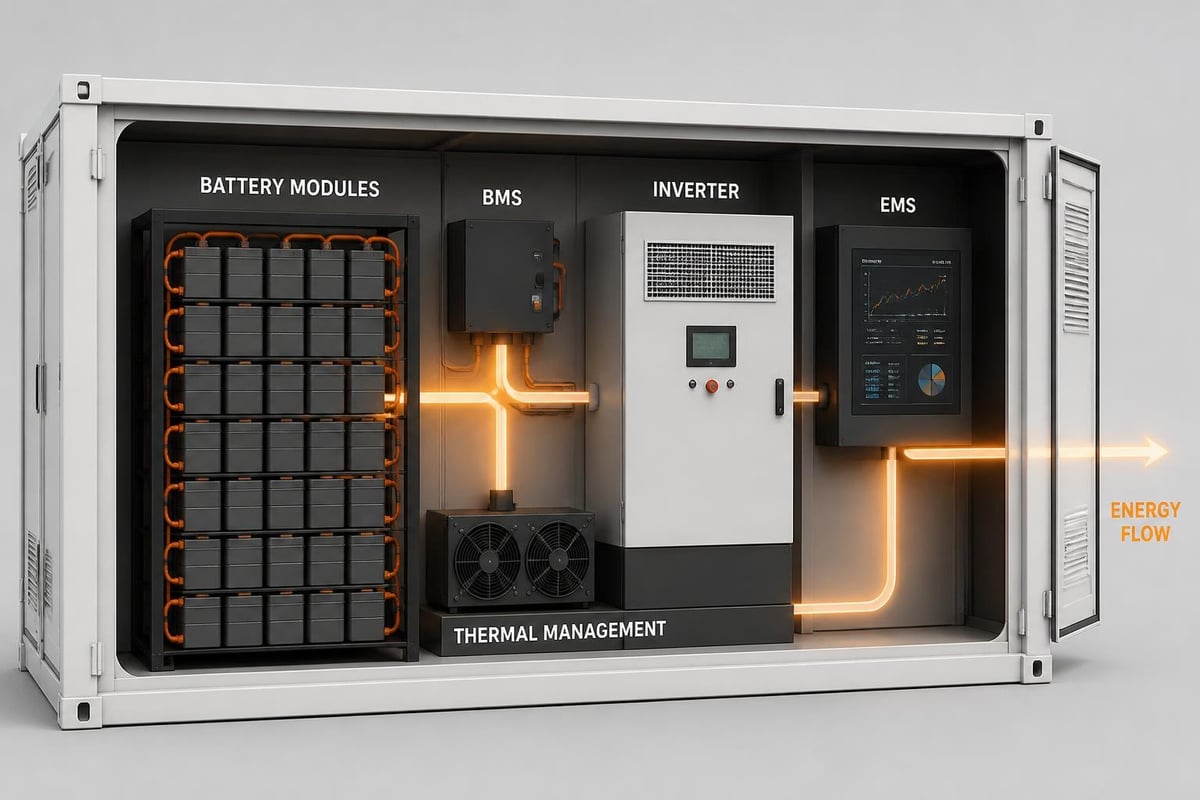
A complete commercial BESS comprises several integrated subsystems that work together to manage energy flow:
- Battery modules: Lithium-ion chemistries (NMC, LFP) dominate commercial applications due to energy density and cycle life
- Battery management system (BMS): Monitors cell voltage, temperature, and state of charge to optimise performance and safety
- Power conversion system (PCS): Bidirectional inverters that convert DC battery power to AC grid power
- Energy management system (EMS): Software that orchestrates charging and discharging based on tariffs, demand forecasts, and operational requirements
- Thermal management: Active cooling or heating to maintain optimal operating temperatures
- Fire suppression: Detection and suppression systems designed to meet UL 9540A and NFPA 855 standards
The selection of battery chemistry significantly influences system performance characteristics. Lithium iron phosphate (LFP) batteries offer superior thermal stability and cycle life exceeding 6,000 cycles, making them particularly suitable for daily cycling applications such as peak shaving. Nickel manganese cobalt (NMC) chemistries provide higher energy density, which reduces the physical footprint for space-constrained installations.
Economic Drivers for Commercial Storage Adoption
The financial case for commercial battery storage in South Africa rests on multiple value streams that can be stacked to improve return on investment. Businesses typically achieve payback periods between 4 and 8 years depending on their tariff structure, load profile, and ability to access various revenue opportunities.
Demand Charge Reduction
Time-of-use (TOU) tariffs and municipal demand charges represent significant cost components for commercial electricity consumers. Eskom's Megaflex tariff structure, widely used by large commercial and industrial customers, includes:
| Tariff Component | Peak Period | Standard Period | Off-Peak Period |
|---|---|---|---|
| Energy charge (c/kWh) | 425.77 | 158.86 | 89.01 |
| Demand charge (R/kW/month) | 1,361.88 | 354.59 | - |
A 500 kW / 2,000 kWh battery system strategically discharged during peak periods can reduce monthly demand charges by R400,000 to R680,000 whilst simultaneously avoiding high energy charges. This dual benefit creates compelling economics for facilities with pronounced demand peaks.
Manufacturing facilities, cold storage operations, and data centres achieve particularly strong returns because their load profiles feature predictable peaks that batteries can reliably offset. The energy management systems that coordinate these strategies have become increasingly sophisticated, using machine learning to forecast demand patterns and optimise discharge schedules.
Load Shedding Mitigation and Business Continuity
Unplanned power interruptions cost South African businesses an estimated R120 billion annually through lost production, damaged equipment, and reduced competitiveness. Commercial battery storage provides seamless backup power without the noise, emissions, and fuel costs associated with diesel generators.
A properly sized BESS can support critical loads for 4 to 12 hours depending on capacity and load profile. Essential functions such as:
- Refrigeration and cold chain integrity
- Manufacturing process continuity
- Data centre uptime
- Security systems and access control
- Point-of-sale systems and customer service
These capabilities translate directly into preserved revenue and avoided losses. Retail operations, for instance, can maintain trading during load shedding periods that would otherwise force closures, whilst food processors protect product value and avoid waste.
Integration with Renewable Energy Systems
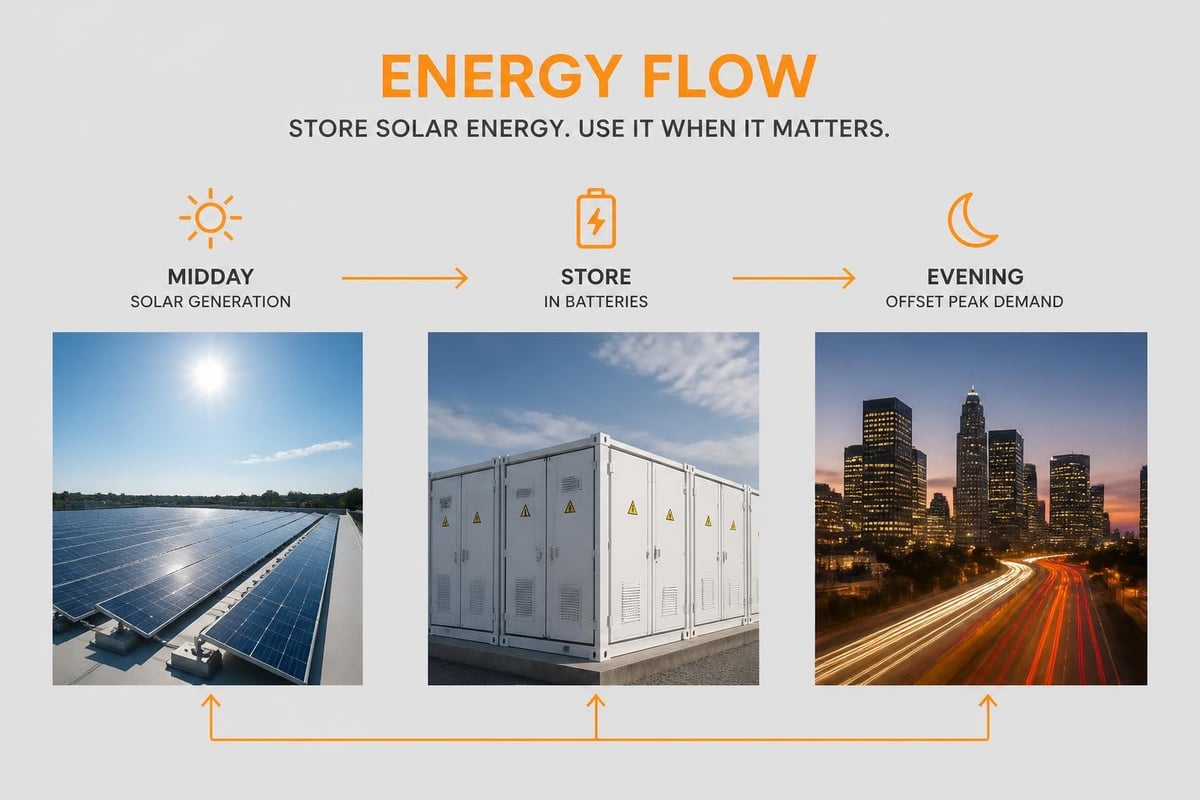
Commercial battery storage unlocks the full potential of on-site solar photovoltaic installations by addressing the fundamental mismatch between solar generation profiles and consumption patterns. Solar arrays produce maximum output during midday hours when many commercial facilities experience moderate demand, then produce nothing during evening peak periods when consumption and tariffs are highest.
Solar-Plus-Storage Synergies
Battery systems paired with solar installations create hybrid energy systems that deliver superior economics compared to either technology alone. The storage component:
- Captures excess solar generation that would otherwise be curtailed or exported at low rates
- Time-shifts that energy to evening peaks when grid electricity is most expensive
- Smooths solar variability to reduce demand charges
- Provides backup power during both daytime and night-time outages
- Maximises self-consumption and grid independence
South African businesses implementing Commercial, Industrial, Agricultural and Residential Battery Energy Storage Systems (BESS) alongside solar typically achieve 70-90% energy independence, dramatically reducing exposure to tariff increases whilst accelerating carbon reduction targets.
The value proposition strengthens as solar penetration increases. Facilities with solar arrays sized to meet 50-80% of annual consumption frequently generate substantial midday surplus, which batteries can store and deploy during the 18:00-20:00 evening peak when demand charges and energy rates are highest.
Grid Services and Revenue Opportunities
Advanced commercial storage systems can participate in ancillary services markets, providing frequency regulation, voltage support, and other grid-balancing functions. Whilst South Africa's ancillary services market remains less developed than international counterparts, global energy storage deployments demonstrate the revenue potential of these applications.
International markets provide instructive examples. The California ISO battery storage market generated substantial revenues for commercial operators through frequency regulation and capacity products. As South African grid operators develop similar mechanisms to support renewable integration and grid stability, early-adopting commercial installations will be positioned to capture these opportunities.
Technical Considerations and System Design
Properly sizing and configuring commercial battery storage requires careful analysis of load profiles, tariff structures, renewable generation (if applicable), and operational requirements. Undersized systems fail to capture available value, whilst oversized installations increase capital costs without proportional returns.
Sizing Methodology
Professional system design follows a structured approach:
- Load analysis: Review 12 months of interval meter data to identify demand peaks, consumption patterns, and seasonal variations
- Tariff modelling: Map electricity costs across time periods to identify highest-value discharge windows
- Solar integration: Model generation profiles and surplus production if solar is present or planned
- Backup requirements: Determine critical load capacity and minimum backup duration
- Financial optimisation: Model various configurations to identify optimal capacity and power ratings
| System Configuration | 250 kW / 1,000 kWh | 500 kW / 2,000 kWh | 1,000 kW / 4,000 kWh |
|---|---|---|---|
| Suitable facility size | 500-1,500 kW demand | 1,500-3,000 kW demand | 3,000-6,000 kW demand |
| Typical application | Medium warehouse | Manufacturing facility | Large industrial complex |
| Peak shaving capacity | 250 kW for 4 hours | 500 kW for 4 hours | 1,000 kW for 4 hours |
| Estimated cost (ZAR) | R3.5M - R4.5M | R6.5M - R8.5M | R12M - R16M |
The power-to-energy ratio (P/E ratio) significantly influences application suitability. Systems with high P/E ratios (e.g., 1:2 or 500 kW / 1,000 kWh) excel at short-duration peak shaving, whilst low P/E configurations (e.g., 1:4 or 500 kW / 2,000 kWh) support extended backup or load shifting applications.
Safety Standards and Compliance
Commercial battery installations must meet rigorous safety standards to protect personnel, property, and surrounding communities. Key regulatory frameworks include:
- SANS 10142-1: South African wiring code requirements for electrical installations
- UL 9540: Safety standard for energy storage systems
- UL 9540A: Test method for thermal runaway fire propagation in battery systems
- NFPA 855: Installation standard for stationary energy storage systems
- Occupational Health and Safety Act: Workplace safety requirements
UL 9540A testing protocols evaluate how fire propagates between cells, modules, and battery cabinets, providing essential data for fire suppression design and spacing requirements. Facilities should specify systems with completed UL 9540A reports and integrated fire detection and suppression systems.
Operational Performance and Maintenance
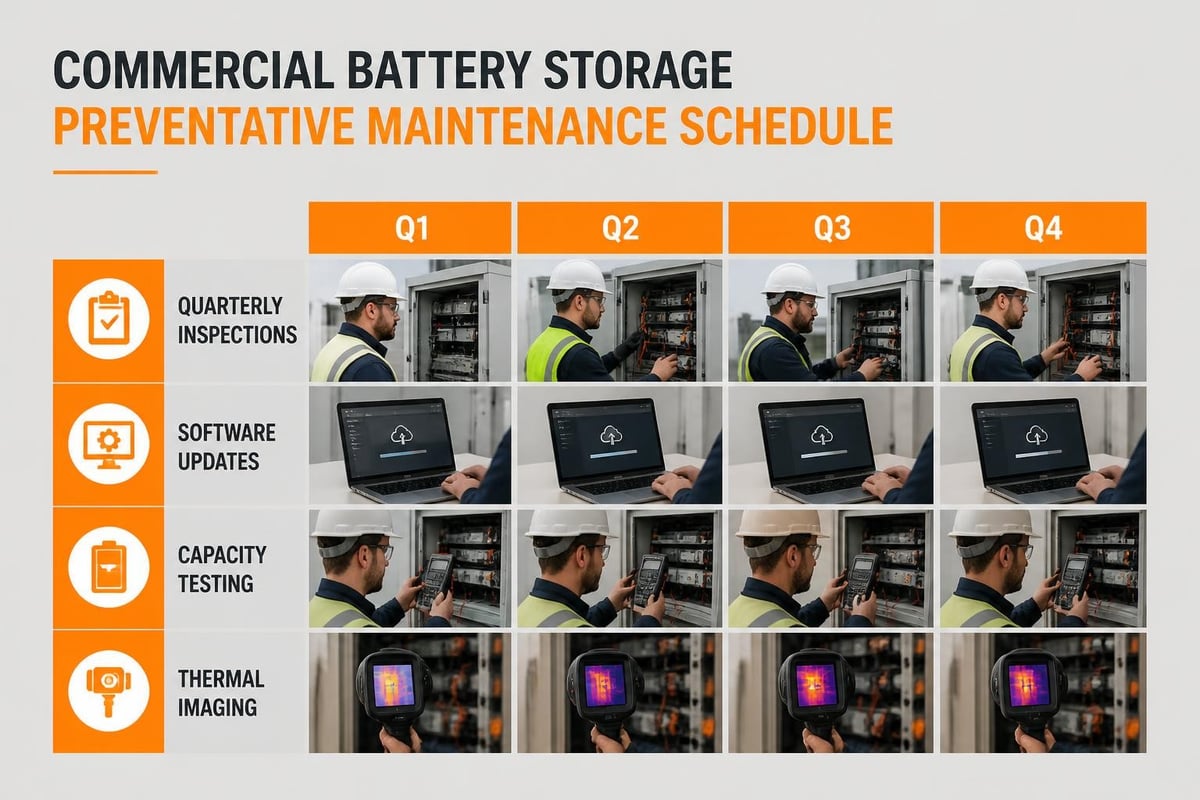
Commercial battery systems require ongoing monitoring and maintenance to sustain performance, maximise lifespan, and ensure safety. Professional operations and maintenance programmes typically include:
- Remote performance monitoring: Real-time tracking of state of charge, power flows, cycling behaviour, and system health
- Preventative maintenance: Quarterly or semi-annual inspections of electrical connections, thermal systems, and safety equipment
- Software updates: Firmware and EMS upgrades to optimise performance and add capabilities
- Capacity testing: Annual verification of available capacity and degradation trends
- Warranty management: Documentation and claims processing for component failures
Battery degradation follows predictable patterns, with quality lithium-ion systems retaining 70-80% of original capacity after 10 years of typical commercial operation. Factors affecting degradation include:
- Depth of discharge (shallower cycles extend lifespan)
- Operating temperature (cooling systems preserve capacity)
- Charge and discharge rates (moderate C-rates reduce stress)
- Calendar age (time-based degradation occurs regardless of cycling)
Businesses can extend system lifespan through intelligent charging strategies that avoid full charge states when immediate discharge isn't planned, thermal management that maintains optimal operating temperatures, and service level agreements that ensure prompt response to performance issues.
Sustainability Impact and ESG Benefits
Commercial battery storage systems deliver measurable environmental benefits that support corporate sustainability goals, ESG reporting requirements, and Net Zero commitments. When combined with renewable generation, batteries enable deep decarbonisation of electricity consumption whilst improving grid stability and reducing reliance on fossil fuel-based peaking plants.
Carbon Reduction and Renewable Integration
South African grid electricity carries a carbon intensity of approximately 0.95 kgCO₂e/kWh due to the coal-dominated generation mix. Battery systems that enable increased solar self-consumption can reduce Scope 2 emissions by 60-90% depending on system configuration and facility load profile.
A 500 kW commercial solar installation with 2,000 kWh of battery storage typically delivers:
- Annual solar generation: 750,000 - 850,000 kWh
- Grid electricity offset: 650,000 - 750,000 kWh (85-90% self-consumption)
- Annual carbon reduction: 617 - 712 tonnes CO₂e
- Equivalent to removing: 134 - 155 passenger vehicles from roads
These reductions contribute directly to Scope 2 emission targets and support compliance with voluntary frameworks such as CDP, GRI, and TCFD. The EPRI Energy Storage Hub provides technical resources and case studies demonstrating storage contributions to grid decarbonisation and renewable integration.
Circular Economy and End-of-Life Management
Responsible commercial battery deployment includes planning for end-of-life recycling and repurposing. Lithium-ion batteries retain significant value after commercial service life, with second-life applications in less demanding stationary storage roles or material recovery through recycling processes that reclaim lithium, cobalt, nickel, and other valuable materials.
South African businesses should work with suppliers and installers that maintain transparent solar recycling and battery recycling programmes. Extended Producer Responsibility (EPR) frameworks are developing locally to ensure proper handling of energy storage systems throughout their lifecycle.
Financial Mechanisms and Investment Structures
Capital requirements for commercial battery installations typically range from R3 million to R15 million depending on system capacity. Multiple financing approaches enable businesses to implement storage without significant upfront capital deployment.
Available Funding Models
South African commercial customers can access battery storage through various structures:
| Financing Model | Upfront Cost | Ownership | Tax Benefits | Operating Risk |
|---|---|---|---|---|
| Cash purchase | 100% | Customer | Full | Customer |
| Finance lease | 10-20% deposit | Customer after term | Depreciation | Customer |
| Operating lease | Minimal | Lessor | None | Lessor |
| Energy-as-a-Service | None | Service provider | None | Service provider |
| Power purchase agreement | None | Third party | None | Third party |
Energy-as-a-Service and PPA structures remove upfront investment barriers by allowing customers to pay for delivered energy savings rather than purchasing equipment. Service providers own, install, and maintain the system whilst customers benefit from reduced electricity costs through contracted rates below prevailing grid tariffs.
Financial modelling should incorporate available incentives, including Section 12B tax allowances for energy efficiency assets (though battery storage qualification requires careful structuring), potential Section 12L energy efficiency savings certificates, and accelerated depreciation provisions.
Supply Chain Considerations and Procurement
Global battery supply chains have experienced significant disruption from raw material constraints, manufacturing bottlenecks, and geopolitical tensions. The U.S. Department of Energy's supply chain analysis identifies critical vulnerabilities and mitigation strategies applicable to South African commercial procurement.
Procurement Best Practices
Organisations specifying commercial battery systems should evaluate suppliers across multiple dimensions:
- Manufacturing quality: ISO 9001 certification, production facility audits, quality assurance processes
- Product certifications: UL 9540, UL 1973, IEC 62619, and other relevant safety standards
- Warranty terms: Minimum 10-year performance warranties with clear degradation thresholds
- Local support: In-country technical support, spare parts availability, commissioning capability
- Financial stability: Manufacturer viability and warranty backing
- Integration experience: Demonstrated commercial installations and reference sites
Procurement timelines have extended to 16-24 weeks for fully customised commercial systems due to component lead times and shipping logistics. Businesses should initiate procurement well ahead of planned commissioning dates and structure contracts with clear delivery milestones and performance guarantees.
Regulatory Framework and Market Evolution
South Africa's regulatory environment for commercial battery storage continues to evolve as grid-connected storage deployment accelerates. Current frameworks address grid connection, licensing exemptions, and electricity trading, though policy development lags behind technological capability and market demand.
Grid Connection and Registration
Commercial battery systems require registration with the relevant electricity distributor (Eskom or municipality) and must comply with grid connection standards including:
- NRS 097-2-3: Grid connection code for distributed generation and storage
- SANS 10142-1: Electrical installation safety requirements
- SSEG registration: Small-Scale Embedded Generation registration for systems with export capability
- Grid connection application: Technical specifications and protection settings submission
Installations that solely import grid electricity for storage and on-site use face simpler approval processes than systems that export to the grid. Most commercial applications prioritise self-consumption and backup power over grid export due to unfavourable feed-in tariffs and regulatory complexity.
The National Energy Regulator of South Africa (NERSA) has expanded embedded generation licensing exemptions to 100 MW, enabling commercial storage deployment without electricity generation licenses. However, trading electricity to third parties or participating in ancillary services markets may trigger additional regulatory requirements as frameworks develop.
Strategic Implementation Roadmap
Successful commercial battery storage deployment follows a structured implementation process that aligns technical, financial, and operational requirements with broader business objectives.
Phased Implementation Approach
Organisations new to energy storage should consider phased deployment that builds capability and demonstrates value before full-scale rollout:
Phase 1: Assessment and feasibility (6-8 weeks)
- Collect 12 months of interval meter data
- Analyse load profiles and identify demand peaks
- Model financial returns across system configurations
- Develop preliminary technical specifications
- Secure preliminary quotations and financing terms
Phase 2: Detailed design and procurement (8-12 weeks)
- Finalise system sizing and configuration
- Complete engineering designs and grid studies
- Submit grid connection applications
- Execute supply contracts and financing agreements
- Obtain necessary permits and approvals
Phase 3: Installation and commissioning (4-8 weeks)
- Civil works and foundation preparation
- Electrical installation and terminations
- System integration and testing
- Commissioning and performance verification
- Operator training and handover
Phase 4: Optimisation and monitoring (ongoing)
- Monitor performance against modelled projections
- Optimise charging and discharging strategies
- Track degradation and warranty compliance
- Implement preventative maintenance programme
- Evaluate expansion opportunities
Multi-site organisations can leverage learnings from initial deployments to streamline subsequent installations whilst achieving economies of scale through standardised specifications and framework supply agreements.
Commercial battery storage has matured into a proven technology that delivers financial returns, operational resilience, and environmental benefits for South African businesses navigating complex energy challenges. From demand charge reduction and load shedding protection to renewable integration and carbon reduction, these systems address multiple business objectives through a single strategic investment. INFOLED specialises in designing, financing, installing, and maintaining intelligent battery energy storage solutions tailored to commercial, industrial, and agricultural operations across Southern Africa. Our comprehensive approach combines technical expertise with financial structuring and ongoing performance support to help businesses reduce electricity costs, improve energy resilience, and achieve sustainability targets through proven renewable energy technologies.
Next Step
Need help with your energy strategy?
Speak to INFOLED about solar, storage, EV charging, service agreements or system performance.