
Modern South African businesses face unprecedented energy challenges. Load shedding disruptions, escalating electricity tariffs, and mounting pressure to meet ESG commitments have transformed energy from a background operational concern into a strategic priority. An energy management system offers a comprehensive solution, enabling organisations to monitor, control, and optimise energy consumption across their facilities whilst building resilience against grid instability.
The sophistication of energy management has evolved dramatically. Where businesses once relied on monthly utility bills and manual meter readings, today's systems leverage real-time data, artificial intelligence, and automated controls to deliver continuous optimisation. This shift represents not merely an upgrade in technology but a fundamental change in how organisations approach energy as a managed resource rather than a fixed cost.
Understanding Energy Management System Architecture
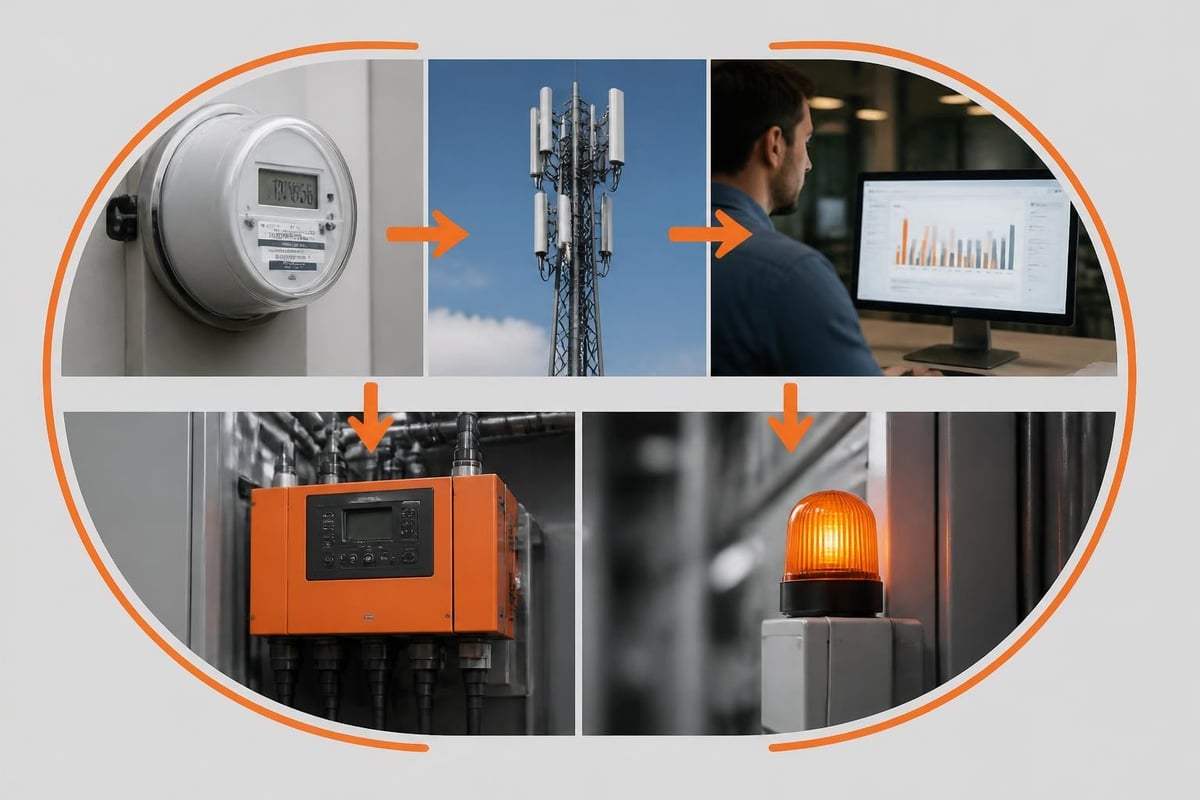
An energy management system comprises interconnected hardware and software components that work together to collect, analyse, and act upon energy data. At its foundation, the system relies on intelligent metering infrastructure deployed across critical consumption points throughout a facility. These meters capture granular data on electricity usage, power quality, and demand patterns at intervals ranging from seconds to minutes.
The data flows into a central platform where analytics engines process information in real-time. Modern systems employ machine learning algorithms to identify consumption patterns, detect anomalies, and predict future demand. This analytical layer transforms raw data into actionable intelligence, highlighting inefficiencies and opportunities for optimisation that would remain invisible to human observers reviewing aggregated monthly reports.
Core Components and Integration Points
Hardware infrastructure forms the tangible foundation of any effective system:
- Smart meters with pulse outputs or digital communication protocols
- Current transformers and voltage sensors for three-phase monitoring
- Building management system (BMS) integration interfaces
- Programmable logic controllers (PLCs) for automated responses
- IoT gateways for secure cloud connectivity
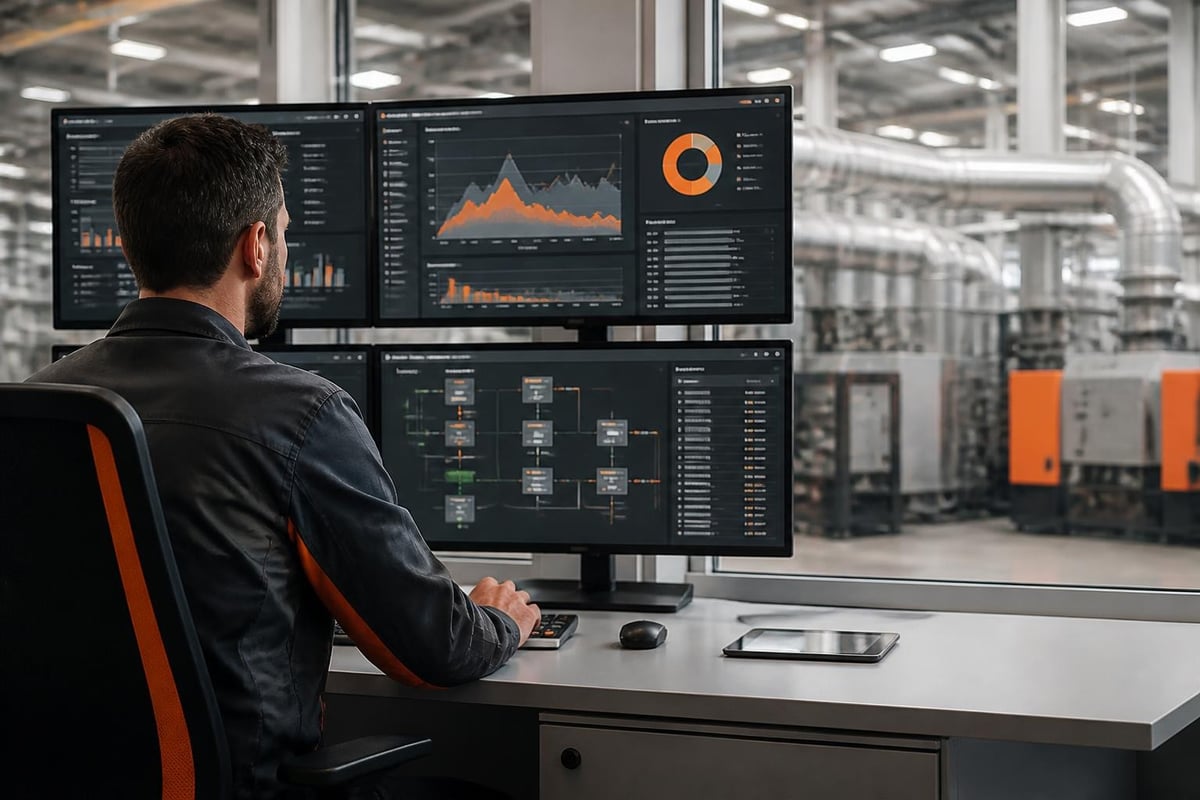
Software platforms deliver the intelligence and user interface. The most capable solutions offer customisable dashboards that present energy data in formats suited to different stakeholders. A facilities manager requires operational detail and alert notifications, whilst executive leadership needs high-level trends and financial metrics tied to corporate sustainability targets.
Integration capabilities determine system value. An isolated energy monitoring platform provides limited benefit compared to a system that connects with existing building controls, renewable energy assets, and battery storage. When properly integrated, the energy management system becomes the orchestration layer that coordinates solar generation, battery discharge cycles, HVAC operation, and production scheduling to minimise costs and maximise efficiency.
Deployment Models for Commercial and Industrial Applications
South African businesses deploy energy management systems across three primary models, each suited to different operational contexts and strategic objectives. The choice of deployment model significantly impacts implementation complexity, ongoing costs, and the range of achievable outcomes.
On-premises systems install all hardware and software within the facility's local network. This approach appeals to organisations with strict data security requirements or limited internet connectivity. Industrial facilities with dedicated IT infrastructure often favour on-premises deployment, accepting higher upfront capital expenditure in exchange for complete control over their energy data and system operation.
Cloud-based platforms shift data processing and storage to remote servers, accessed through web browsers or mobile applications. This model reduces initial investment, enables remote access for multi-site organisations, and ensures automatic software updates. The International Energy Agency's Energy Efficiency 2024 report highlights that cloud-based energy management systems have driven significant efficiency improvements across commercial sectors, with organisations reporting average energy savings of 15-25% following implementation.
| Deployment Model | Capital Cost | Scalability | Data Security | Maintenance |
|---|---|---|---|---|
| On-Premises | High | Limited | Full control | Internal team required |
| Cloud-Based | Low to Medium | Excellent | Shared responsibility | Vendor managed |
| Hybrid | Medium to High | Good | Configurable | Split responsibility |
Hybrid architectures combine local data collection and critical control functions with cloud-based analytics and reporting. This approach offers resilience-the system continues basic operation during internet outages-whilst providing the analytical power and accessibility advantages of cloud platforms. For manufacturers and processing facilities where production continuity is paramount, hybrid deployment balances operational reliability with advanced capabilities.
Implementation Phases and Timeline Considerations
Successful deployment follows a structured methodology spanning several months. Initial energy audits establish baseline consumption patterns and identify measurement points. This discovery phase typically requires four to six weeks for medium-sized commercial facilities, longer for complex industrial sites with multiple process areas.
Week 1-6: Energy audit, load profiling, and feasibility assessment
Week 7-10: System design, equipment specification, and procurement
Week 11-14: Hardware installation and network configuration
Week 15-18: Software deployment, integration, and commissioning
Week 19-22: Staff training, algorithm tuning, and performance validation
The commissioning period proves critical. Algorithms require time to learn normal operating patterns before they can reliably detect anomalies or optimise control strategies. Organisations should expect three to six months of algorithmic learning before the system delivers its full potential.
Advanced Features Driving Operational Value
Modern energy management systems extend far beyond simple monitoring. The most sophisticated platforms incorporate predictive analytics, automated controls, and integration with renewable energy assets to deliver continuous optimisation without manual intervention.
Demand forecasting employs machine learning models that analyse historical consumption data, weather forecasts, production schedules, and occupancy patterns to predict future energy requirements. Recent research published in Springer's review of intelligent energy management systems demonstrates that AI-based forecasting achieves accuracy within 3-5% for commercial buildings, enabling proactive rather than reactive energy management.
Load shifting capabilities allow the system to automatically adjust non-critical processes to operate during off-peak tariff periods. For facilities with time-of-use electricity pricing, this single feature often delivers return on investment within 18-24 months. The system identifies flexible loads-such as water heating, cold storage, or batch processes-and reschedules operation to minimise demand charges whilst respecting operational constraints.
Renewable Energy and Storage Optimisation
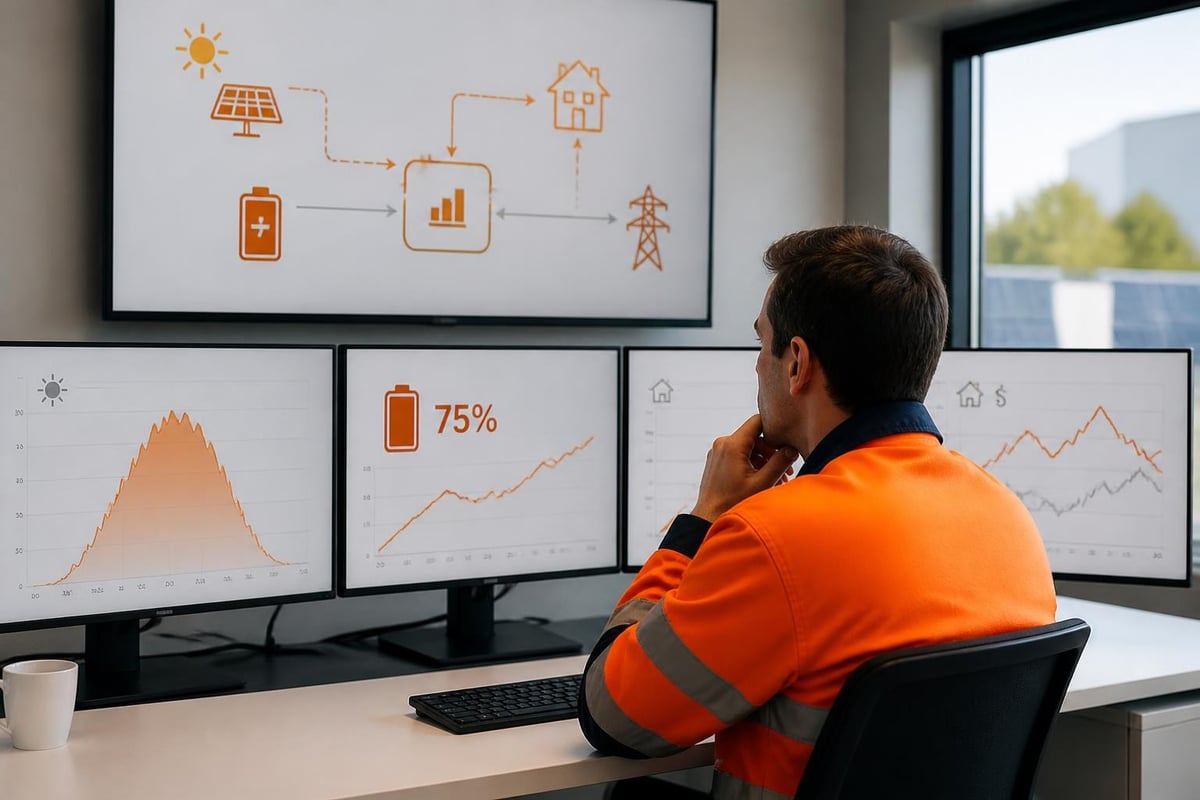
For organisations with solar photovoltaic installations, the energy management system becomes the intelligence layer that maximises self-consumption and financial returns. The platform monitors real-time generation, compares it against building load, and makes millisecond decisions about whether to consume solar power directly, charge battery storage, or export surplus to the grid.
Energy management platforms that integrate renewable assets and battery systems deliver the highest value in the Southern African context. During periods of grid instability or planned load shedding, the system can automatically island critical loads, ensuring business continuity whilst minimising diesel generator runtime and associated costs.
Battery optimisation algorithms consider multiple variables:
- Current state of charge and battery health metrics
- Forecast solar generation based on weather data
- Predicted building load profiles
- Time-of-use tariff structures
- Grid stability indicators and load shedding schedules
- Battery cycle life and degradation models
This multi-objective optimisation balances conflicting goals-minimising electricity costs, preserving battery lifespan, ensuring backup capacity, and maximising renewable energy utilisation-to deliver outcomes that manual operation cannot achieve.
Cybersecurity and Data Protection Considerations
Energy management systems represent critical infrastructure that requires robust security measures. As these platforms increasingly connect to corporate networks and cloud services, they create potential vulnerability pathways that organisations must address through comprehensive cybersecurity strategies.
The NIST cybersecurity practice guide for energy sector asset management outlines essential security controls. Network segmentation isolates energy management infrastructure from general corporate networks, limiting lateral movement in case of breach. All data transmissions should employ end-to-end encryption, particularly for cloud-connected systems transmitting sensitive operational data across public internet connections.
Access control policies must enforce role-based permissions, ensuring that users can only view or modify data relevant to their responsibilities. Multi-factor authentication should be mandatory for any remote access, and all system interactions should generate audit logs retained for compliance and forensic analysis.
Compliance with South African Data Protection Requirements
The Protection of Personal Information Act (POPIA) applies to energy management systems that process data associated with identifiable individuals, such as tenant sub-metering in commercial buildings. Organisations deploying these systems must implement appropriate technical and organisational measures to protect personal information, maintain transparent privacy policies, and obtain necessary consents where applicable.
Data retention policies should balance operational requirements against privacy principles and storage costs. Granular meter data serves immediate optimisation needs but aggregated historical trends often suffice for long-term analysis. Most systems retain high-resolution data for 30-90 days before aggregating to hourly or daily averages for permanent storage.
Financial Modelling and Return on Investment
Quantifying the financial case for an energy management system requires analysis across multiple value streams. Direct electricity cost savings typically represent the largest component, but organisations should also account for demand charge reductions, operational efficiency improvements, and avoided capital expenditure on emergency backup systems.
Typical investment ranges for South African installations:
| Facility Type | System Cost (ZAR) | Annual Savings | Payback Period |
|---|---|---|---|
| Small Commercial (< 500 kVA) | 150,000 - 400,000 | 80,000 - 200,000 | 2-3 years |
| Medium Industrial (500-2,000 kVA) | 500,000 - 1,500,000 | 300,000 - 800,000 | 18-30 months |
| Large Industrial (> 2,000 kVA) | 1,500,000 - 5,000,000 | 1,000,000 - 3,000,000 | 12-24 months |
These figures exclude VAT and assume integration with existing metering infrastructure. Greenfield installations requiring comprehensive sub-metering deployment may increase initial costs by 30-50%.
Beyond direct financial returns, energy management systems deliver strategic value that traditional ROI calculations often underestimate. Enhanced operational visibility enables faster fault detection and resolution, reducing unplanned downtime. Detailed energy data supports credible ESG reporting and renewable energy integration initiatives, increasingly important for organisations pursuing Net Zero commitments or responding to investor sustainability expectations.
Integration with Building Systems and Production Processes
Maximum value emerges when the energy management system connects with other facility systems rather than operating as a standalone platform. Integration with building management systems, industrial control systems, and enterprise resource planning platforms creates a unified view of facility operations and enables coordinated optimisation across domains.
HVAC systems represent the largest energy consumer in most commercial buildings. When integrated with the energy management system, climate control can respond to occupancy patterns, weather forecasts, and electricity pricing. The U.S. Department of Energy's industrial tools catalogue provides resources for integrating energy management with manufacturing execution systems, enabling production scheduling that considers energy costs and grid conditions alongside traditional operational parameters.
Common integration protocols include:
- BACnet for building automation systems
- Modbus TCP/IP for industrial equipment
- MQTT for IoT sensor networks
- OPC UA for manufacturing systems
- REST APIs for cloud platform connectivity
Open standards facilitate integration and prevent vendor lock-in. Organisations should prioritise systems that support multiple protocols and provide documented APIs for custom integration requirements.
Manufacturing and Process Industry Applications
Energy-intensive industries gain particular value from sophisticated energy management. Mining operations, food processing facilities, and chemical manufacturers can optimise production schedules to align with renewable energy availability or favourable tariff periods. The system can automatically curtail non-essential loads during demand spikes, preventing expensive peak charges whilst maintaining critical production.
Process heating and cooling systems benefit from predictive controls that anticipate thermal loads and pre-condition systems during low-cost periods. A cold storage facility might super-cool refrigerated spaces using solar energy during midday generation peaks, allowing compressors to operate at reduced capacity during evening demand peaks when electricity costs more.
Emerging Technologies and Future Capabilities
The energy management landscape continues to evolve rapidly, driven by advances in artificial intelligence, edge computing, and distributed energy resources. Organisations planning deployments in 2026 should consider both current capabilities and the system's capacity to incorporate emerging technologies over its operational lifetime.
Edge computing moves analytical processing closer to data sources, reducing latency and bandwidth requirements whilst enabling faster response to dynamic conditions. Next-generation systems will process complex optimisation algorithms locally, maintaining sophisticated control even during internet outages whilst synchronising insights and updates to cloud platforms when connectivity resumes.
Digital twin technology creates virtual replicas of physical facilities, enabling simulation and scenario testing without disrupting operations. Facilities managers can model the impact of equipment upgrades, operational changes, or renewable energy additions before committing capital, reducing implementation risk and optimising investment decisions.
Blockchain and distributed ledger technologies promise new opportunities for peer-to-peer energy trading and transparent renewable energy certificate management. As South Africa's regulatory framework evolves to accommodate distributed generation and energy trading, energy management systems will likely incorporate these capabilities to help organisations monetise surplus renewable generation.
Artificial Intelligence and Autonomous Operation
Current AI capabilities focus primarily on pattern recognition, anomaly detection, and predictive modelling. The IEEE review of home energy management systems highlights emerging autonomous control strategies that learn from operational outcomes and continuously refine decision-making without human intervention. Commercial implementations of these technologies remain nascent but suggest a future where energy systems require minimal ongoing management once properly commissioned.
Federated learning techniques allow energy management systems to improve through collective intelligence whilst preserving data privacy. Multiple facilities contribute anonymised operational patterns to shared models that identify optimisation opportunities, with insights flowing back to individual deployments. This collaborative approach accelerates the learning curve and benefits organisations deploying systems in less common building types or industrial processes.
Regulatory Compliance and Utility Interaction
South African organisations must navigate an evolving regulatory landscape governing distributed generation, energy storage, and utility interconnection. Energy management systems provide the monitoring and reporting capabilities necessary to demonstrate compliance with municipal requirements, Eskom grid codes, and environmental regulations.
For facilities with embedded generation, the system documents solar production, export volumes, and power quality parameters required by grid connection agreements. Automated reporting functions generate the records necessary for renewable energy certificate claims, carbon offset verification, and ESG disclosure frameworks such as the Carbon Disclosure Project or Task Force on Climate-related Financial Disclosures.
Municipal tariff structures across South African cities vary considerably. An effective energy management system adapts to local tariff frameworks, whether time-of-use pricing in major metros, seasonal variations in agricultural regions, or demand-based charging common in industrial areas. The platform's ability to model financial outcomes under different tariff scenarios helps organisations evaluate the business case for renewable energy projects and optimise operational strategies as pricing structures change.
Workforce Development and Organisational Change
Technology alone does not guarantee successful energy management. Organisations must invest in training, define clear responsibilities, and foster a culture that values energy efficiency alongside other operational priorities. The transition from reactive energy consumption to proactive management represents an organisational change that requires executive sponsorship and sustained commitment.
Key roles in mature energy management programmes:
- Energy manager with strategic oversight and executive reporting responsibility
- Systems operator monitoring real-time performance and responding to alerts
- Technical specialist managing system configuration and integration
- Data analyst developing insights and identifying optimisation opportunities
Smaller organisations may consolidate these functions, but the responsibilities remain essential. Without dedicated attention, even sophisticated systems fail to deliver potential value as configuration drifts, algorithms become stale, and optimisation opportunities go unrecognised.
Training requirements extend beyond the core energy team. Facilities maintenance staff need sufficient understanding to avoid inadvertently undermining system operation through manual overrides or equipment changes. Production managers benefit from awareness of how scheduling decisions impact energy costs. Executive leadership requires visibility into energy performance metrics and their connection to corporate sustainability commitments.
An energy management system represents a strategic investment that transforms energy from a largely uncontrolled operational expense into a managed resource that supports business resilience, cost optimisation, and sustainability objectives. As South African organisations navigate ongoing electricity challenges and escalating environmental expectations, intelligent energy management transitions from competitive advantage to operational necessity. INFOLED partners with commercial, industrial, and agricultural clients across Southern Africa to design and implement integrated renewable energy solutions, including comprehensive energy management and monitoring platforms that optimise solar, battery storage, and facility operations whilst supporting your journey toward reduced costs and Net Zero targets.
Next Step
Need help with your energy strategy?
Speak to INFOLED about solar, storage, EV charging, service agreements or system performance.