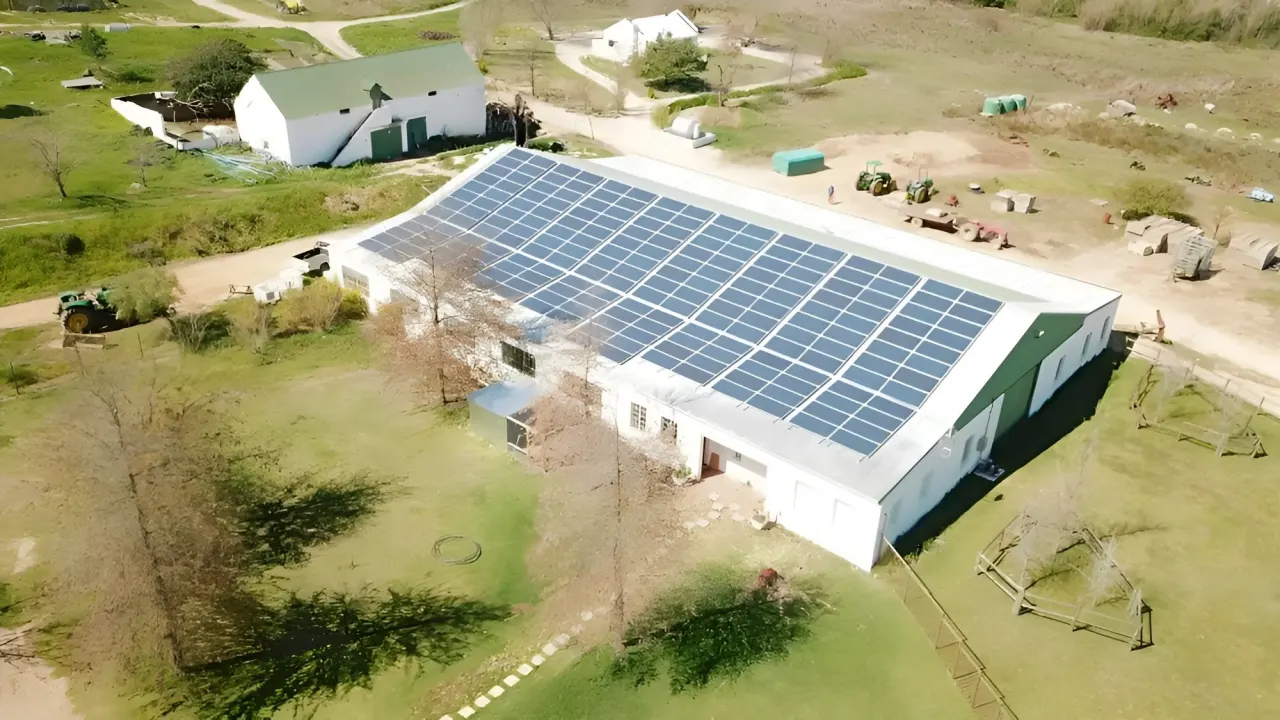
Industrial facilities across South Africa face mounting pressure from escalating electricity tariffs, grid instability, and increasingly stringent environmental, social, and governance (ESG) requirements. Industrial solar panels have emerged as a strategic solution that addresses all three challenges simultaneously, offering manufacturers, warehouses, and processing plants a pathway to energy independence whilst reducing operational expenditure. As 2026 unfolds, the technology has matured significantly, with installation costs declining and performance metrics improving year-on-year, making large-scale photovoltaic systems financially viable for a broader range of industrial applications than ever before.
Understanding Industrial Solar Panel Systems
Industrial solar panels differ substantially from residential or small commercial systems in scale, design philosophy, and operational requirements. These installations typically range from 100 kW to several megawatts, necessitating robust structural engineering, sophisticated electrical design, and integration with existing industrial power infrastructure.
Technical Specifications and Module Selection
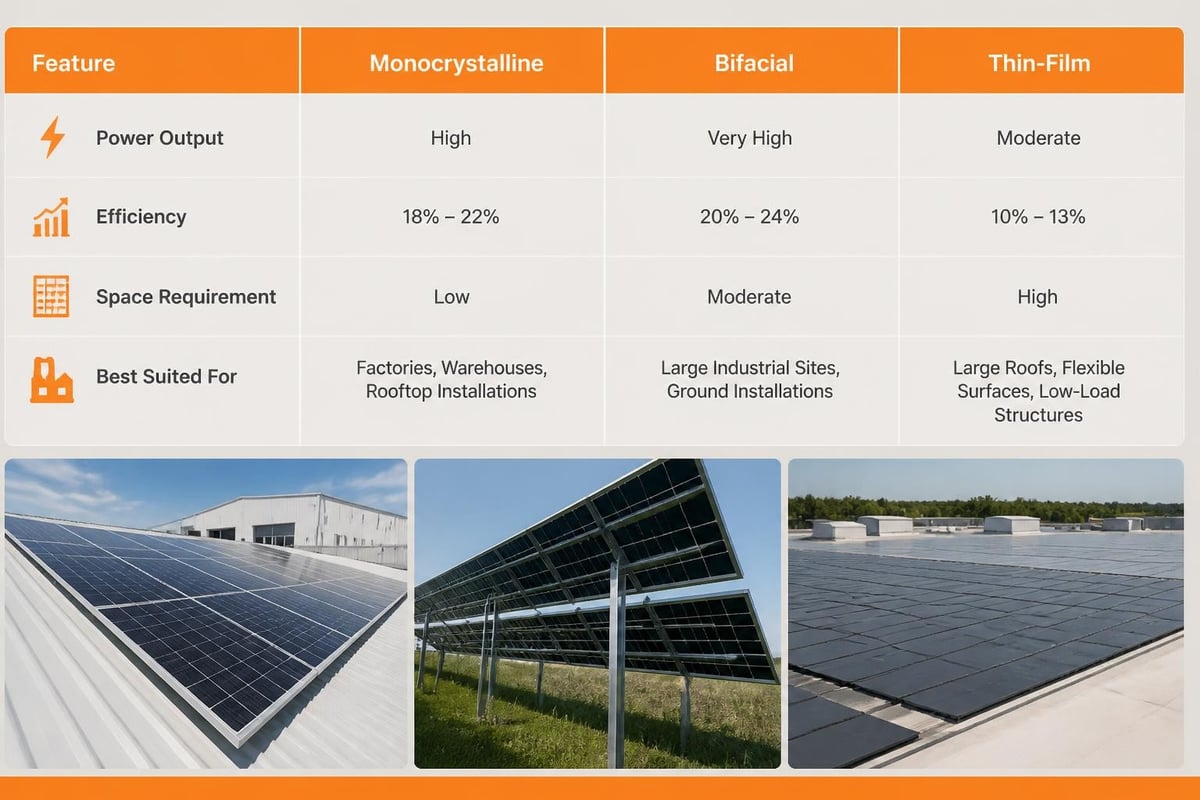
Modern industrial solar panels deployed in 2026 predominantly utilise monocrystalline silicon cells with efficiencies exceeding 21%, though bifacial modules are gaining significant traction in ground-mounted applications. The IEC 61730 standard governs module safety and construction requirements, ensuring industrial-grade panels meet stringent durability thresholds for harsh operating environments.
Key technical parameters for industrial module selection include:
- Power output: Typically 450W to 670W per module for current-generation industrial panels
- Temperature coefficient: -0.35%/°C or better for optimal hot-climate performance
- Mechanical load resistance: Minimum 5,400 Pa for wind and snow loads
- Degradation rate: Less than 0.45% annually over 25-year operational life
- Warranty structure: 25-year linear performance guarantee, 12-year product warranty
The choice between monofacial and bifacial technology represents a critical decision point. Recent research published in Nature Scientific Reports demonstrates that vertically mounted bifacial systems can achieve yield gains of 10-30% in industrial applications where land or roof space is constrained, making them particularly suitable for sites with limited installation area but high energy demand.
System Architecture and Configuration
Industrial solar installations require carefully engineered system architecture that balances capital expenditure, energy yield, and operational flexibility. The fundamental decision between grid-tied, hybrid, and off-grid configurations depends on site-specific factors including grid reliability, tariff structure, and load profile.
| Configuration Type | Capital Cost (ZAR/kW) | Grid Dependency | Battery Required | Typical Application |
|---|---|---|---|---|
| Grid-tied | 11,000 - 14,000 | High | No | Cost reduction, stable grid |
| Hybrid | 18,000 - 24,000 | Medium | Yes | Load shedding protection |
| Off-grid | 28,000 - 35,000 | None | Yes | Remote facilities, mines |
Inverter selection represents another critical component, with string inverters dominating smaller installations (100-500 kW) whilst central inverters prove more economical for multi-megawatt deployments. The latest generation of industrial inverters incorporates advanced grid-support functions, reactive power control, and remote monitoring capabilities that facilitate compliance with utility interconnection requirements outlined in the U.S. Department of Energy's interconnection roadmap, principles increasingly adopted by South African distribution network operators.
Financial Considerations and Return on Investment
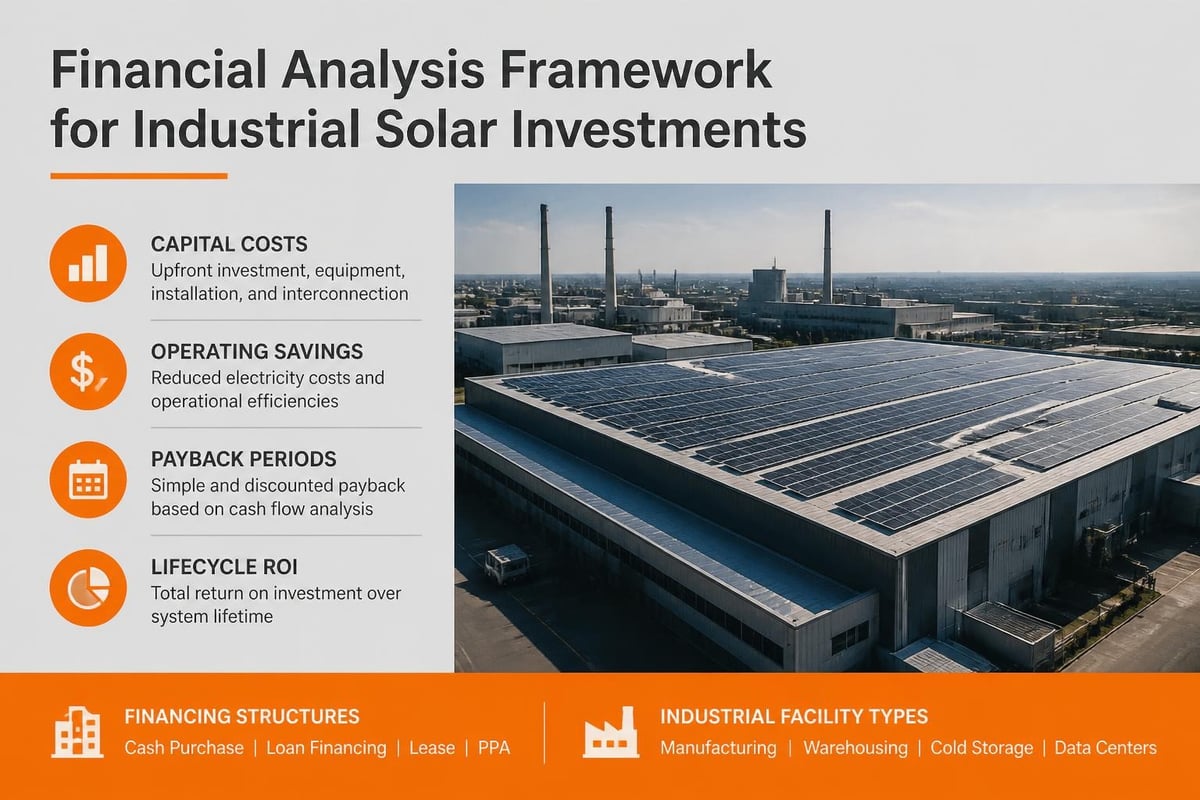
The economics of industrial solar panels in South Africa have improved dramatically, with levelised cost of electricity (LCOE) from industrial photovoltaic systems now substantially below municipal tariff rates for most commercial and industrial customers. Understanding the financial mechanics enables informed decision-making and accurate ROI projections.
Capital Expenditure and Financing Mechanisms
Industrial solar panel installations in 2026 typically require capital investment ranging from ZAR 12,000 to ZAR 18,000 per kilowatt installed, depending on mounting configuration, system size, and site complexity. A 500 kW rooftop system for a Gauteng manufacturing facility, for example, would require approximately ZAR 6 million to ZAR 8 million in upfront capital.
Financing options available to South African industrial clients include:
- Direct purchase: Outright capital expenditure with accelerated depreciation benefits
- Power purchase agreements (PPAs): No upfront cost, fixed energy tariff for 15-20 years
- Operating leases: Monthly rental payment structure with tax advantages
- Green finance facilities: Preferential lending rates from development finance institutions
- Blended finance structures: Combination of debt, equity, and concessional capital
The World Bank's renewable energy financing guidance highlights how blended finance mechanisms can reduce the cost of capital for industrial renewable projects, particularly for energy-intensive sectors facing competitive pressure.
Operational Savings and Payback Analysis
Industrial solar panels generate savings through multiple mechanisms beyond simple electricity cost displacement. A comprehensive financial analysis must account for avoided network charges, demand charge reduction, carbon tax mitigation, and hedging against future tariff escalation.
For a typical industrial facility consuming 200,000 kWh monthly at Megaflex tariff rates, a well-designed solar installation can deliver:
- Monthly savings: ZAR 180,000 - ZAR 240,000 (depending on time-of-use optimisation)
- Annual savings: ZAR 2.16 million - ZAR 2.88 million
- Simple payback: 3.5 - 4.5 years (direct purchase)
- Internal rate of return: 18% - 26% over 25 years
These figures assume conservative performance metrics and exclude potential revenue from carbon credits or renewable energy certificates, which may provide additional value streams for certain industrial applications. Facilities exploring solar energy for business applications should conduct detailed load studies and financial modelling to optimise system sizing and configuration.
Installation Methodologies for Industrial Applications
The physical installation of industrial solar panels requires meticulous planning, structural engineering, and project management to minimise disruption to ongoing operations whilst ensuring system longevity and performance. Installation methodology varies significantly based on mounting location and facility characteristics.
Rooftop Installations
Rooftop solar represents the most common configuration for industrial facilities, leveraging otherwise unutilised space whilst avoiding land acquisition costs. However, not all industrial roofs suit solar panel installation.
Critical assessment factors include:
- Structural capacity to support 15-20 kg/m² additional load
- Roof condition and remaining service life (minimum 20 years recommended)
- Roof material compatibility (metal sheeting, concrete, composite panels)
- Obstruction analysis (HVAC equipment, skylights, service penetrations)
- Maintenance access requirements and safety systems
Professional engineering assessment is mandatory, particularly for older industrial buildings constructed before current structural codes. Renewable Energy Engineering Services encompass comprehensive structural analysis, load calculations, and certification to ensure compliance with SANS 10400 building regulations and OHS Act requirements.
The installation process for a typical 500 kW industrial rooftop system proceeds through distinct phases:
- Structural reinforcement (if required): 2-3 weeks
- Mounting rail installation: 1-2 weeks
- Module installation and DC cabling: 2-3 weeks
- Inverter and AC integration: 1 week
- Testing, commissioning, and grid connection: 1-2 weeks
Total project duration typically ranges from 8 to 12 weeks for standard installations, with larger or more complex projects extending to 16-20 weeks.
Ground-Mounted and Carport Systems
Industrial facilities with available land often opt for ground-mounted arrays, which offer simplified installation, optimal tilt angles, and easier maintenance access compared to rooftop systems. Carport solar installations serve dual purposes, generating electricity whilst providing covered parking or storage for vehicles, equipment, or materials.
Ground-mounted industrial solar panels utilise either fixed-tilt or single-axis tracking systems. Whilst tracking systems increase capital cost by approximately 20-25%, they deliver 15-25% higher annual energy yield, improving overall economics for large installations exceeding 1 MW capacity. The decision depends on land costs, shading analysis, and operational complexity tolerance.
| Mounting Type | Capital Cost Premium | Energy Yield Gain | Maintenance Complexity | Optimal Application |
|---|---|---|---|---|
| Fixed-tilt | Baseline | Baseline | Low | Space-constrained sites |
| Single-axis tracking | +20-25% | +15-25% | Medium | Large open land areas |
| Carport | +15-20% | 0-5% | Low | Dual-use requirements |
Integration with Industrial Operations
Successful deployment of industrial solar panels extends beyond photovoltaic hardware to encompass sophisticated energy management, load optimisation, and operational integration. Modern industrial solar installations function as active energy assets rather than passive generation devices.
Energy Management and Monitoring
Industrial facilities require real-time visibility into solar generation, consumption patterns, and system performance to maximise value realisation. Advanced monitoring platforms aggregate data from solar inverters, utility meters, and production equipment to enable proactive energy management decisions.
Essential monitoring capabilities include:
- Real-time generation and consumption dashboards
- String-level performance analysis and fault detection
- Weather-normalised yield analysis and degradation tracking
- Load forecasting and demand response integration
- Financial performance reporting and savings verification
Integration with energy management systems enables automated load shifting, where energy-intensive processes are scheduled during peak solar production hours, maximising self-consumption and reducing grid demand charges. This proves particularly valuable for industrial operations with flexible production scheduling or thermal storage capabilities.
Grid Interconnection and Compliance
Connecting industrial solar panels to the distribution network requires navigating technical requirements, utility approval processes, and compliance obligations. The Department of Energy's resources on solar systems integration provide valuable frameworks, increasingly referenced by South African network operators.
Key compliance requirements include:
- Grid connection application: Submitted to local municipality or Eskom
- Network impact study: Required for installations exceeding 1 MW
- Protection equipment: Anti-islanding, over/under voltage and frequency protection
- Metering configuration: Bi-directional meters for net metering or SSEG registration
- Grid code compliance: Adherence to NRS 097-2-3 for embedded generation
Processing times for grid connection approvals vary dramatically across municipalities, ranging from 4-8 weeks in well-resourced metros to 16-24 weeks in smaller municipalities with limited technical capacity. Early engagement with network operators and submission of complete documentation packages accelerates the approval process.
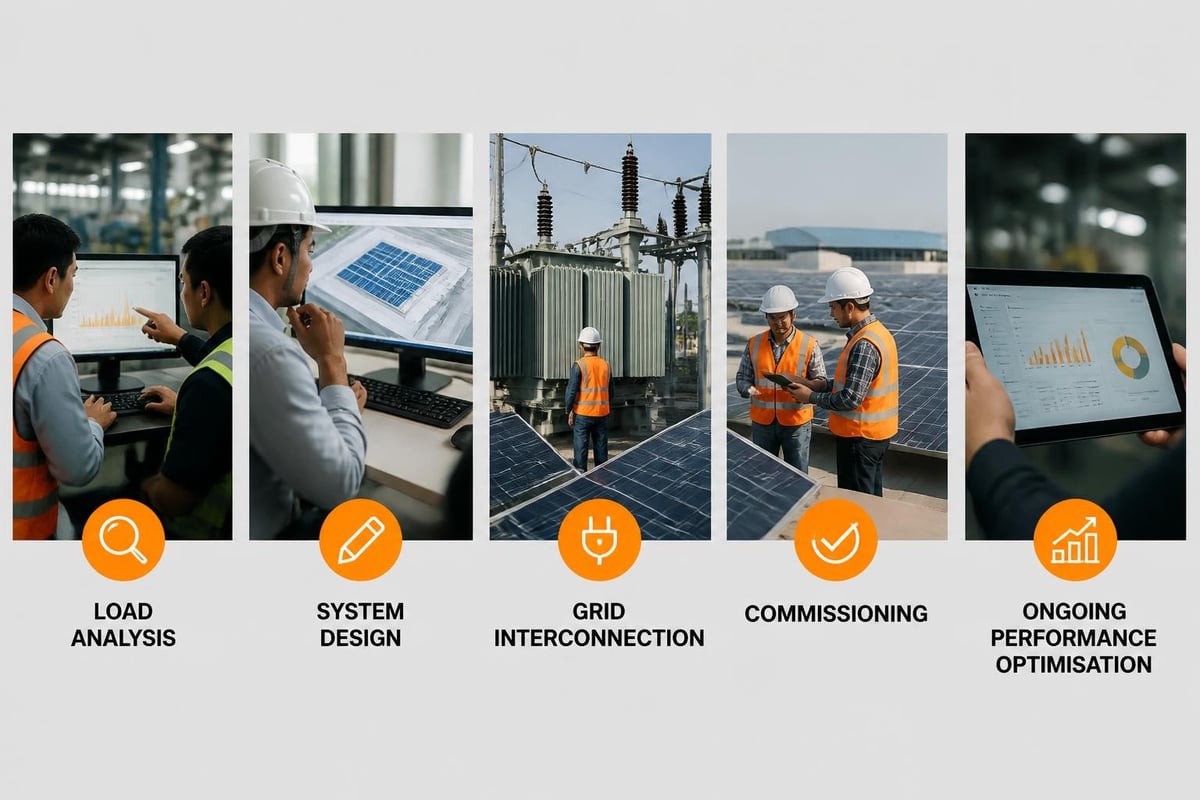
Maintenance and Performance Optimisation
Long-term performance of industrial solar panels depends critically on proactive maintenance, systematic monitoring, and rapid fault resolution. Unlike residential systems where gradual performance degradation may go unnoticed, industrial facilities require maximum availability and consistent output to achieve projected financial returns.
Preventative Maintenance Protocols
Industrial solar installations benefit from structured maintenance programmes that combine routine inspections, cleaning schedules, and condition monitoring to sustain optimal performance throughout the system lifecycle.
Recommended maintenance activities and frequencies:
| Activity | Frequency | Purpose | Typical Cost (ZAR/kW/year) |
|---|---|---|---|
| Panel cleaning | Quarterly | Soiling removal, output optimisation | 120 - 180 |
| Visual inspection | Bi-annually | Physical damage, connection integrity | 80 - 120 |
| Thermal imaging | Annually | Hot spot detection, cell failure identification | 200 - 300 |
| Inverter servicing | Annually | Component replacement, calibration | 150 - 250 |
| Performance testing | Annually | I-V curve analysis, system verification | 180 - 280 |
Cleaning proves particularly important in industrial environments where airborne particulates from manufacturing processes accelerate soiling rates. A warehouse in Ekurhuleni operating near cement production, for instance, may require monthly cleaning to maintain optimal output, whilst a food processing facility in the Western Cape might maintain adequate performance with quarterly cleaning.
Recent advances in cell-level technology have improved module resilience and reduced susceptibility to partial shading and soiling effects, though preventative maintenance remains essential for maximising energy yield and return on investment.
Performance Guarantees and Service Agreements
Industrial solar panel installations typically incorporate performance guarantees backed by comprehensive service level agreements that define availability targets, response times, and remediation obligations. These contractual protections ensure system performance meets financial projections and provide recourse in the event of underperformance.
A well-structured service level agreement for industrial solar should specify:
- Minimum energy production guarantees (typically 90-95% of P50 yield projection)
- System availability targets (>98% annually)
- Fault response times (4-8 hours for critical failures, 24-48 hours for non-critical issues)
- Scheduled maintenance windows and operational coordination
- Performance reporting frequency and format
- Warranty claim administration and equipment replacement procedures
Environmental and Regulatory Considerations
Industrial solar panels deliver measurable environmental benefits whilst introducing end-of-life management obligations and regulatory compliance requirements. Understanding these dimensions ensures sustainable project development and avoids future liabilities.
Carbon Reduction and ESG Impact
A 1 MW industrial solar installation in South Africa typically displaces approximately 1,800 tonnes of CO₂ annually, based on the carbon intensity of grid electricity in 2026. Over a 25-year operational life, a single megawatt installation prevents 45,000 tonnes of greenhouse gas emissions, equivalent to removing 9,750 passenger vehicles from South African roads for one year.
This carbon reduction translates directly into corporate ESG performance metrics, sustainability reporting credentials, and potential participation in carbon markets. Industrial facilities pursuing Net Zero commitments find solar installations essential for Scope 2 emissions reduction, whilst the electricity cost savings fund further decarbonisation initiatives.
Lifecycle Management and Recycling
Industrial solar panels contain valuable materials including silicon, silver, copper, and aluminium that can be recovered and recycled at end-of-life. However, South Africa currently lacks comprehensive photovoltaic recycling infrastructure, creating future waste management challenges as the installed base ages.
Forward-thinking industrial facility operators should:
- Specify module manufacturers with take-back programmes
- Budget for end-of-life disposal costs (estimated ZAR 800-1,200 per tonne in 2026)
- Monitor regulatory developments around Extended Producer Responsibility
- Explore solar panel recycling options and emerging local infrastructure
Module lifetimes exceeding 30 years with degradation rates below 0.4% annually mean that panels installed in 2026 will remain productive well into the 2050s, but planning for eventual decommissioning ensures environmental stewardship and avoids future liabilities.
Future Developments and Technology Trends
The industrial solar panel sector continues evolving rapidly, with emerging technologies and business models reshaping the value proposition for industrial energy users. Understanding these trends enables strategic planning and future-proofing of solar investments.
Technology Roadmap
Several technological developments will influence industrial solar panel selection and system design in the coming years:
- Tandem cell technology: Silicon-perovskite tandem cells achieving 30%+ efficiency in laboratory settings, with commercial availability expected by 2028-2029
- Advanced bifacial designs: Optimised rear-side light capture and improved angular response characteristics
- Integrated storage: Factory-integrated DC-coupled battery systems for seamless hybrid operation
- Smart modules: Panel-level optimisation, monitoring, and safety features embedded within junction boxes
- Floating solar: Adaptations enabling installation over industrial water storage or treatment facilities
These advances will progressively reduce the levelised cost of solar electricity whilst improving space efficiency and integration possibilities for industrial applications. Facilities planning commercial solar PV installations should maintain design flexibility to accommodate future technology upgrades.
Regulatory and Market Evolution
South Africa's regulatory environment for industrial solar continues maturing, with several developments affecting project economics and feasibility:
- Embedded generation licensing thresholds: Current 100 MW registration limit provides ample headroom for industrial projects
- Wheeling regulations: Progressive municipalities enabling solar energy wheeling from off-site installations to industrial facilities
- Carbon tax escalation: Annual increases in carbon tax rates (ZAR 190 per tonne in 2026) improve solar economics
- Green hydrogen integration: Emerging demand for renewable electricity to power electrolysis for industrial hydrogen production
- Grid services markets: Potential revenue from ancillary services and demand response programmes
Industrial solar panels represent a proven, economically compelling solution for South African manufacturers, warehouses, and processing facilities seeking to reduce energy costs, improve operational resilience, and meet sustainability commitments. The technology has matured substantially, with installations delivering reliable performance, predictable returns, and measurable environmental benefits across diverse industrial applications. INFOLED provides comprehensive renewable energy engineering services encompassing feasibility studies, system design, project financing, installation, and long-term operations and maintenance for industrial clients throughout Southern Africa, ensuring your solar investment delivers maximum value across its operational lifetime.
Next Step
Need help with your energy strategy?
Speak to INFOLED about solar, storage, EV charging, service agreements or system performance.