
Industrial solar systems are large-scale photovoltaic (PV) installations, often paired with battery storage, that supply a factory, warehouse or processing plant with its own electricity and cut the amount bought from Eskom or the municipality. In South Africa, they are typically sized from a few hundred kilowatts to several megawatts, and they can be funded through service agreements that require no upfront capital from the business.
For property owners and operators facing annual tariff increases and unreliable grid supply, the question is no longer whether solar makes financial sense, but how to structure it. This guide covers system types, sizing, storage, wheeling, financing and the practical steps that determine whether a project delivers the savings promised.
What Are Industrial Solar Systems and How Do They Work?
An industrial solar system converts sunlight into electricity through PV panels, then conditions that power through inverters so it can run machinery, refrigeration, lighting and compressors on site. Surplus generation either charges batteries, is curtailed, or, where the municipality permits, is exported to the grid.
A typical installation includes five core components:
- PV modules, mounted on rooftops, carports or ground frames
- Inverters, which convert direct current to alternating current and manage grid interaction
- Mounting structures, engineered for local wind loads and roof type
- Protection and metering equipment, including isolators, surge protection and smart meters
- Monitoring software, which tracks output and flags faults in real time
Many South African industrial sites receive high levels of annual solar irradiation, which makes solar a strong option. A well-designed system in Gauteng, the Western Cape or KwaZulu-Natal can therefore generate predictable output across most of the year, with winter yields lower but still meaningful.
Types of Industrial Solar Installations
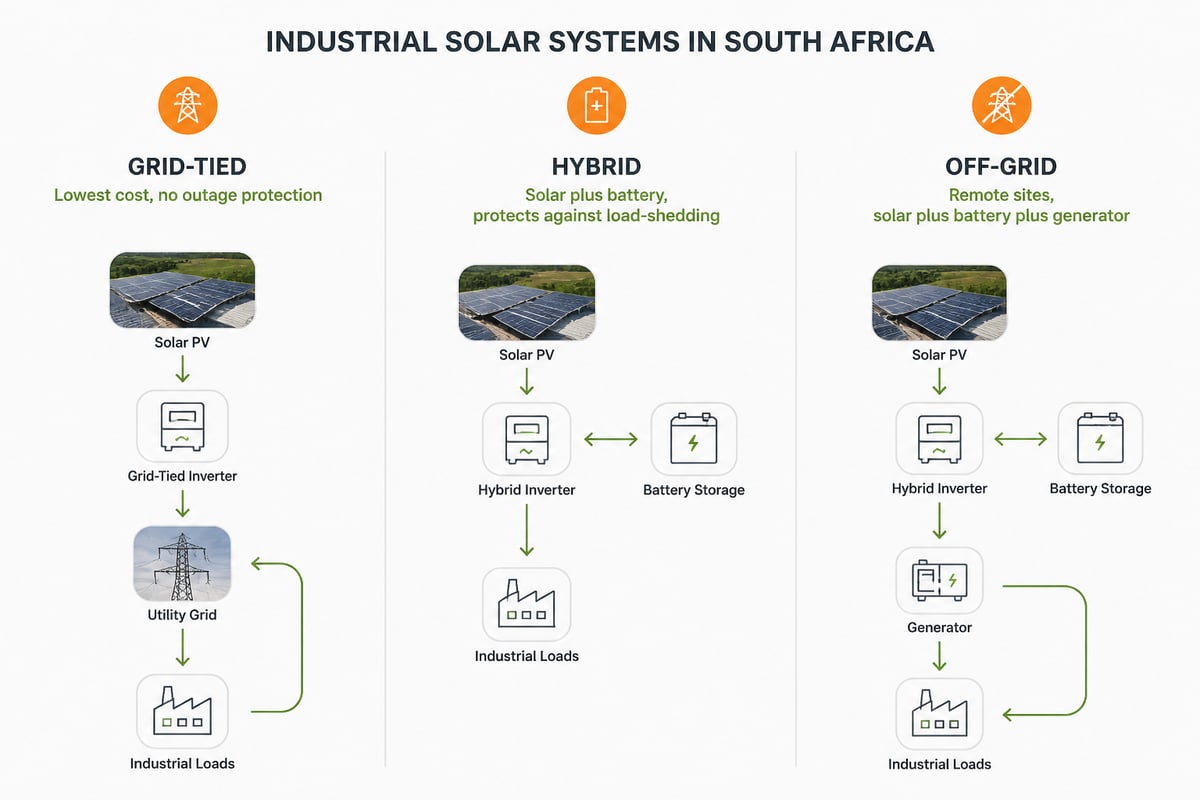
The main types are grid-tied, hybrid and off-grid systems, and the right choice depends on how much the site values resilience compared with pure cost reduction.
| System type | How it works | Typical use case |
|---|---|---|
| Grid-tied | Solar offsets daytime grid consumption; no storage | Day-shift manufacturing, warehousing with stable supply |
| Hybrid | Solar plus batteries, with grid as backup | Cold storage, food processing, sites with outage exposure |
| Off-grid | Solar, batteries and often a generator, with no grid connection | Remote mining, agricultural and processing sites |
Grid-tied systems deliver the fastest payback because they avoid battery costs. Hybrid systems protect production during load-shedding and municipal outages, which matters where a single stoppage can spoil stock or halt a line. Off-grid systems are a niche solution, reserved for locations where a grid connection is unavailable or unreliable.
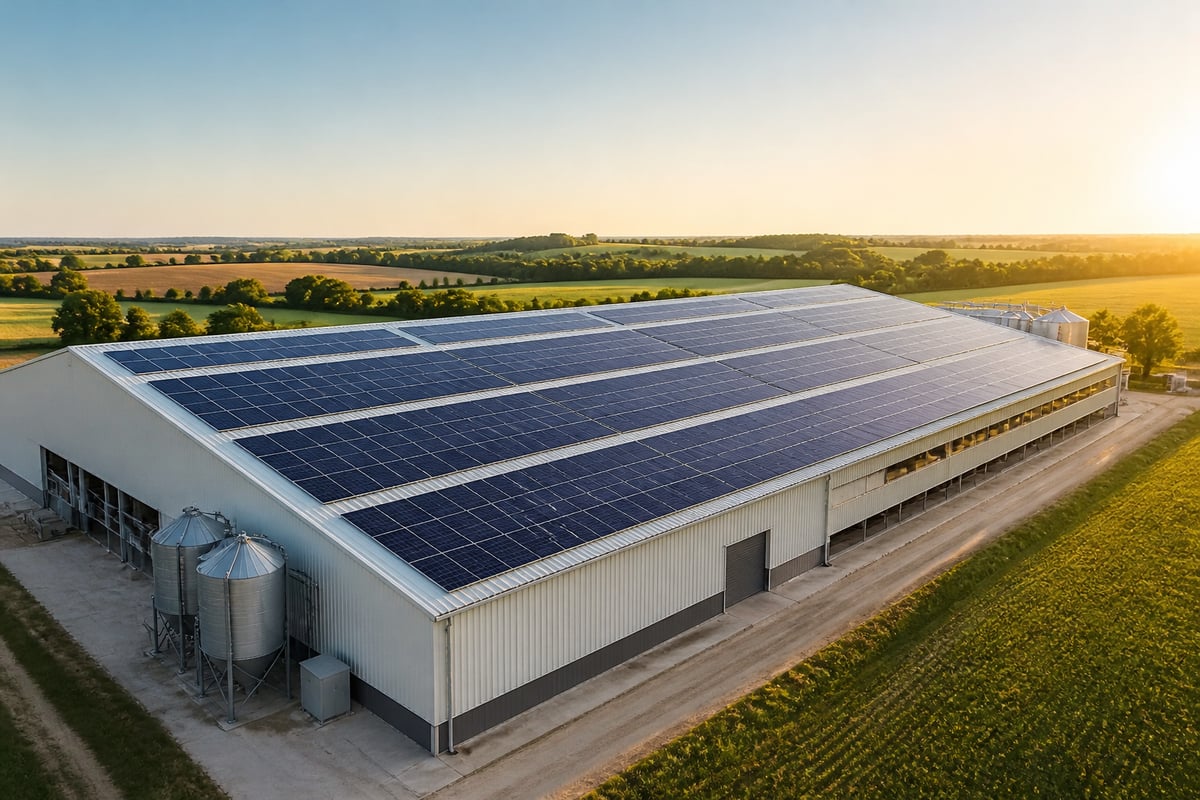
The physical installation also varies. Rooftop arrays use existing building surface and cause no loss of productive land. Ground-mount systems suit sites with spare yard or farmland, and carports add generation over parking while providing shade and a platform for EV charging. A guide to ground-mounted solar power explains when the extra civil work is justified.
How Much Do Industrial Solar Systems Cost in South Africa?
Commercial and industrial solar PV costs vary with scale, roof conditions and specification, and a quote should be obtained for each project. Battery storage adds substantially to the cost, and pricing depends on scale and supplier.
These are indicative ranges. Final pricing depends on:
- Roof condition and structure, including any required reinforcement or re-sheeting
- Distance to the main distribution board and the grid connection upgrades needed
- Panel and inverter specification, and whether components are locally stocked
- Site access, working-at-heights requirements and installation programme
- Compliance requirements, such as NRS 097-2-1 for grid-tied embedded generation and municipal registration
For a deeper look at how these variables combine, see this breakdown of solar costs, and use a solar cost calculator to test scenarios against your own consumption profile.
VAT at 15% applies to equipment and installation, though VAT-registered businesses can generally claim input tax. The Income Tax Act has also allowed accelerated deductions on renewable energy assets, which can reduce the effective cost for businesses that own their systems. Confirm current eligibility with a tax adviser, as these allowances have been revised in recent budgets.
Can You Go Solar With No Capital Outlay?
Yes. Many South African businesses now adopt industrial solar systems through an operating-expense model, where a provider designs, finances, installs and maintains the plant, and the client pays for the energy produced rather than buying the hardware.
The mechanics are straightforward. The provider owns the asset and the client signs a multi-year agreement, typically at a tariff set below the current municipal or Eskom rate. Savings begin from the first month, and the business avoids tying up capital that would otherwise be spent on machinery, stock or expansion.
For commercial and industrial property owners, this model offers specific advantages:
- No capital expenditure, protecting cash flow and credit lines
- Maintenance and monitoring responsibilities sit with the provider
- Performance risk is carried by the party that designed the system
- Tariff certainty against annual electricity price escalations
INFOLED structures financing around the client's cash flow, with zero capital investment and multi-year agreements. Businesses weighing this route can read more about solar funding options and how different models compare on total cost of energy.
Wheeling and the Removal of the Licensing Cap
Wheeling allows electricity generated at one site to be transported through the Eskom or municipal network and consumed at another, which opens solar to businesses without enough roof space of their own.
South Africa has progressively liberalised embedded generation. The Electricity Regulation Act was amended so that many generation facilities no longer require a licence, subject to registration with the National Energy Regulator of South Africa (NERSA). Removing earlier licensing limits has enabled larger private plants and multi-site supply arrangements.
For a business with several facilities, such as a retailer with branches in Johannesburg, Durban and Cape Town, wheeling can aggregate demand under a single supply agreement. It involves wheeling charges, network use-of-system fees and a contract with the municipality or Eskom, so the economics need careful modelling. Wheeling suits larger energy users; most single-site operations will find on-site generation simpler and faster to deploy.
Adding Battery Storage and Energy Management
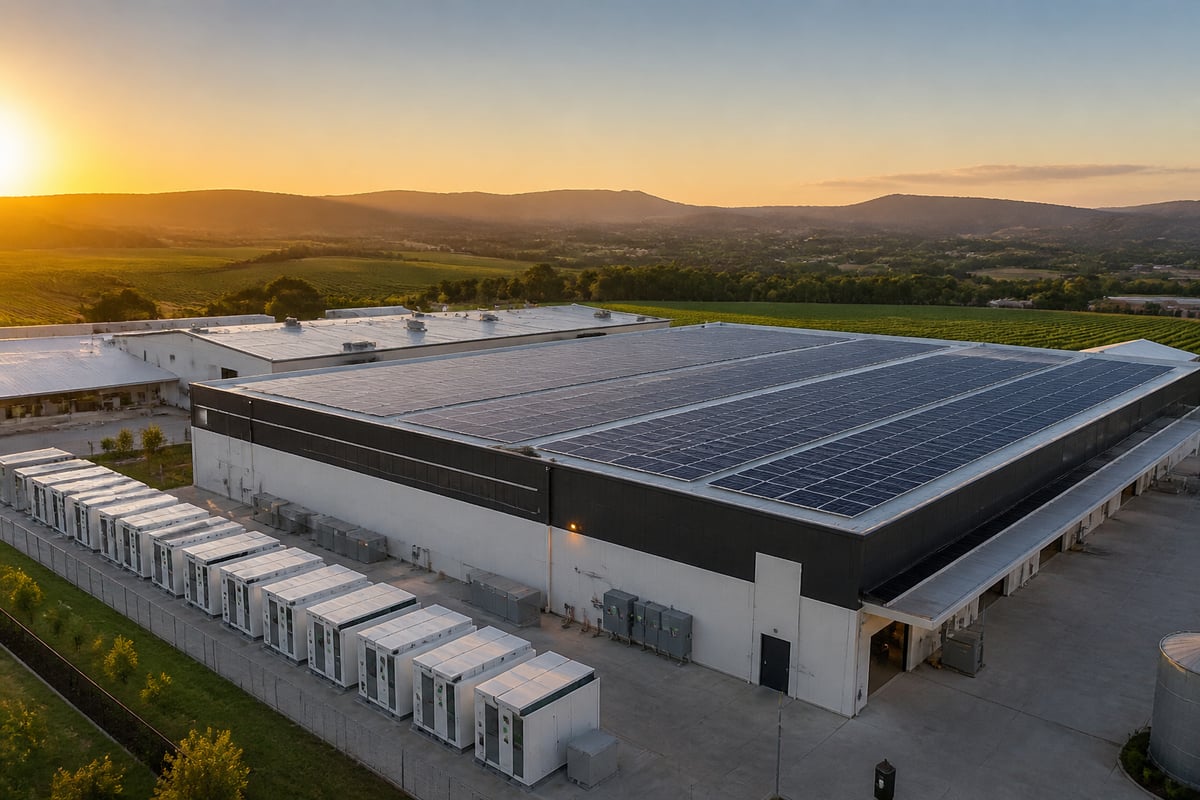
Battery energy storage systems (BESS) let a plant shift solar energy into evening hours, ride through outages and shave peak demand charges, and they are increasingly standard on new industrial projects.
Storage creates value in three ways. First, it provides resilience during load-shedding or grid faults. Second, it reduces maximum demand charges, which on many time-of-use tariffs make up a large share of the monthly bill. Third, it allows more of the solar output to be used on site instead of being curtailed or exported at low value.
Sizing is the critical decision. Oversized batteries leave capital idle, while undersized ones fail to protect critical loads. A load profile study over at least 12 months of half-hourly data is the sound starting point. Further reading on solar and battery storage and energy management systems shows how control software coordinates solar, storage and grid import to minimise cost.
Real South African Project Examples
South African industrial rooftops are already delivering at multi-megawatt scale, and completed projects offer useful benchmarks for system size and configuration.
INFOLED has completed several installations that illustrate the range:
- 1.3 MWp rooftop solar PV at UPD Rooftop, Lea Glen
- 1.947 MWp solar PV at CTP Parow, Cape Town
- 266 kWp solar PV with 512 kWh battery storage at Nutec Ink, Ottery
The Nutec Ink project shows how a mid-sized manufacturer can pair generation with storage to address both cost and continuity. The larger Parow and Lea Glen systems reflect the logistics and distribution sector, where wide, unobstructed roofs and daytime-heavy consumption suit solar well. Businesses exploring similar installations can review INFOLED's commercial, industrial, agricultural and residential solar PV work, which covers design, financing, monitoring and asset management under one provider.
How to Plan an Industrial Solar Project
A successful project follows a clear sequence, and skipping early analysis is the most common cause of underperformance.
- Gather consumption data. Collect at least 12 months of electricity bills and, where available, half-hourly interval data from smart meters.
- Assess the site. Check roof age, structural capacity, orientation, shading and available electrical capacity.
- Define objectives. Decide whether the priority is cost reduction, outage protection, ESG reporting or a mix.
- Model the options. Compare grid-tied, hybrid and financed models on lifetime cost, not just upfront price.
- Confirm compliance. Arrange municipal approval, NERSA registration where applicable, and a registered installer holding the correct certification.
- Commission and monitor. Insist on documented testing, handover data and live monitoring from day one.
Quality control separates reliable systems from troublesome ones. INFOLED has every installation tested and inspected by an in-house quality control team, and live monitoring with proactive maintenance keeps systems running at maximum uptime. Performance data is also turned into reports that show where energy is being lost and how to recover it, which matters because an unmonitored array can lose several percentage points of yield to soiling, faulty strings or inverter issues without anyone noticing.
Distributors such as IBC SOLAR South Africa supply modules and components to installers, but the system's long-term performance depends on engineering, workmanship and maintenance rather than on hardware alone. Further guidance on the commercial angle is available in this overview of commercial solar PV.
Benefits of Solar Energy for Industrial Users
The main benefits of solar for industry are lower and more predictable electricity costs, reduced exposure to outages, and measurable progress on carbon targets.
- Cost control: Solar energy can be priced below grid tariffs, and it shields a business from future Eskom increases.
- Resilience: Paired with storage, solar keeps critical processes running during load-shedding and municipal faults.
- ESG and Net Zero: Each megawatt-hour generated displaces grid power that in South Africa is heavily coal-based, so solar delivers quantifiable emissions reductions for reporting and supply-chain requirements.
- Property value: Buildings with installed generation are increasingly attractive to tenants who want lower occupancy costs.
- Scalability: Arrays can be extended later as demand grows or as EV charging is added to the site.
A broader look at the pros of solar power covers these points alongside environmental and economic considerations.
FAQ
Can I run a 1.5 ton air conditioner on a 3 kW solar system?
Usually yes for a single unit, provided the inverter can handle the starting surge and the system has enough panels and battery capacity for the duration. A 1.5 ton inverter-type air conditioner typically draws around 1.2 to 1.8 kW when running, but starting current can be several times higher. Industrial users cooling larger spaces will need a properly sized system rather than a 3 kW installation.
How many solar plants are there in South Africa?
South Africa has a growing number of utility-scale solar plants procured through the Renewable Energy Independent Power Producer Procurement Programme, alongside many private rooftop installations. The private commercial and industrial segment has grown since licensing requirements were relaxed. Current figures are best taken from NERSA and the Department of Electricity and Energy.
How long do industrial solar systems last?
Quality PV modules typically carry long performance warranties, with gradual output decline over time. Inverters generally need replacement after some years of service, and lithium batteries are commonly warranted for a set period or number of cycles. Regular maintenance and monitoring help systems reach or exceed these lifespans.
Your next step is to gather 12 months of electricity bills for each site you operate, since that data lets an engineer size a system accurately and model the savings before you commit to anything. From there, INFOLED can assess your roof, load profile and tariff, and its Commercial, Industrial, Agricultural and Residential Solar PV service covers design, installation, monitoring and maintenance through a single provider. If you want solar without upfront capital, you can use INFOLED to check funding eligibility and find out whether a five-year, zero-capex agreement suits your business.
Next Step
Need help with your energy strategy?
Speak to INFOLED about solar, storage, EV charging, service agreements or system performance.