

Making informed decisions about solar energy investments requires accurate financial projections, detailed cost breakdowns, and realistic savings estimates. A solar cost calculator has become an essential tool for commercial, industrial, and residential clients across Southern Africa who need to evaluate the economic viability of photovoltaic systems before committing capital. These digital planning tools transform complex engineering data, electricity tariff structures, and equipment specifications into clear financial insights that support strategic energy decisions.
Understanding Solar Cost Calculator Fundamentals
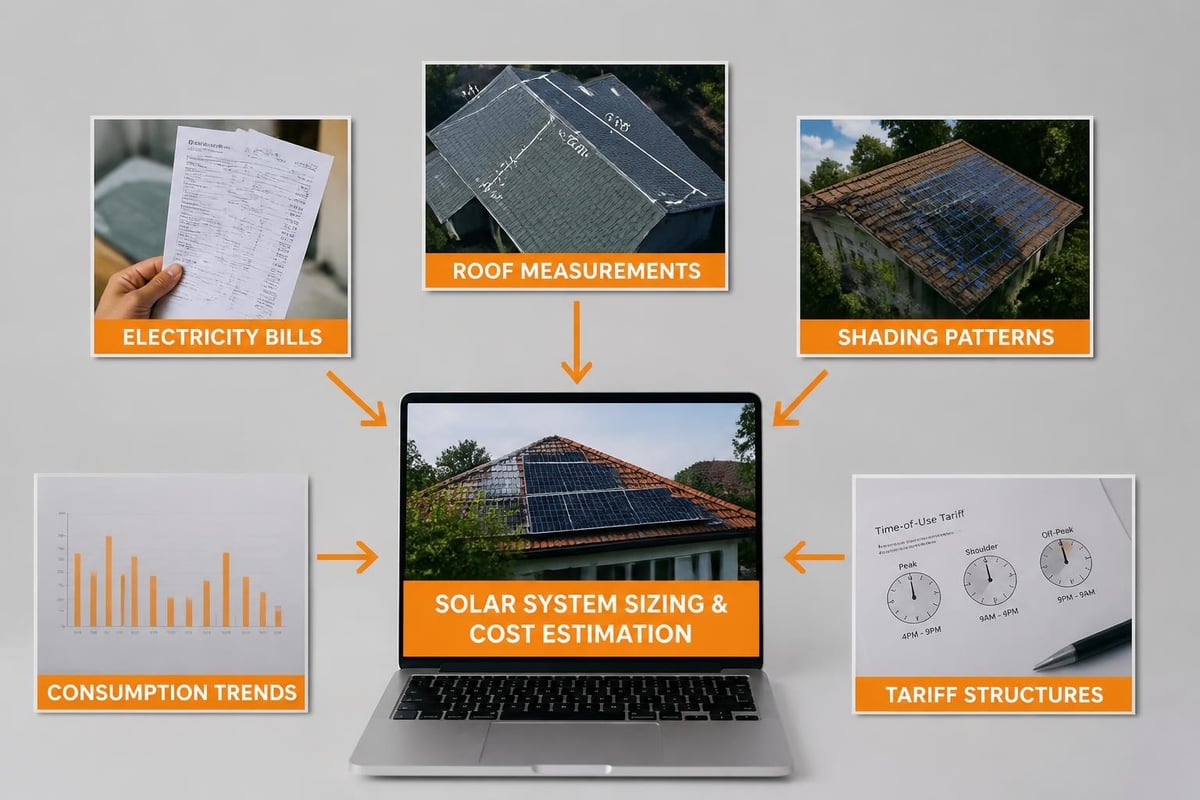
A solar cost calculator processes multiple variables to generate customised financial projections for photovoltaic installations. These tools account for system size, equipment quality, installation complexity, available roof or ground space, and local electricity rates to produce accurate estimates. In South Africa, where load shedding and escalating municipal tariffs have accelerated solar adoption, these calculators have evolved to incorporate backup power requirements and grid independence scenarios.
Core Input Variables
Effective solar cost calculators require specific information to deliver meaningful results:
- Monthly electricity consumption (kWh) from recent utility bills
- Available installation area measured in square metres
- Roof orientation and pitch affecting panel efficiency
- Shading analysis throughout different seasons
- Current electricity tariff including demand charges for commercial users
- Budget constraints or financing preferences
- Energy resilience requirements during grid outages
The accuracy of calculator outputs depends directly on the precision of these inputs. Commercial and industrial clients should gather at least twelve months of electricity bills to identify seasonal consumption patterns and peak demand periods. According to the U.S. Department of Energy's analysis, understanding these variables helps clarify payback periods and long-term savings potential.
System Sizing and Equipment Specifications
Professional solar cost calculators translate consumption data into specific system recommendations. A typical household consuming 900 kWh monthly might require a 6 kW system, whilst a manufacturing facility drawing 50,000 kWh could need 200 kW or more. The calculator accounts for South Africa's excellent solar irradiation levels, which average 4.5 to 6.5 peak sun hours daily depending on location.
| System Size | Typical Application | Panel Count (400W) | Estimated Area Required |
|---|---|---|---|
| 5 kW | Small residence | 13 panels | 25 m² |
| 10 kW | Large home / small business | 25 panels | 48 m² |
| 50 kW | Commercial building | 125 panels | 240 m² |
| 250 kW | Industrial facility | 625 panels | 1,200 m² |
Equipment selection significantly impacts both upfront costs and long-term performance. Premium monocrystalline panels with 22% efficiency command higher prices than polycrystalline alternatives but deliver superior output in limited space. Inverter choice equally affects system cost, with string inverters offering economy whilst microinverters provide module-level optimisation and monitoring.
Installation Cost Breakdown
Current market conditions in South Africa show installed solar costs ranging from ZAR 12,000 to ZAR 18,000 per kW for residential systems, whilst commercial installations achieve economies of scale at ZAR 10,000 to ZAR 14,000 per kW. A comprehensive solar cost calculator itemises these expenses:
Equipment costs (60-70% of total):
- Solar panels
- Inverters
- Mounting structures
- Electrical components
- Monitoring systems
Installation services (20-25%):
- Engineering and design
- Labour and commissioning
- Electrical compliance certification
- Grid connection applications
Soft costs (10-15%):
- Project management
- Permits and approvals
- Insurance during construction
- Performance testing
Global benchmarking data from the Department of Energy's cost analysis shows consistent price declines, but South African costs must account for import duties, currency fluctuations, and local installation standards.
Financial Returns and Payback Analysis
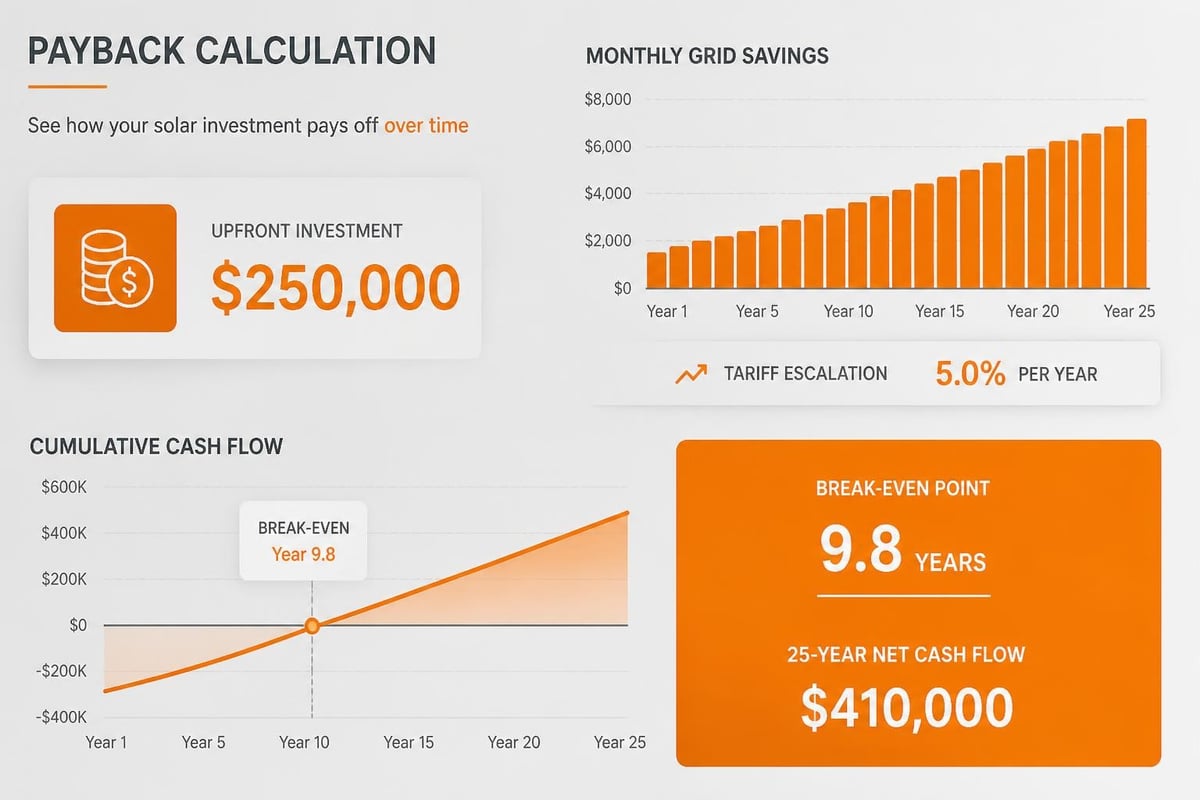
The primary value of a solar cost calculator lies in projecting financial returns over the system's operational lifetime. These tools model monthly savings by comparing grid electricity costs against solar generation, factoring in degradation rates (typically 0.5% annually) and maintenance requirements.
A properly configured calculator shows that commercial clients in Johannesburg or Cape Town currently achieve payback periods of 4 to 6 years, whilst residential systems typically recover costs within 5 to 8 years. These timelines improve substantially when facilities maximise self-consumption during expensive daytime tariff periods.
Savings Calculation Methodology
Monthly savings calculations follow this framework:
- Solar generation estimate based on system size and local irradiation
- Self-consumption ratio determining how much generated power displaces grid purchases
- Grid electricity avoided multiplied by current tariff rates
- Tariff escalation assumptions (historically 8-12% annually in South Africa)
- System degradation reducing output gradually over time
- Maintenance costs deducted from gross savings
The RMI Green Upgrade Calculator methodology demonstrates transparent approaches to these calculations, showing how different assumptions affect projected returns. South African calculators must additionally account for load shedding impacts, which increase the value of solar installations providing operational continuity.
Incentives and Financing Mechanisms
Sophisticated solar cost calculators incorporate available incentives that improve project economics. South Africa's Section 12B tax allowance permits businesses to deduct 125% of renewable energy asset costs in the first year, substantially accelerating payback for commercial and industrial clients. The calculator models this benefit alongside other financial mechanisms.
Available Financial Support
Current South African incentives include:
- Section 12B tax deduction for businesses investing in renewable energy
- Commercial financing options from banks and renewable energy funds
- Power purchase agreements requiring minimal upfront capital
- Leasing structures preserving cash flow whilst accessing solar benefits
- VAT recovery for registered businesses on equipment and installation costs
When exploring commercial solar PV options, businesses should use calculators that properly account for tax benefits and financing costs. A ZAR 2 million installation might reduce taxable income by ZAR 2.5 million under Section 12B, creating immediate tax savings of ZAR 700,000 for a company in the 28% bracket.
Hybrid System Considerations
Modern solar cost calculators extend beyond grid-tied systems to model hybrid configurations incorporating battery storage. For South African clients facing regular load shedding, these integrated solutions deliver both cost savings and energy security. The calculator must balance increased upfront investment against expanded benefits.
Battery energy storage adds ZAR 8,000 to ZAR 15,000 per usable kWh to system costs, but enables load shifting, backup power, and reduced demand charges. A commercial facility might install a 100 kW solar array with 200 kWh of battery storage, using the calculator to optimise the balance between renewable generation and storage capacity.
INFOLED's experience designing Commercial, Industrial, Agricultural and Residential Battery Energy Storage Systems (BESS) demonstrates how integrated storage solutions enhance solar investment returns through peak shaving, demand management, and backup power capabilities that extend beyond simple grid-tied generation.
Tariff Structure Impact
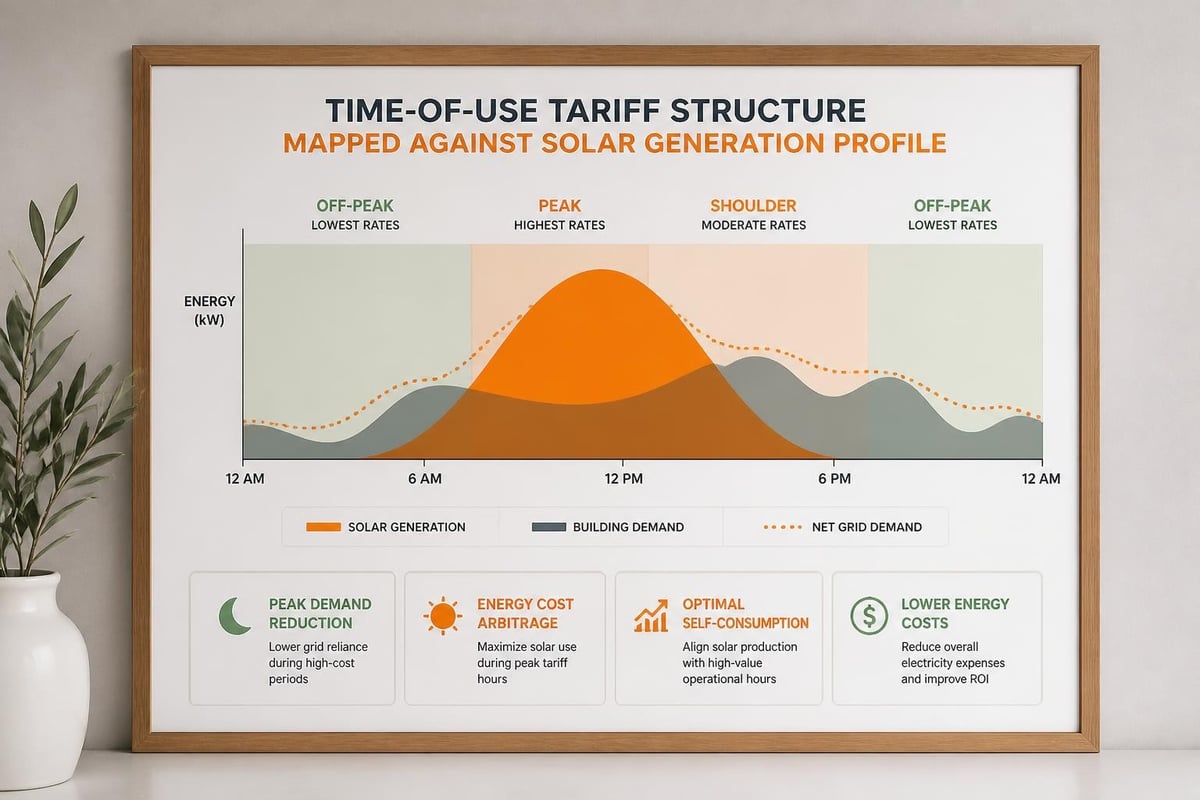
South Africa's complex electricity tariffs significantly influence solar economics. Time-of-use rates charge different prices for peak, standard, and off-peak consumption, whilst commercial clients face demand charges based on maximum monthly draw. A competent solar cost calculator models these nuances:
| Tariff Component | Impact on Solar Value | Calculator Treatment |
|---|---|---|
| Peak energy rates | High solar value during generation hours | Weighted savings by time-of-use |
| Demand charges | Reduced by consumption management | Peak shaving analysis |
| Off-peak rates | Low displacement value | Minimal solar offset |
| Seasonal variations | Summer vs winter consumption patterns | Monthly generation/demand matching |
Facilities with high daytime consumption during peak tariff periods achieve superior returns from solar investments. The calculator should demonstrate how system output aligns with consumption patterns to maximise self-consumption and minimise grid reliance during expensive periods.
Environmental Impact Quantification
Beyond financial metrics, comprehensive solar cost calculators quantify environmental benefits from renewable energy adoption. These outputs support ESG reporting requirements, Net Zero commitments, and sustainability marketing initiatives increasingly important to South African businesses and their stakeholders.
The calculator converts kilowatt-hours of solar generation into meaningful equivalencies:
- Carbon dioxide avoided measured in tonnes annually
- Coal consumption displaced from Eskom's generation fleet
- Trees planted equivalent for carbon sequestration comparison
- Passenger vehicle emissions offset in vehicle-years
- Household electricity equivalents for context
Using methodologies similar to the EPA's Green Power Equivalency Calculator, these calculations assume South Africa's grid emission factor of approximately 0.95 kg CO₂ per kWh. A 100 kW commercial system generating 160,000 kWh annually avoids roughly 152 tonnes of carbon emissions, equivalent to removing 33 petrol vehicles from roads.
System Performance Monitoring
Leading solar cost calculators extend beyond installation planning to project long-term performance tracking. Monitoring capabilities allow comparison between projected and actual generation, identifying maintenance needs, degradation patterns, or underperformance requiring attention. These ongoing insights validate initial calculator assumptions and support optimisation decisions.
Performance metrics tracked include:
- Daily, monthly, and annual generation compared to modelled estimates
- Specific yield (kWh per kW installed) benchmarked against location norms
- Performance ratio accounting for losses versus ideal conditions
- Financial tracking showing actual savings versus projections
- System availability measuring uptime and reliability
Commercial Versus Residential Calculations
Solar cost calculators must accommodate fundamentally different economics between commercial and residential installations. Commercial clients benefit from larger system sizes, tax incentives, demand charge savings, and higher daytime consumption. Residential calculations focus on retail tariff offsets, lifestyle consumption patterns, and backup power value during outages.
Key Commercial Considerations
- Demand charge reduction through peak shaving
- Section 12B accelerated depreciation improving ROI
- Operational continuity value during load shedding
- Corporate sustainability targets and reporting requirements
- Power purchase agreement options as alternatives to ownership
Residential Calculation Factors
- Feed-in tariff rates for surplus generation (where available)
- Backup power requirements sized for essential loads
- Roof structural capacity and aesthetic preferences
- Financing approval criteria for residential loans
- Property value enhancement from solar installations
Understanding these distinctions ensures the solar cost calculator delivers relevant insights for each client segment. Commercial facilities should examine detailed projects to see how industrial-scale systems achieve different economics than residential installations.
Geographic Variations Across South Africa
Solar irradiation varies significantly across South African provinces, directly affecting system output and financial returns. A calculator calibrated for Cape Town's 5.1 peak sun hours daily generates different projections than one configured for Durban's 4.8 hours or Johannesburg's 5.5 hours. These geographic factors influence system sizing recommendations and payback timelines.
Northern Cape installations benefit from exceptional solar resources exceeding 6.0 peak sun hours, whilst coastal regions experience more variable conditions due to marine weather patterns. The calculator should reference location-specific data from the South African Weather Service or satellite-derived irradiation databases to ensure accurate generation estimates.
Calculator Accuracy and Limitations
No solar cost calculator perfectly predicts actual system performance and financial returns. These tools model expected outcomes based on historical data, equipment specifications, and economic assumptions, but real-world results vary. Professional calculators communicate confidence intervals and sensitivity analyses showing how results change with different assumptions.
Common sources of projection variance include:
- Actual consumption patterns differing from historical averages
- Tariff escalation rates deviating from assumptions
- Equipment performance varying from manufacturer ratings
- Weather variations creating generation anomalies
- Regulatory changes affecting incentives or connection rules
- Maintenance requirements exceeding or falling below estimates
Transparent calculators specify their assumptions and allow users to adjust key variables. The International Energy Agency's deployment analysis provides context on global cost trends and technology evolution that inform reasonable long-term projections.
Integration with Professional System Design
Whilst online solar cost calculators provide valuable preliminary insights, professional system design refines these estimates through site visits, detailed engineering analysis, and customised financial modelling. The calculator serves as a screening tool helping clients understand approximate costs and returns before engaging engineering services.
Professional design services add value through:
- Structural engineering confirming roof capacity for panel loads
- Electrical compliance ensuring installations meet SANS 10142 standards
- Shading analysis using specialised tools measuring seasonal impacts
- Load profiling from interval meter data for optimal sizing
- Financial optimisation balancing system size, storage, and returns
- Grid connection applications navigating municipal requirements
These detailed assessments transform calculator estimates into bankable project proposals with accurate costs, performance guarantees, and financing structures. Clients can explore renewable energy services that extend beyond calculation into comprehensive project delivery.
Integration with Energy Management Strategies
Solar installations rarely exist in isolation within comprehensive energy strategies. Progressive solar cost calculators account for complementary technologies like smart metering, load management, and efficiency improvements that enhance overall returns. The calculator should model how solar integrates with broader energy optimisation initiatives.
For commercial clients, this integration might include:
- Smart metering providing granular consumption data for sizing optimisation
- Demand response shifting loads to maximise solar self-consumption
- LED lighting upgrades reducing overall electrical demand
- HVAC optimisation leveraging solar generation during cooling loads
- Process scheduling aligning energy-intensive operations with generation
These synergies improve the financial case for solar whilst delivering operational benefits beyond simple electricity cost reduction. Calculator outputs become inputs for holistic energy management systems that optimise total energy performance.
Using Calculator Results for Decision Making
Solar cost calculator outputs inform multiple stakeholders within investment decision processes. Financial directors assess payback periods and internal rates of return, operations managers evaluate reliability benefits, sustainability teams quantify environmental impacts, and procurement specialists compare supplier proposals against calculator benchmarks.
Effective use of calculator results involves:
Scenario analysis comparing system sizes and configurations to identify optimal investments balancing cost and benefit. A facility might model 50 kW, 100 kW, and 150 kW systems to determine diminishing returns on larger installations.
Sensitivity testing evaluating how results change with different tariff escalation rates, financing costs, or consumption growth assumptions. Conservative, moderate, and optimistic scenarios bracket likely outcomes.
Supplier validation using calculator estimates to evaluate quotations, identifying proposals significantly above or below market norms requiring explanation. Informed clients negotiate better terms and avoid overpriced installations.
Budget planning incorporating calculator projections into capital expenditure plans and securing appropriate approvals based on demonstrated returns.
Future-Proofing Investment Decisions
Solar installations represent 25-year commitments requiring consideration of future developments. Quality solar cost calculators incorporate flexibility for evolving conditions including further tariff increases, regulatory changes, and technology advances. Clients should use calculators modelling adaptive scenarios rather than static assumptions.
Future considerations include:
- Electric vehicle adoption increasing electricity demand and solar value
- Battery cost declines improving hybrid system economics over time
- Grid connection changes as networks adapt to distributed generation
- Carbon pricing mechanisms potentially rewarding renewable generation
- Technology improvements in panel efficiency and energy storage
These forward-looking perspectives prevent under-sizing systems that become inadequate as energy needs grow or missing opportunities to future-proof installations for emerging requirements. The calculator should accommodate expansion planning and modular implementation strategies.
A solar cost calculator transforms complex technical and financial variables into actionable insights that support confident renewable energy investment decisions across residential, commercial, and industrial applications. These tools have become indispensable for South African clients navigating electricity cost pressures, load shedding challenges, and sustainability commitments. For comprehensive support from initial feasibility analysis through system design, financing, installation, and ongoing performance optimisation, INFOLED delivers integrated renewable energy solutions tailored to your specific requirements and financial objectives.
Next Step
Need help with your energy strategy?
Speak to INFOLED about solar, storage, EV charging, service agreements or system performance.