

An electric vehicle charger is the equipment that delivers mains power to an EV battery, and the right choice depends on power level, connector type and how much electrical capacity your site can spare. For most South African businesses, a 7.4 kW single-phase or 22 kW three-phase AC unit installed on site covers daily charging needs, while public DC rapid chargers remain scarce.
That scarcity matters for planning. South Africa had fewer than 400 publicly accessible EV charging stations as of June 2025, and Naamsa has begun work on a national network of 120 public charging points along major routes. A fleet, a tenant base or a staff car park therefore needs its own charging. This article compares the main charger types, the two wallboxes commonly specified for sites like these, and the commercial service INFOLED offers.
1. How do AC and DC electric vehicle chargers differ?
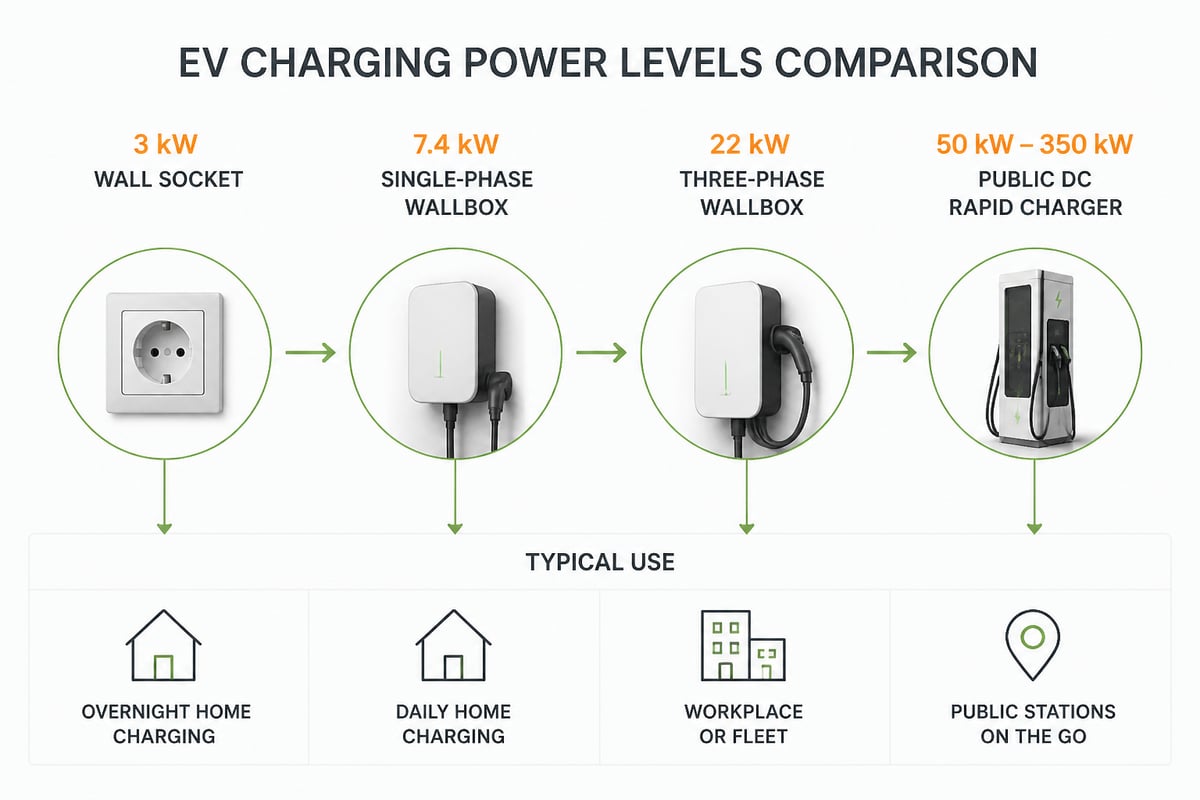
AC chargers pass mains power to the car, which converts it to direct current internally, while DC chargers convert power in the unit and feed the battery directly, which allows much higher speeds. The practical differences are:
- AC (3 kW to 22 kW): lower hardware cost, simple installation, suited to charging for several hours at a depot, office or retail centre.
- DC (50 kW to 350 kW): much faster, but a installing a single public charging station can cost R500,000 to R2 million, according to a South African industry report.
The same report indicates that up to 80% of EV users rarely rely on public charging infrastructure, which supports the case for AC charging where vehicles are parked for long periods. The speed of an AC session is also limited by the car itself, because the onboard charger sets the ceiling regardless of what the wallbox can supply. A staff car park in Johannesburg where cars sit from 08:00 to 17:00 gains little from DC speeds, since a modest AC unit will already return a full battery within the working day.
2. Can you charge an EV from a 13A socket?
You can charge an EV from a standard 13A socket, but it is the slowest option at roughly 2.3 to 3 kW and is not recommended for regular business use. Sustained high current through a general-purpose socket and domestic-grade wiring creates heat and reliability risks, and the vehicle may add only a modest number of kilometres of range per hour. Plugs, extension leads and older socket outlets can overheat when they carry a near-continuous load for eight hours or more.
For occasional top-ups it works. For a fleet or workplace, a dedicated wallbox on its own circuit with earth leakage protection is the sensible standard, and it is far easier to meter, restrict and manage. A dedicated unit also lets you record consumption per vehicle, which matters when staff charge at work and the cost must be allocated or recovered.
3. Which connector types apply in Southern Africa?
Most EVs sold in South Africa use Type 2 for AC charging and CCS for DC charging, so Type 2 and CCS are the two connectors to plan around. Older vehicles may use other standards, so confirm against your fleet list. Check each vehicle's inlet before you specify hardware, because the socket on the car determines which cable and charger combination will work.
| Connector | Current | Typical power | Notes |
|---|---|---|---|
| Type 1 | AC | 3 kW to 7 kW | Older single-phase standard |
| Type 2 | AC | 3 kW to 43 kW | Common AC standard, single or three phase |
| CCS | DC | 50 kW to 350 kW | Combines Type 2 with extra DC pins |
| CHAdeMO | DC | 25 kW to 100 kW | Found on some older imports |
A Type 2 untethered wallbox covers the widest range of current vehicles, and an adaptor cable can bridge a Type 1 car where one is still in the fleet. Mixed fleets that include grey imports are the most likely to need a connector audit before purchase.
4. Tethered or untethered: which suits a business site?
An untethered charger has a socket and each driver uses their own cable, whereas a tethered unit has a cable permanently attached. Untethered units suit mixed vehicle fleets and shared car parks, since they accommodate different connectors and reduce cable theft and wear. Tethered units suit a dedicated bay used by a single vehicle type, where convenience matters more than flexibility. A tethered cable left on the ground also becomes a trip hazard and a maintenance item in a busy basement car park, so consider where each bay sits and how cables will be stowed. Where drivers rotate between bays, untethered sockets avoid the situation of a cable that is too short or the wrong type for the car that arrives.
5. The Pulsar Plus 7.4kW is a single-phase wallbox with smart app control and solar-surplus charging, priced at approximately R12,000 to R16,000.
- Power: 7.4 kW, single-phase
- Features: app control, solar-surplus charging
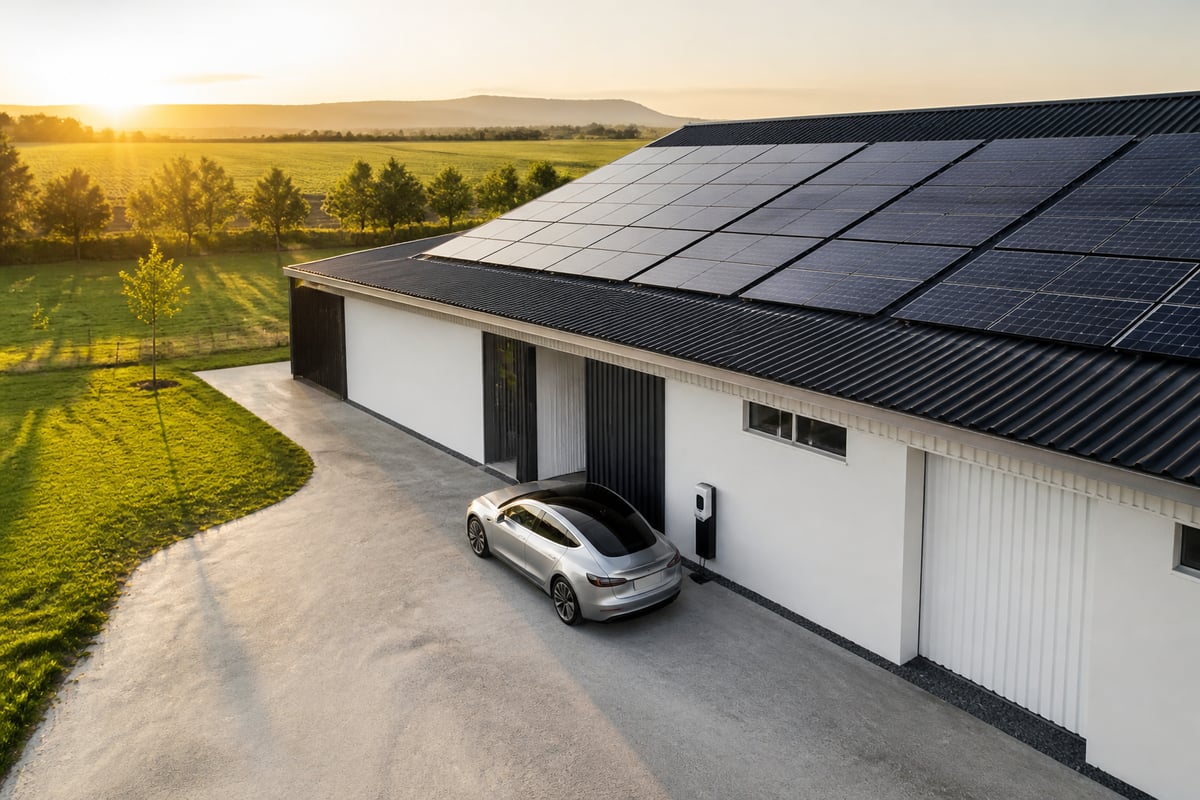
- Suits: sites with single-phase supply that already have rooftop solar, where vehicles sit parked through the middle of the day and can absorb surplus generation
- Budget view: a higher price than the R7,499 to R8,499 listed by a South African retailer for basic 7.4 kW units, the premium paying for the smart features
The app control allows charging to be scheduled and monitored remotely, which helps a facilities manager keep sessions within agreed hours. Solar-surplus charging means the unit can direct spare generation into the car instead of exporting it or wasting it, which suits a small office in Cape Town with panels on the roof and staff who arrive in the morning and leave in the afternoon.
Verdict: a sound choice where charging should follow solar output rather than draw grid power.
6. Go 22kW (Zaptec)
The Go 22kW is a three-phase wallbox listed at up to 120 km of range per hour, priced at approximately R15,000 to R22,000.
- Power: 22 kW, three-phase
- Range added: up to 120 km per hour of charging, as listed
- Suits: sites with three-phase supply and vehicles that accept higher AC rates, such as delivery vans or shared pool cars that need a fast turnaround between shifts
- Budget view: the retailer above lists a basic 22 kW three-phase charger at R9,990, so the Go 22kW sits higher in price
The 120 km per hour figure is a ceiling that depends on the vehicle, so a car limited to 11 kW on its onboard charger will add range at roughly half that rate. A three-phase supply is a prerequisite, and a distribution board that is already heavily loaded may need upgrading before a 22 kW unit can be added. Several such units on one site make load management important, since they can quickly exceed the available supply if they all start together.
Verdict: the faster option for three-phase sites, provided the vehicles can actually draw 22 kW.
7. INFOLED Electric Vehicle Charging Infrastructure
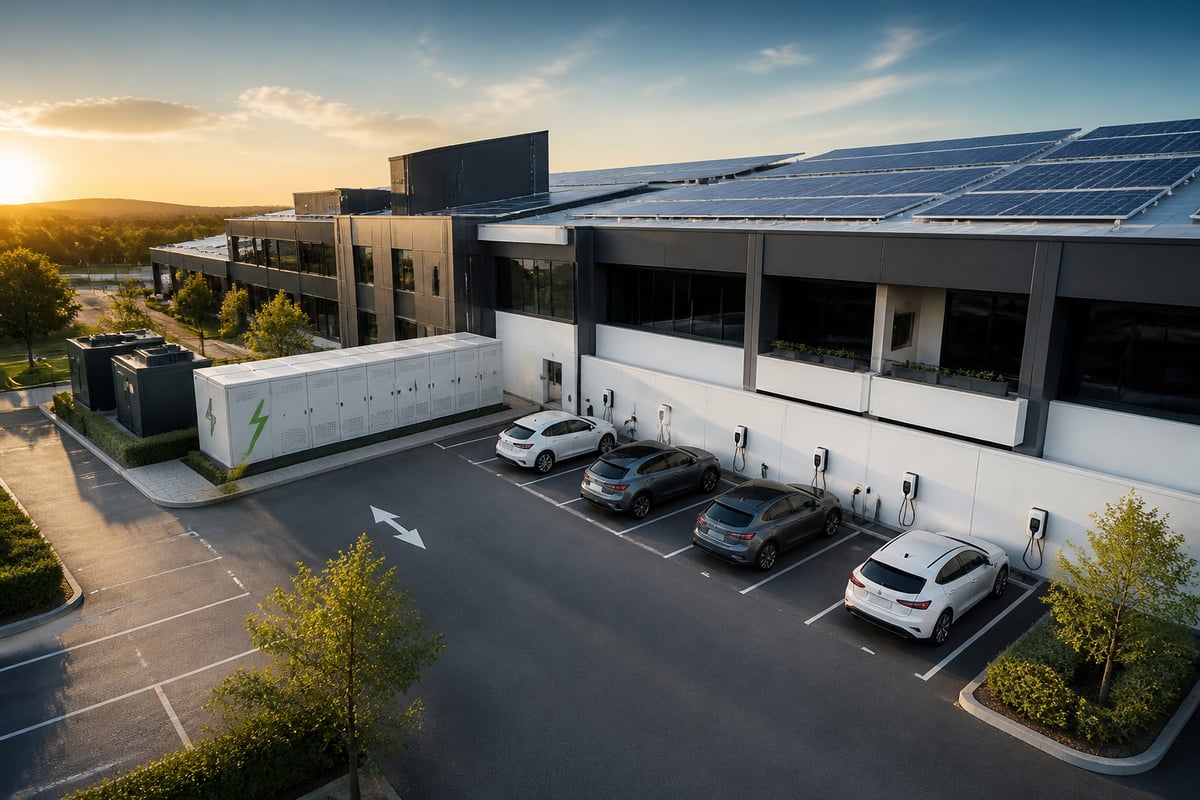
INFOLED's EV charging service covers commercial, workplace, fleet, residential and public charging, across both AC and DC fast charging, with load management and charging-as-a-service options.
- Scope: equipment, installation, monitoring and maintenance managed by one provider alongside solar and battery storage
- Funding: financing structured around cash flow, with zero capital investment and five-year agreements
- Suits: property owners and operators who want chargers without a capital outlay, and who want charging linked to on-site solar
- Price: project-based; contact INFOLED for a quotation
Because one provider handles design, installation and monitoring, a landlord does not have to coordinate separate electricians, software suppliers and maintenance contractors. Charging-as-a-service suits a property owner who wants to offer bays to tenants or visitors and recover usage costs without carrying the hardware on the balance sheet. Pairing the chargers with the same provider's solar and battery storage also keeps the supply design consistent from the roof to the bay.
Verdict: the better route when you want a managed, funded installation rather than buying hardware outright.
8. All options compared
| Option | Power | Phase | Approx. price (ZAR) | Suits |
|---|---|---|---|---|
| Pulsar Plus 7.4kW (Wallbox) | 7.4 kW | Single | R12,000 to R16,000 | Solar-linked sites with single-phase supply |
| Go 22kW (Zaptec) | 22 kW | Three | R15,000 to R22,000 | Three-phase sites with fast-turnaround vehicles |
| INFOLED EV Charging Infrastructure | AC and DC | Per design | Quotation | Funded, managed installations |
The two wallboxes are products you buy and have installed, while the INFOLED option is a project designed around your site and funded over a term. Choose by supply first: a single-phase building points to the Pulsar Plus, a three-phase building opens up the Go 22kW, and a site that wants no upfront spend or mixed AC and DC provision points to a managed project. Hardware prices exclude installation and VAT, so compare them on a like-for-like basis before deciding.
9. How much does an electric vehicle charger cost to install?
Installation cost depends on hardware, cable runs, distribution board capacity and any upgrade to the incoming supply, so a 7.4 kW unit with a short cable run costs far less than a multi-bay site. Hardware alone ranges from roughly R7,499 for a basic wallbox to R22,000 for a smart three-phase unit, as the figures above show. Installation, a certificate of compliance and any electrical upgrades come on top and vary by site. VAT at 15% applies to supply and installation, and VAT-registered businesses can generally claim it as input tax, subject to their own accountant's advice. Trenching across a parking area, mounting on a basement wall far from the distribution board, or adding a dedicated sub-board will each raise the quote, so ask installers to itemise cable length, protection devices and labour separately.
10. Can you install an EV charger yourself?
In South Africa, a charger should be installed by a registered electrician who can issue a certificate of compliance, so self-installation is not advisable for a business site. A wallbox is a dedicated high-current circuit, and insurers, landlords and municipalities will usually expect certified work. A professional installation also confirms that the existing supply can carry the load, which is the point most likely to cause trouble on older commercial buildings. The electrician will also select the correct cable size and earth leakage protection, and will test the circuit before handover. Uncertified work can complicate an insurance claim after a fire or fault, which is a risk no business should accept for the sake of a modest labour saving.
11. How does solar and load management reduce charging costs?
Pairing chargers with rooftop solar and load management lowers the grid energy your vehicles consume, which is where the saving sits for a commercial operator. INFOLED has delivered a 1.3 MWp rooftop solar PV project at UPD Rooftop in Lea Glen and a 1.947 MWp project at CTP Parow in Cape Town, and its Nutec Ink project in Ottery combines 266 kWp of solar PV with 512 kWh of battery storage. Systems of this kind can supply daytime charging directly, with batteries covering part of the evening demand. For more on the approach, read about commercial EV charging, business EV charging and solar power for EV chargers.
Load management also protects your maximum demand. Without it, several vehicles starting at 08:00 can push a site into a higher demand charge, so dynamic limiting across bays is worth specifying from the outset. The software shares the available capacity between connected vehicles, slowing some sessions when the building is busy and speeding them up when it is quiet. Solar-surplus modes, such as the one offered on the Pulsar Plus, add a further layer by matching charging rate to what the panels are producing at that moment. Fleets that return in the late afternoon can use battery storage to shift some of that charging into the evening without drawing heavily on the grid.
FAQ
How much does it cost to get a charger for an electric car?
Basic wallboxes are listed at about R7,499 to R9,990 by one South African retailer, while smart units such as the Pulsar Plus 7.4kW and Go 22kW run from roughly R12,000 to R22,000. Installation and any electrical upgrades are additional.
Is a 22 kW charger always better than a 7.4 kW one?
No. A 22 kW charger only delivers that rate if the vehicle's onboard charger accepts it and the site has three-phase supply. Where cars are parked for eight hours or more, 7.4 kW is often sufficient and cheaper to install.
To start, list your vehicles, their onboard charging rates and your site's available supply, then ask for a load assessment before choosing hardware. INFOLED designs, finances, installs and monitors solar, battery storage and EV charging infrastructure as one managed service, with five-year agreements and no capital outlay. You can Check Funding Eligibility to see whether a funded charging installation suits your property.
Next Step
Need help with your energy strategy?
Speak to INFOLED about solar, storage, EV charging, service agreements or system performance.