
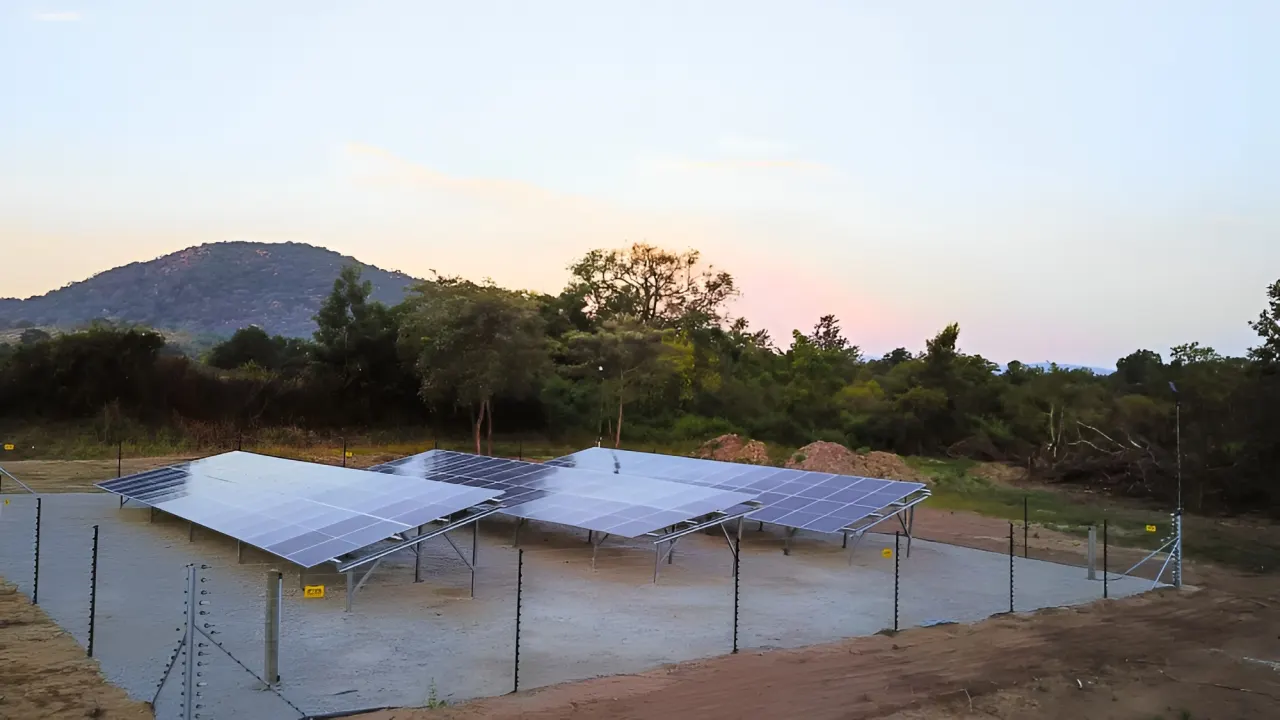
Business EV charging means installing chargers at your commercial site so employees, customers or fleet vehicles can charge on your premises, and the most practical route is to match charger type to how long vehicles stay parked, check your electrical capacity, and choose a funding model that avoids upfront capital. For South African property owners, the real question is rarely whether to install chargers but how to power them without pushing up your Eskom or municipal bill.
This guide sets out the steps in the order you will meet them: assessing your site, choosing hardware, managing load, deciding how to charge for energy, and paying for the project.
Why South African businesses are adding chargers
Chargers at a business site serve three purposes: they attract drivers who spend money while they charge, they provide a staff benefit that costs little to run, and they can become a revenue line in their own right.
Demand is easy to measure in markets that have surveyed it. A 2025 Plug In America survey found that most respondents without workplace incentives were interested or very interested in workplace EV charging. The survey drew more than 1,620 responses, most from EV drivers, so it reflects people who already own the vehicles. The same research found that respondents were only moderately satisfied with the reliability and accessibility of workplace chargers. Those gaps point to where a well-run site can stand out.
For retail centres in Sandton, Century City or Umhlanga, dwell time is the commercial argument. A driver who plugs in for 45 minutes is a shopper for 45 minutes. For logistics yards in Gauteng or the Western Cape, chargers reduce fuel spend on delivery fleets and remove the need for vehicles to detour to public stations.
Assess your site before you choose a charger
A site assessment establishes how much spare electrical capacity you have, where chargers can physically go, and how long vehicles will stay, and it should be completed before any hardware is specified.
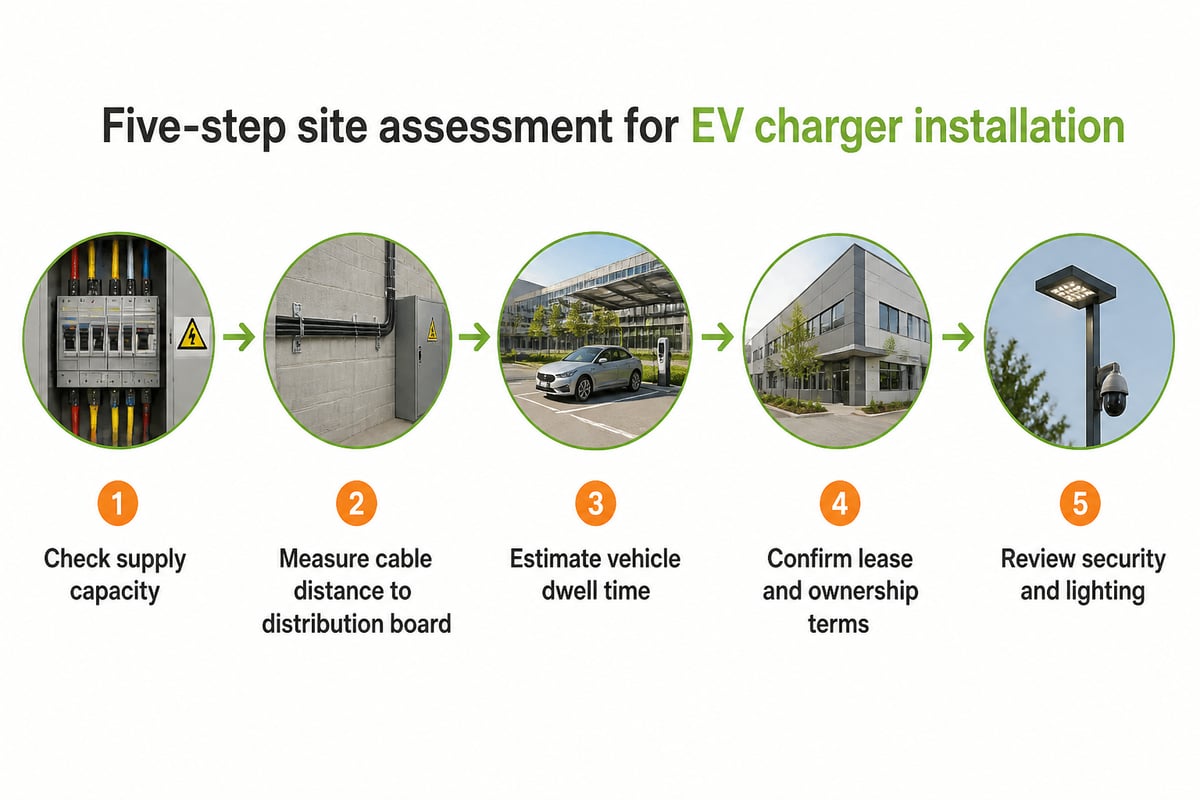
Work through these checks in order:
- Supply capacity. Review your notified maximum demand and your main distribution board. Adding eight 7 kW chargers can add more than 50 kW of potential load if they all run at once.
- Distance to the board. Cable runs drive cost. Bays close to the distribution board are cheaper to equip than a remote corner of the car park.
- Dwell time. Staff parking suggests hours, shopping centres suggest one to two hours, and highway-adjacent sites suggest minutes.
- Ownership and lease terms. If you are a tenant, confirm that the landlord permits installation and agree who owns the equipment at lease end.
- Security and visibility. Chargers in well-lit, monitored bays are used more and vandalised less.
Choosing between AC and DC charging
AC chargers suit sites where vehicles park for hours, while DC fast chargers suit sites where drivers want a substantial top-up in under an hour, and the cost gap between the two is large.
EnergySage estimates that a fully installed Level 2 (AC) charger generally costs $2,000 to $5,000, while a fully installed Level 3 DC fast charger can cost $50,000 to $100,000 or more per unit, with site infrastructure needs adding further cost. Those are US figures, so treat them as a guide to the ratio rather than a South African quotation. Rand pricing depends on current exchange rates, import costs and your site's electrical work, so request a site-specific quote.
| Factor | AC charging | DC fast charging |
|---|---|---|
| Typical use | Offices, hotels, residential estates, fleet depots overnight | Retail forecourts, highway sites, high-turnover fleets |
| Dwell time suited | Two hours or more | 20 to 60 minutes |
| Upfront cost | Lower | Considerably higher |
| Grid demand | Modest per bay | High per unit, often needs a dedicated supply upgrade |
| Revenue potential | Steady, lower margin per session | Higher price per kWh, fewer bays needed |
Most commercial properties start with AC chargers across several bays and add one or two DC units only where footfall justifies it. A mixed approach also spreads risk if vehicle adoption in your area grows more slowly than expected.
Manage load so chargers do not inflate your demand charges
Load management caps the combined draw of all chargers so that peak demand stays within your supply limit, and it is often the difference between a project that saves money and one that adds cost.
Many commercial and industrial tariffs in South Africa include a maximum demand or capacity charge. If ten vehicles start charging at 17:00, just as the building reaches its normal evening peak, the resulting spike can raise your monthly bill for the whole period. Smart chargers avoid this by sharing a fixed amount of power between active vehicles and by delaying sessions until demand falls.
Practical load management options include:
- Static limits that hold total charger draw below a set kilowatt ceiling.
- Dynamic balancing that reads the building's live consumption and gives chargers whatever capacity is left.
- Scheduled charging that moves fleet vehicles to overnight or midday periods.
- Solar prioritisation, where chargers draw first from your rooftop array and battery before the grid.
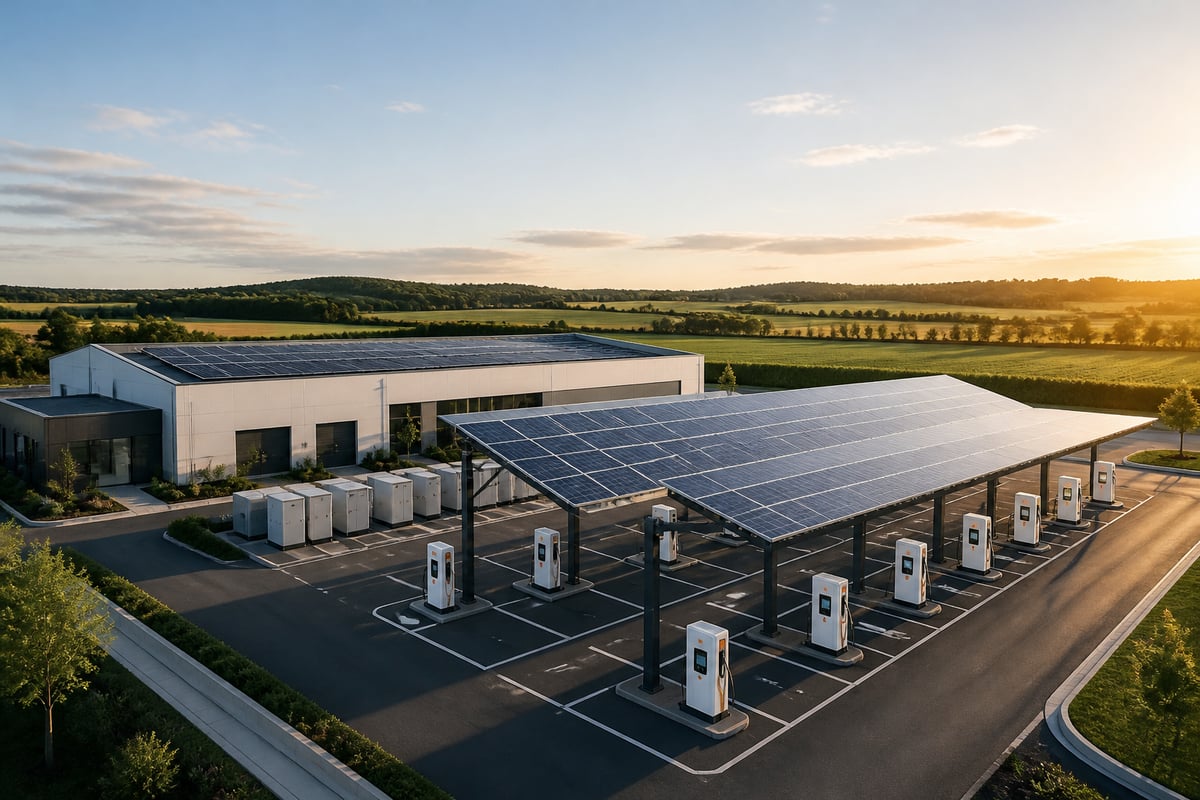
The last option links charging to your generation. A site with a rooftop array can charge vehicles during daylight hours with energy that would otherwise be exported or curtailed. INFOLED has delivered large rooftop installations, including a 1.3 MWp project at UPD Rooftop in Lea Glen and a 1.947 MWp project at CTP Parow in Cape Town, and sites of that scale have the generation to support charging bays at a low marginal energy cost. For the underlying technology, see INFOLED's overview of commercial solar PV and commercial battery storage, which explains how stored energy covers evening charging.
Pairing chargers with solar and storage
Pairing chargers with solar and a battery lowers the cost of every kilowatt-hour you sell or provide, and it protects charging availability during load shedding.
A battery matters more in South Africa than in most markets. If the grid drops and your chargers go offline, you lose revenue and frustrate staff or customers. A battery system with the right inverter capacity can keep priority bays running. INFOLED completed a solar PV and battery storage project at Nutec Ink in Ottery, which shows the kind of storage that commercial sites in the Western Cape are installing alongside generation.
When sizing the system, treat the chargers as a new load profile. A fleet that charges overnight needs stored energy or off-peak grid power, while a workplace that charges from 08:00 to 16:00 matches solar output almost perfectly. Your energy data should drive the design, and INFOLED's approach of turning performance data into reports that show where energy is being lost supports this kind of planning. More on tracking consumption is available in the guide to energy consumption monitoring.
Deciding whether to give charging away or charge for it
You can offer charging free, recover your electricity cost, or price sessions to earn a margin, and the right choice depends on who uses the bays and what they are worth to your business.
Free charging works as an amenity at hotels, offices and some retail sites. It is simple, but costs add up quickly if bays are used all day, so many operators cap session length or restrict free use to customers.
Cost recovery charges a per-kWh rate set close to your blended electricity cost. It removes the subsidy without making the site a profit centre.
Margin pricing sets a per-kWh or per-minute rate above cost, plus an idle fee to discourage vehicles from occupying bays after charging ends. This model turns a car park into an income stream, and it is the one most relevant to owners of public-facing parking.
Whichever model you choose, you need accurate sub-metering and a payment platform that handles tariffs, receipts and VAT. Charges for electricity sold to drivers are generally subject to VAT at 15% if your business is VAT-registered, so confirm the treatment with your accountant before publishing prices. INFOLED's article on EV charging pricing covers rate structures in more detail.
Funding business EV charging without capital expenditure
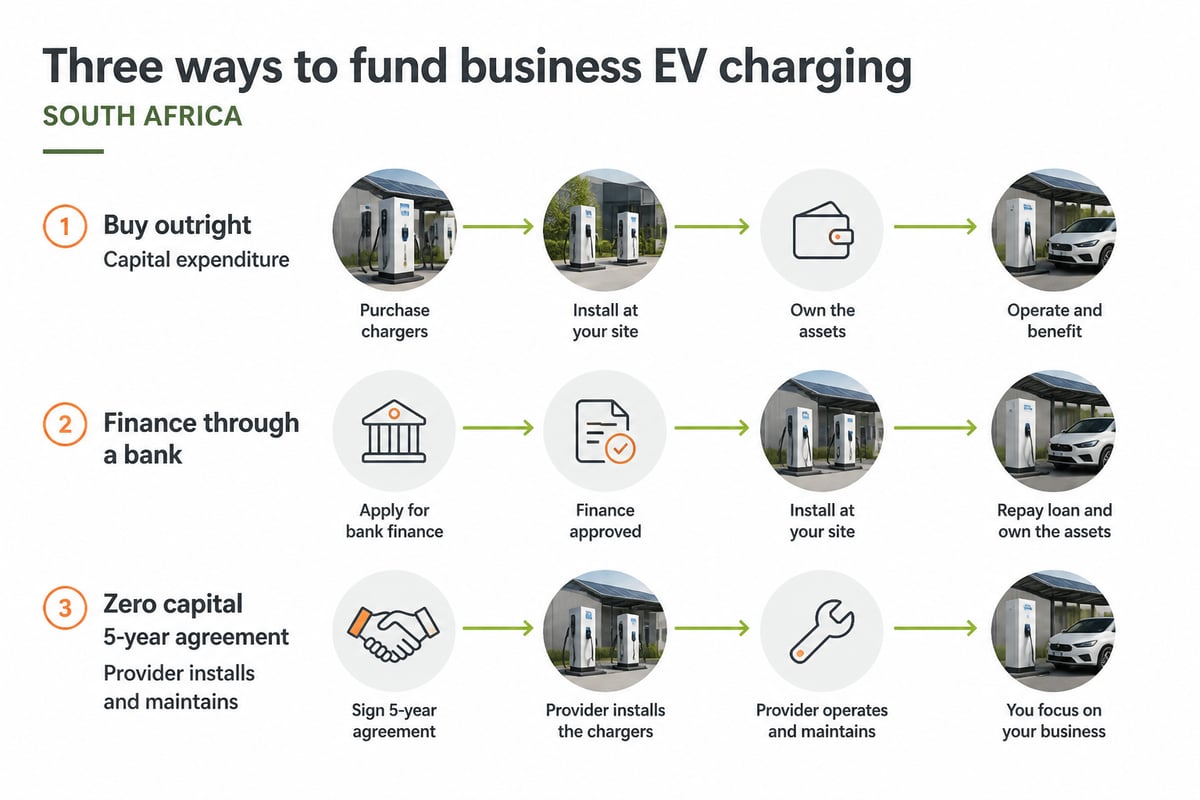
You can install chargers without paying for them upfront through a structured agreement in which the provider designs, finances, installs and maintains the equipment, and you pay from the savings or revenue it generates.
For many commercial and industrial property owners, capital is the main barrier rather than the business case. INFOLED structures financing around the client's cash flow, with no capital outlay required. Because solar, battery, EV charging and energy solutions are managed by one provider, the charging equipment is designed together with the generation that powers it, which avoids the gaps that appear when separate contractors handle each part.
When comparing any funding offer, ask these questions:
- Who owns the chargers during and after the agreement?
- Who is responsible for maintenance, repairs and software updates?
- How is uptime monitored, and what happens when a charger fails?
- How is revenue shared, if the chargers earn income?
- What happens to the equipment at the end of the term?
Reliability deserves particular attention. In a separate finding from EverCharge's 2025 research, most workplace respondents rated support as important when evaluating EV charging solutions. A funding model that includes live monitoring and proactive maintenance addresses this directly, because a charger that is out of order earns nothing and damages trust in the facility.
Installation, compliance and ongoing operation
A compliant installation needs a qualified electrician, a certificate of compliance, and approval from your municipality or landlord where required, followed by a monitoring and maintenance routine.
The main stages are:
- Design and quotation. Confirm charger count, type, cable routes and any distribution board upgrade.
- Approvals. Check whether your municipality requires notification of the additional load, particularly if you are changing your supply agreement or feeding energy back to the grid.
- Installation. Mount the chargers, install protection devices and sub-meters, and commission the software.
- Testing and inspection. Every installation should be tested before handover. INFOLED's in-house quality control team tests and inspects each installation it delivers.
- Monitoring. Live monitoring flags faults early, so you resolve them before drivers notice.
- Reporting. Monthly usage data shows utilisation, energy sold and savings, which informs whether to add bays.
Signage and bay marking are small details with a large effect. Clear branding, a visible tariff and an obvious reporting contact reduce support calls and improve the experience for drivers who have never visited your site before.
Where INFOLED fits into a charging project
INFOLED's Electric Vehicle Charging Infrastructure service covers commercial, workplace and fleet charging, load management and revenue generation as part of a managed energy offering. Because the same provider handles solar, batteries and charging, the load management rules, the generation forecast and the monitoring all work from the same data. For a wider view of how this fits into a commercial energy strategy, the guide to commercial EV charging is a useful companion to this article.
Frequently asked questions
How many chargers does my business need?
Start with demand you can evidence: the number of EV-driving staff, fleet vehicles or customers who visit regularly. Install enough bays to serve that demand, and run conduit to additional bays so you can expand later without digging up the car park again.
Will chargers raise my electricity bill?
They will increase consumption, but a well-designed system limits the effect on maximum demand and supplies much of the energy from solar. Without load management, simultaneous charging can raise capacity charges, so sub-metering and controls matter.
Can I earn income from chargers on my property?
Yes, if you price sessions above your energy cost and manage idle time. Income depends on utilisation, tariffs and the quality of your payment and monitoring platform. A funding agreement can also set how revenue is shared.
Do I need solar to run chargers?
No, but solar lowers the cost of the energy you supply and gives you a hedge against tariff increases. Adding a battery also keeps chargers available during outages.
Your next step is to gather twelve months of electricity bills and a site plan showing your distribution board and parking layout, since these two items let an engineer size chargers and solar correctly. INFOLED can review that information, design a charging solution alongside your solar and storage, and structure it so no capital outlay is required. If you want to know whether your site qualifies for a five-year agreement, start with the Electric Vehicle Charging Infrastructure service and then use INFOLED to check funding eligibility for your property.
Next Step
Need help with your energy strategy?
Speak to INFOLED about solar, storage, EV charging, service agreements or system performance.