
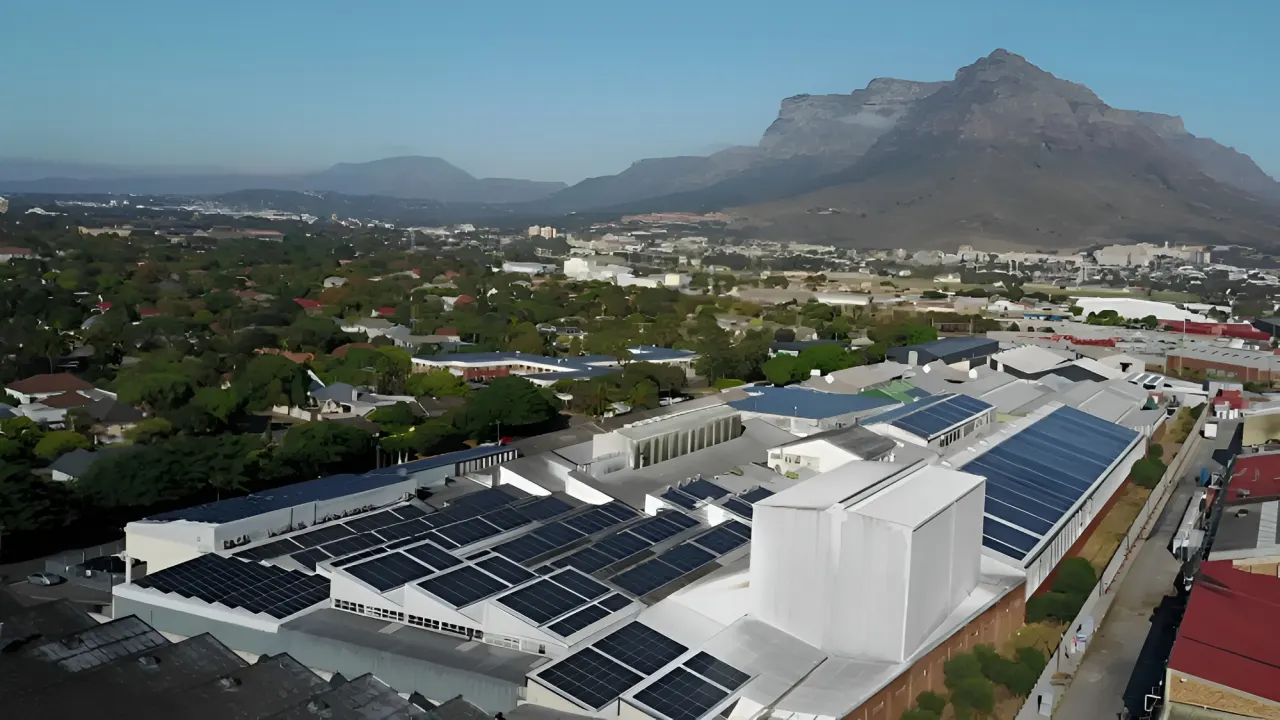
The electric vehicle revolution has arrived in Southern Africa, and with it comes an unprecedented opportunity for entrepreneurs, property developers, and established energy companies to enter the rapidly expanding ev charging business. As vehicle manufacturers introduce more affordable electric models and governments across the region implement policies to reduce carbon emissions, the demand for reliable, accessible charging infrastructure continues to accelerate. For businesses considering entry into this market, understanding the technical requirements, revenue models, regulatory landscape, and competitive positioning is essential for long-term success.
Understanding the Southern African EV Charging Landscape
The ev charging business in Southern Africa operates within a unique context shaped by intermittent grid reliability, diverse energy policies across countries, and varying levels of EV adoption. South Africa leads the region with approximately 1,000 registered electric vehicles as of 2026, whilst countries like Namibia, Botswana, and Zambia are beginning to see early adoption amongst corporate fleets and environmentally conscious consumers.
Market drivers currently shaping demand include:
- Corporate sustainability mandates requiring fleet electrification
- Rising petrol and diesel costs making electric vehicles economically attractive
- Government incentives in select markets, particularly South Africa's Green Transport Programme
- Shopping centres and office parks seeking tenant amenities
- Load shedding creating demand for solar-integrated charging solutions
The infrastructure gap presents both challenge and opportunity. Whilst major urban centres like Johannesburg, Cape Town, and Durban have seen charging station deployment, vast regions remain underserved. This creates whitespace for businesses willing to invest in strategic locations with strong traffic patterns and anchor tenants.
Market Segmentation and Target Customers
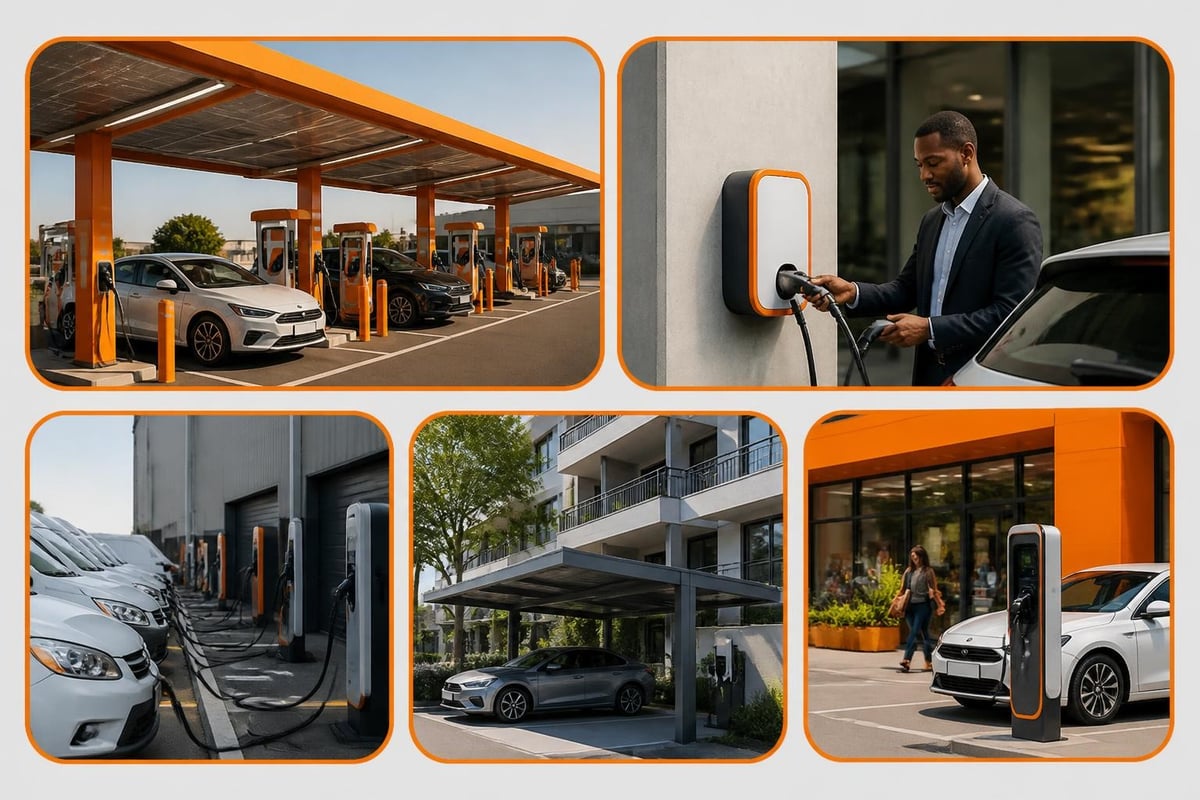
Successful operators in the ev charging business typically focus on specific customer segments rather than attempting to serve all markets simultaneously. Each segment presents distinct technical requirements, capital investment levels, and revenue characteristics.
| Customer Segment | Installation Type | Typical Charger | Revenue Model | Capital Investment (ZAR) |
|---|---|---|---|---|
| Public/Retail | DC Fast Chargers | 50-150 kW | Per kWh + Time | R800,000 - R2,500,000 |
| Workplace | AC Level 2 | 7-22 kW | Monthly Subscription | R45,000 - R120,000 |
| Fleet Depots | Mixed AC/DC | 22-350 kW | Contract/Managed Service | R1,200,000 - R5,000,000 |
| Residential Estates | AC Level 2 | 7-11 kW | Bundled/Tenant Billing | R35,000 - R80,000 |
| Destination Charging | AC Level 2 | 11-22 kW | Free/Loss Leader | R50,000 - R150,000 |
Commercial fleet operators represent particularly attractive customers due to predictable usage patterns, high utilization rates, and long-term contract potential. Companies operating delivery vehicles, taxi services, or corporate fleets require reliable charging infrastructure with minimal downtime, often justifying premium service agreements.
Technical Infrastructure and Equipment Selection
Establishing a viable ev charging business requires careful consideration of equipment specifications, electrical infrastructure, and grid connection capacity. The technical foundation determines operational reliability, customer satisfaction, and long-term scalability.
Charger Classification and Selection Criteria
AC Level 2 chargers (7-22 kW) suit workplace, residential, and overnight charging applications where vehicles remain parked for extended periods. These units cost between R35,000 and R120,000 per port, depending on features like smart connectivity, load management, and weather protection. Installation costs typically add R15,000 to R50,000 per unit, varying with electrical infrastructure proximity and trenching requirements.
DC Fast Chargers (50-350 kW) serve highway corridors, retail destinations, and fleet applications requiring rapid turnover. Capital costs range from R800,000 for entry-level 50 kW units to R2,500,000 or more for high-power 150-350 kW installations. These systems demand robust electrical infrastructure, often requiring dedicated transformers and grid capacity upgrades costing R300,000 to R1,200,000.
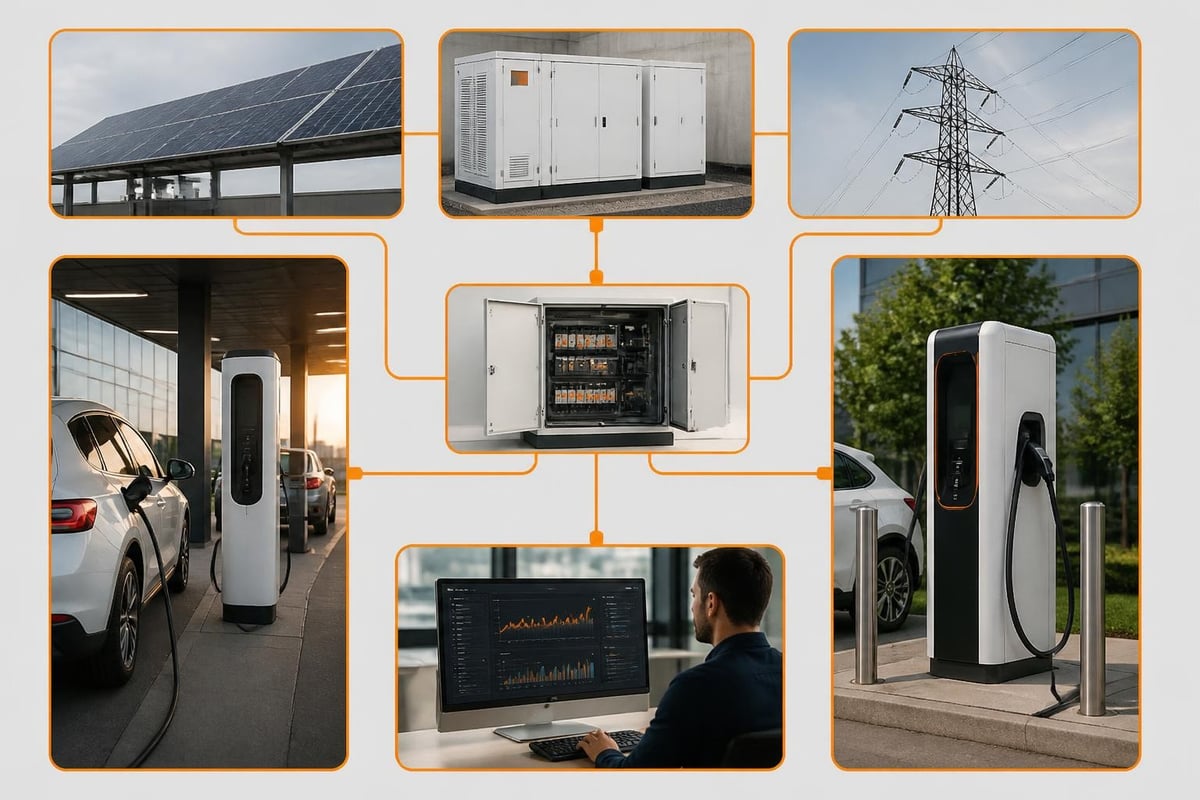
For businesses operating in regions experiencing frequent load shedding, integrating solar photovoltaic systems with battery energy storage creates resilient charging infrastructure that maintains operations during grid outages. This hybrid approach, whilst increasing upfront capital by 40-60%, provides competitive differentiation and appeals to sustainability-focused customers.
Grid Connection and Power Management
Securing adequate electrical capacity represents one of the most significant challenges in the ev charging business. Distribution network operators across Southern Africa face capacity constraints, particularly in older industrial areas and townships, leading to connection approval delays of 6-18 months in some regions.
Essential power management strategies include:
- Load management systems that dynamically allocate available power across multiple charging points
- Time-of-use scheduling to shift demand away from peak periods
- Vehicle-to-grid (V2G) readiness for future revenue opportunities
- Power factor correction to optimize grid efficiency
- Redundant supply arrangements for mission-critical installations
The Public EV Charging Infrastructure Playbook provides valuable frameworks for site assessment and electrical planning, though adaptation to Southern African grid conditions and regulatory requirements is essential.
Revenue Models and Financial Performance
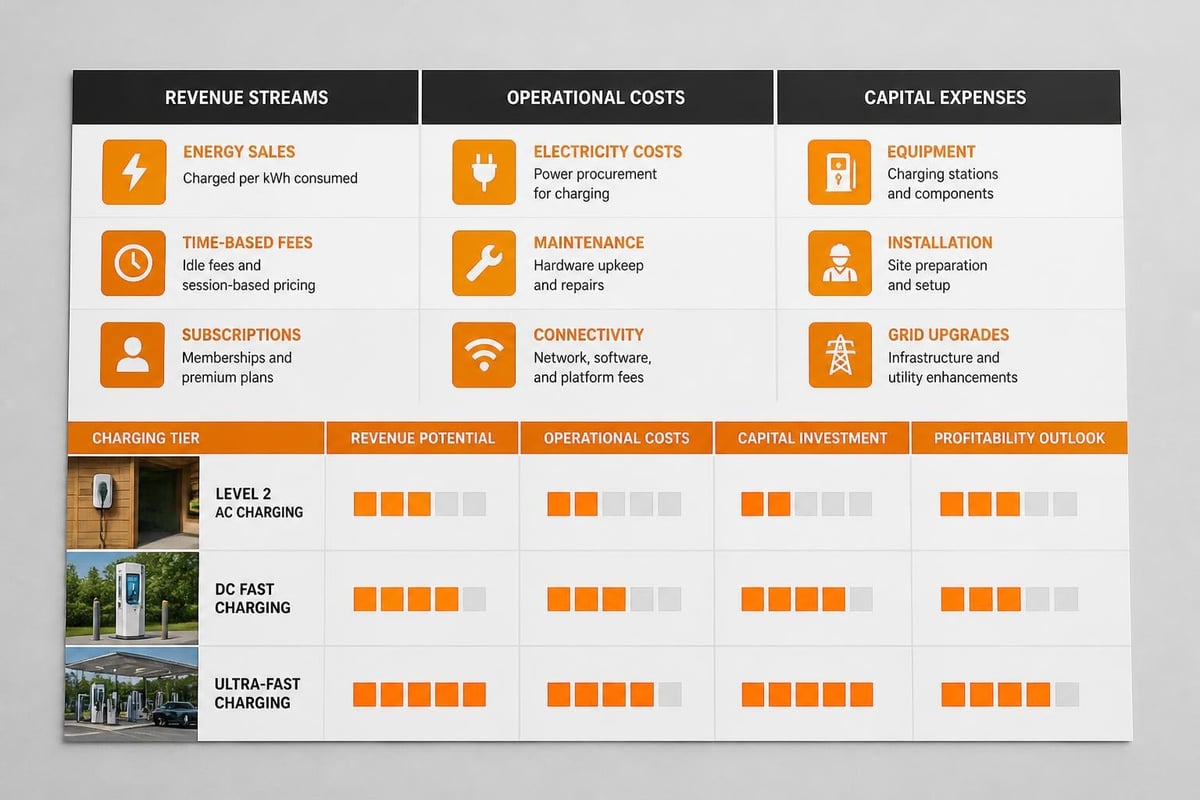
Profitability in the ev charging business depends on selecting appropriate revenue models aligned with customer segments, utilization rates, and competitive positioning. Successful operators typically employ multiple revenue streams to optimize returns across diverse asset portfolios.
Primary Revenue Mechanisms
Energy sales represent the most direct revenue source, with operators charging per kilowatt-hour (kWh) consumed. Public DC fast charging commands premium pricing of R5.50 to R8.50 per kWh in South Africa's major metros, compared to residential electricity tariffs of R2.20 to R3.50 per kWh. The markup reflects capital recovery, demand charges, maintenance costs, and convenience value.
Time-based fees supplement energy charges, particularly for fast chargers where occupancy impacts revenue potential. Operators typically charge R15 to R45 per minute beyond the charging session to discourage vehicle overstay and maximize asset utilization. This mechanism proves most effective at high-traffic locations with strong demand.
Subscription models suit workplace and residential applications where users value predictable costs and guaranteed access. Monthly fees range from R450 to R1,200 per user, depending on allocation (reserved vs. shared), power levels, and included energy allowances. This model provides stable, predictable revenue but requires critical mass for profitability.
Alternative and Ancillary Revenue Streams
Forward-thinking operators in the ev charging business are exploring additional revenue sources beyond direct charging fees. Advertising and sponsorship opportunities at charging locations generate R3,500 to R15,000 per screen per month in high-traffic retail environments. Data monetization, whilst nascent, offers potential through anonymized insights into customer movement patterns, dwell times, and demographic profiles valuable to property developers and retailers.
Participation in demand response programmes and grid services creates additional revenue where regulatory frameworks exist. The MIT Energy Initiative research on commercial EV fleets demonstrates significant potential for vehicle-to-grid services, though Southern African markets lack the regulatory mechanisms currently required to unlock these opportunities.
Partnership arrangements with property owners, fleet operators, and energy companies often structure revenue sharing at 60/40 to 80/20 splits, depending on capital contribution, operational responsibility, and market positioning. These partnerships accelerate deployment by sharing risk and leveraging complementary capabilities.
Regulatory Compliance and Standards
Operating within the ev charging business requires navigating complex regulatory frameworks spanning electrical safety, grid connection, consumer protection, and environmental compliance. Southern African markets lack harmonized standards, necessitating jurisdiction-specific approaches.
Technical Standards and Certification
Charging equipment installed in South Africa must comply with SANS 10142-1 (Wiring of Premises) and SANS 61851 series standards governing electric vehicle charging systems. These align substantially with IEC 61851 international standards, ensuring interoperability with imported vehicles and future-proofing installations against technology evolution.
Certificate of Compliance (CoC) issuance by registered electrical contractors remains mandatory for all installations, with non-compliance exposing operators to liability claims and insurance invalidation. Municipal electrical inspections add 2-4 weeks to deployment timelines but ensure safety and regulatory adherence.
Type 2 (Mennekes) connectors dominate the European and South African markets, whilst CCS (Combined Charging System) serves DC fast charging applications. Operators should avoid proprietary standards that limit vehicle compatibility and reduce utilization potential.
Grid Connection and Licensing Requirements
Eskom and municipal electricity departments require formal applications for connections exceeding 100 kVA, with processing times varying from 3 months in well-served areas to 18 months where infrastructure upgrades are necessary. Application fees range from R5,000 to R45,000, with infrastructure contribution charges potentially reaching R500,000 or more for major installations.
Some municipalities classify commercial charging operations as electricity resale, triggering licensing requirements under the Electricity Regulation Act. Johannesburg, Cape Town, and eThekwini have issued guidance clarifying that charging services constitute value-added services rather than resale when structured appropriately, but provincial variations create compliance complexity.
Site Selection and Location Strategy
The viability of an ev charging business correlates directly with strategic site selection. Successful operators employ data-driven methodologies considering traffic patterns, competitor positioning, electrical infrastructure, and anchor tenant agreements.
High-Value Location Characteristics
Shopping centres and retail destinations offer strong dwell times (45-90 minutes) matching AC Level 2 and moderate DC charging requirements. Landlords increasingly view charging infrastructure as tenant amenity and foot traffic driver, often providing favourable lease terms or revenue-sharing arrangements. Locations should target affluent catchments (LSM 8-10) where EV ownership concentrates.
Highway corridors require DC fast charging (≥50 kW) to serve intercity travel. Spacing of 120-150 km aligns with vehicle range limitations and driver psychology. Successful sites combine charging with quality amenities (restrooms, restaurants, convenience retail) justifying premium pricing and encouraging repeat patronage.
Corporate office parks and industrial estates serve workplace charging demand from commuter vehicles and company fleets. Morning arrival clustering necessitates load management systems preventing grid overload. Long dwell times (8-10 hours) suit lower-power AC charging, minimizing capital investment whilst maintaining high utilization.
Competitive Analysis and Market Positioning
INFOLED's experience deploying Electric Vehicle Charging Infrastructure across Southern Africa demonstrates that early market entry in underserved regions establishes competitive advantages through brand recognition, customer relationships, and preferred site access. Network effects become significant as drivers develop loyalty to reliable, well-maintained charging networks.
Competitive analysis should map existing installations within 5 km radius for public charging and 15 km for workplace/fleet applications. Market gaps indicate opportunity but require validation of underlying demand through traffic studies, demographic analysis, and anchor tenant commitments.
Operational Excellence and Customer Experience
The ev charging business is fundamentally a service operation where reliability, user experience, and customer support drive utilization rates and pricing power. Technical excellence means little if customers encounter broken chargers, payment failures, or unhelpful support.
Reliability and Maintenance Protocols
Industry benchmarks target 98% uptime for public charging infrastructure, necessitating proactive maintenance programmes and rapid fault response. Preventative maintenance schedules should include quarterly electrical inspections, connector wear assessment, software updates, and cleaning protocols.
Remote monitoring systems tracking charger status, usage patterns, energy consumption, and fault codes enable predictive maintenance and rapid fault isolation. These platforms typically cost R450 to R850 per charger per month but substantially reduce operational costs through optimized service routing and minimized downtime.
Establishing service level agreements committing to maximum fault resolution times (4-24 hours depending on location criticality) differentiates premium operators from opportunistic competitors. Spare parts inventory, particularly for proprietary components with long lead times, prevents extended outages damaging customer relationships.
User Experience and Payment Systems
Friction in payment processes represents the primary customer complaint across EV charging networks globally. Southern African operators must accommodate diverse payment preferences including credit/debit cards, mobile money, fleet accounts, and subscription billing.
Recommended payment architecture includes:
- RFID cards for fleet and subscription users
- Contactless credit/debit card terminals (no app required)
- QR code-initiated mobile payments
- Integration with popular EV charging apps (PlugShare, Chargemap)
- Invoice billing for commercial accounts
Dynamic pricing capabilities enable time-of-use optimization, reducing grid stress whilst incentivizing off-peak charging. Research from Lawrence Berkeley National Laboratory on EV-specific rate designs demonstrates that properly structured pricing influences charging behavior, improving grid outcomes whilst maintaining customer satisfaction.
Business Models and Entry Strategies
Aspiring participants in the ev charging business can pursue multiple entry pathways depending on capital availability, risk tolerance, and operational capabilities. Each model presents distinct advantages and challenges.
Operator-Owned Model
Direct ownership and operation provides maximum control over customer relationships, pricing, and service quality. This model suits established energy companies, property groups, and well-capitalized entrepreneurs willing to manage ongoing operations.
Capital requirements range from R350,000 for a small workplace installation (4-6 AC chargers) to R8,000,000 or more for a highway DC fast-charging plaza. Payback periods typically span 4-7 years at conservative utilization assumptions, improving to 2.5-4 years at mature sites with strong traffic.
Operators must develop capabilities across electrical engineering, software systems, customer service, maintenance logistics, and financial management. For many businesses, these requirements exceed core competencies, suggesting partnership or outsourcing approaches.
Charging-as-a-Service (CaaS)
CaaS models shift capital burden and operational responsibility to specialized providers whilst property owners, fleet operators, or businesses benefit from charging infrastructure without direct investment. Providers like INFOLED design, finance, install, and maintain charging systems under long-term service agreements spanning 7-15 years.
Arrangements typically structure as:
- Revenue-sharing agreements (host receives 15-30% of charging revenue)
- Lease agreements (host pays fixed monthly fee per charger)
- Bundled utility billing (charging costs incorporated into property fees)
- Hybrid models combining elements above
This model accelerates deployment by removing capital barriers whilst enabling hosts to offer modern amenities expected by tenants, customers, and employees. Providers capture recurring revenue streams whilst building network scale driving operational efficiency.
Partnership and White-Label Models
Energy retailers, telecoms operators, and property management groups increasingly enter the ev charging business through partnerships with technical specialists. These arrangements leverage existing customer relationships, billing systems, and brand equity whilst outsourcing technical complexity.
White-label platforms enable rapid deployment under partner brands, with backend services including charger procurement, installation management, software platforms, customer support, and maintenance coordination provided by infrastructure specialists. Revenue shares typically allocate 40-60% to the technical provider, 30-40% to the brand partner, and 10-20% to property owners.
Financial Planning and Investment Considerations
Building a sustainable ev charging business requires rigorous financial modeling accounting for utilization ramp-up, electricity cost volatility, equipment depreciation, and competitive dynamics. Overly optimistic projections have contributed to operator failures globally, emphasizing the importance of conservative assumptions.
Revenue Projections and Utilization Curves
New charging locations typically achieve 5-15% utilization in year one, increasing to 25-40% by year three as EV adoption grows and driver awareness develops. Utilization rates vary dramatically by location type, with workplace charging reaching 60-80% during business hours whilst public DC fast chargers average 15-25% across 24-hour periods.
Key revenue assumptions requiring validation:
- Average energy dispensed per session (workplace: 15-25 kWh; public fast: 35-55 kWh)
- Sessions per charger per day (workplace: 1.5-2.5; retail: 0.8-3.5; highway: 4-12)
- Energy pricing (R5.00-R8.50/kWh depending on market positioning)
- Customer acquisition cost and retention rates
- Competitive pricing pressure as markets mature
Sensitivity analysis should model revenue impact of 25-50% lower utilization than base case, ensuring financial viability under conservative scenarios. The U.S. Department of Energy's National EV Charging Network resources provide valuable benchmarking data, though Southern African adoption curves lag developed markets by 3-5 years.
Cost Structure and Margin Analysis
Operating costs consuming 40-60% of revenue include electricity purchase (30-45%), maintenance and repairs (5-10%), connectivity and software (3-6%), insurance (2-4%), and customer support (3-5%). Labor represents additional 8-15% for operators managing multiple sites.
Gross margins vary significantly by charger type and utilization. AC workplace charging achieves 35-50% gross margins at mature utilization, whilst DC fast charging reaches 40-60% when energy purchase and demand charges are optimized through renewable integration and load management.
Accessing incentive programmes improves project economics substantially. South Africa's Section 12B tax allowance provides 100% first-year depreciation on renewable energy assets, whilst certain provincial programmes offer capital grants covering 15-30% of installation costs. The Treasury guidance on clean vehicle charging incentives offers frameworks applicable to Southern African policy development, though local programmes remain limited compared to developed markets.
Integration with Renewable Energy and Storage
The intersection of the ev charging business with solar photovoltaic systems and battery storage creates compelling value propositions addressing grid constraints, electricity cost optimization, and sustainability positioning. This integration becomes particularly relevant across Southern Africa where load shedding and electricity price volatility challenge conventional charging operations.
Solar-Powered Charging Infrastructure
Carport solar installations generate electricity directly at charging locations whilst providing vehicle shade and weather protection. A typical 50 kW solar array costs R650,000 to R950,000 installed, generating approximately 75,000-85,000 kWh annually in Gauteng's climate conditions, sufficient for 1,500-2,000 full EV charges.
Financial benefits include:
- Electricity cost reduction from R2.80/kWh grid supply to R0.80-R1.20/kWh solar levelized cost
- Demand charge mitigation reducing peak power costs
- Carbon reduction supporting corporate ESG commitments
- Enhanced brand positioning as truly "green" charging
- Protection against future electricity price increases
Solar generation profiles align reasonably well with workplace charging demand (morning arrival/afternoon departure) but mismatch public fast-charging patterns, necessitating battery storage or grid supplementation.
Battery Energy Storage Systems Integration
Combining battery storage with charging infrastructure enables operation during grid outages, peak shaving to reduce demand charges, and energy arbitrage buying electricity during off-peak periods for sale during peak windows. A 200 kWh battery system costs approximately R1,800,000 to R2,400,000 installed, with payback periods of 5-8 years depending on utilization and tariff structure.
Operational advantages include:
- Uninterrupted service during load shedding maintaining customer satisfaction
- Reduced grid connection capacity requirements lowering infrastructure costs
- Demand charge reduction improving margin economics
- Frequency regulation and grid services revenue potential (future)
- Extended solar utilization through time-shifting
As explored in research on NBER working papers examining EV charging rate design, proper integration of storage, solar, and charging infrastructure creates sophisticated energy management systems optimizing across multiple value streams. Southern African markets show particular promise given grid instability and high electricity costs creating favorable economics for integrated systems.
Future Trends and Market Evolution
The ev charging business will undergo substantial transformation through 2030 as technology advances, market scale develops, and regulatory frameworks mature. Operators positioning for these shifts gain competitive advantages whilst those focused solely on current market dynamics risk obsolescence.
Technology Evolution
Bidirectional charging (V2G and V2B - vehicle-to-building) will enable parked EVs to supply power back to buildings or grids during peak demand periods. This transforms vehicles from pure electricity consumers into distributed energy resources, creating new revenue opportunities whilst supporting grid stability. Southern African regulatory frameworks currently lack mechanisms to compensate V2G services, but evolution appears inevitable given global trends.
Ultra-fast charging systems (350+ kW) reducing charge times to 10-15 minutes will reshape highway corridor economics, enabling higher throughput and improved customer satisfaction. However, these systems demand substantial electrical infrastructure investment and suit only high-utilization locations justifying capital deployment.
Wireless charging remains in early deployment but could revolutionize workplace and fleet applications by eliminating connector handling and enabling automatic charging upon parking. Cost premiums of 40-60% over conventional systems currently limit adoption, though scale production should compress pricing differentials by 2028-2029.
Market Consolidation and Scale Dynamics
International charging networks including Shell Recharge, BP Pulse, and regional operators are establishing Southern African presence through acquisitions and partnerships. This consolidation creates competitive pressure on independent operators whilst potentially accelerating infrastructure deployment through capital access and operational expertise.
Network effects favor larger operators offering geographic coverage enabling trip planning and seamless roaming across borders. Independent operators should focus on underserved niches, superior service quality, or integration with complementary businesses (property development, fleet management, renewable energy) creating defensible competitive positions.
Interoperability standards enabling customers to access multiple networks through single accounts and payment methods will intensify competition whilst improving customer experience. Southern African operators should prioritize open standards and roaming agreements preventing network fragmentation hindering market development.
The ev charging business presents compelling opportunities for entrepreneurs and established energy companies willing to invest in infrastructure, operational excellence, and customer experience that Southern Africa's growing electric vehicle market demands. Success requires careful attention to site selection, robust financial modeling, technical standards compliance, and integration with renewable energy systems addressing regional grid challenges. As a renewable energy engineering and technology company with extensive experience deploying intelligent solar, battery storage, and EV charging solutions across Southern Africa, INFOLED helps commercial, industrial, and residential clients reduce electricity costs whilst building resilient energy infrastructure supporting sustainable transport electrification. Contact INFOLED to explore how integrated renewable energy solutions can position your organisation at the forefront of Southern Africa's electric mobility transition.
Next Step
Need help with your energy strategy?
Speak to INFOLED about solar, storage, EV charging, service agreements or system performance.