

An EV charging station is a fixed unit that supplies electricity to an electric vehicle, and the main types are slower AC chargers (7 to 22 kW) and faster DC chargers (50 kW and above). For a South African business, the right choice depends on how long vehicles stay on site, the electrical supply available and whether the chargers will serve staff, customers or a fleet. This guide sets out the main charger types, then compares four AC units available locally with approximate prices as of November 2026.
South Africa's charging network is growing quickly. A CleanTechnica report on Rubicon's network says the country had more than 500 public charging stations by mid-2025, with an EV-to-charger ratio of 1:7. The same report records 21,606 charging transactions in 2025, up from 8,338 in 2024. Demand is rising, and sites that install capacity early can serve it.
Charger classes: AC, DC fast and ultra-rapid
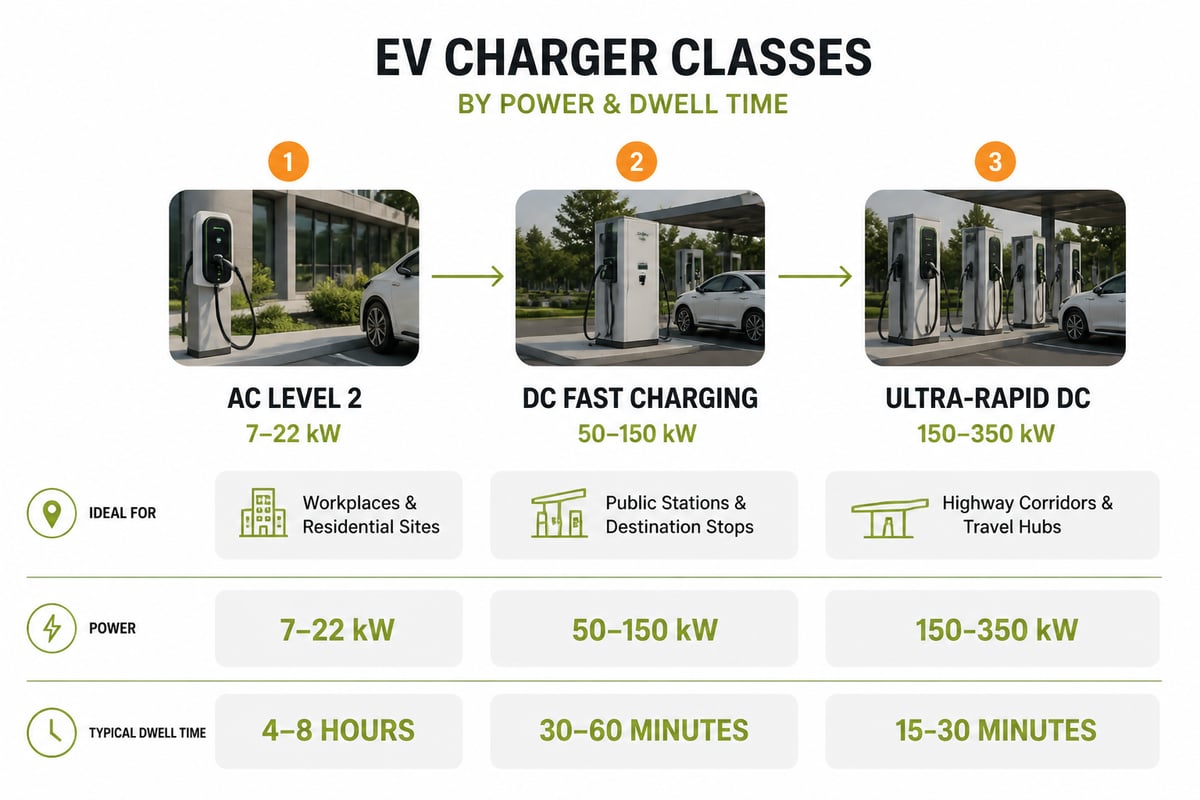
EV chargers fall into three power classes, and dwell time is the main factor in choosing between them. An Infoled guide to renewable energy services lists AC Level 2 charging at 7 to 22 kW for workplace and residential use, DC fast charging at 50 to 150 kW, and ultra-rapid DC at 150 to 350 kW.
- AC charging (7 to 22 kW): the vehicle's onboard charger converts the power, so the station is simpler and cheaper. Suited to vehicles parked for hours, such as staff cars, hotel guests and office visitors.
- DC fast charging (50 to 150 kW): converts power inside the station and delivers it directly to the battery. Suited to short stops at retail sites, depots with tight turnaround times and routes with high traffic.
- Ultra-rapid DC (150 to 350 kW): suited to highway corridors and high-throughput public sites, and it places large demands on the grid connection.
Most commercial properties begin with AC. It costs less to install, puts a lighter load on the supply and matches how most parking behaviour works.
Four AC charging stations compared
The four units below are all AC chargers sold in South Africa, listed by merit for commercial and destination use, with prices approximate as of November 2026. Specifications are as supplied by the makers or retailers and should be checked against your vehicles and supply before purchase.
1. Wallbox Pulsar Plus 7.4kW
The Wallbox Pulsar Plus 7.4kW is a compact single-phase smart charger with app control and solar-surplus charging. It is priced at approximately R12,000 to R16,000.
- Power: 7.4 kW, single-phase
- Control: smart app control
- Solar: supports solar-surplus charging
Suits: sites with a single-phase supply and rooftop solar, where vehicles can soak up midday generation that would otherwise be exported or wasted. App control also lets a site manager schedule charging outside peak tariff periods. A small office park with a rooftop array, for instance, can set the charger to follow surplus generation so that cars parked from mid-morning to mid-afternoon take energy the building is not using. This reduces reliance on grid electricity at the points when the array is producing most. Because the unit is single-phase, it avoids the cost of three-phase cabling and distribution board work at properties that do not already have it. The 7.4 kW rating adds up to roughly 30 kWh over four hours, which suits staff who park for a working day.
Verdict: a sound single-phase choice where solar-surplus charging is the priority.
2. Zaptec Go 22kW
The Zaptec Go 22kW is a three-phase AC charger offering up to 120 km of range per hour, subject to vehicle and supply compatibility. It is priced at approximately R15,000 to R22,000.
- Power: 22 kW, three-phase
- Range gain: up to 120 km per hour of charging, depending on the vehicle and supply
Suits: sites with a three-phase supply and vehicles able to accept high-rate AC charging, such as a business park with several fleet cars returning each evening. Many vehicles accept less than 22 kW on AC, so the range gain depends on the car. A vehicle limited to 11 kW on its onboard charger will draw that rate even from a 22 kW station, so check the specification of each model in your fleet before buying. The three-phase requirement also means confirming the building's spare capacity first, since a 22 kW charger placed on a constrained supply can force a distribution board upgrade. Where several bays are planned, pairing the unit with load management stops simultaneous charging from lifting maximum demand and triggering higher commercial tariff charges. The R15,000 to R22,000 range reflects differences in cabling, configuration and supply, so obtain a site-specific quotation.
Verdict: the faster AC option for three-phase sites with compatible vehicles.
3. Zencar 7.4kW wall or pedestal charging station
The Zencar 7.4kW is a wall- or pedestal-mounted charger with a colour display and adjustable maximum current and charging times. It is priced at approximately R9,980.
- Power: 7.4 kW
- Mounting: wall or pedestal
- Features: colour display, adjustable maximum current, adjustable charging times
Suits: entry-level destination charging, such as a small retail centre or office car park that needs a straightforward unit with basic scheduling and a pedestal option for open bays. The pedestal mount matters in open-air parking, where there is no wall nearby, such as a surface lot at a shopping centre. The adjustable maximum current lets an installer cap the draw to suit a limited supply, so the charger can be fitted without immediately upgrading the connection. Adjustable charging times allow a manager to restrict use to off-peak hours or business hours, depending on the tariff and the site. The colour display shows drivers charging status at the bay, which reduces questions to reception or security staff. At R9,980 it is the lowest-priced unit in this comparison, though installation, VAT and any payment system remain additional.
Verdict: the lowest-cost route to a fixed, scheduled charge point on a modest budget.
4. Victron 22kW charger
The Victron 22kW charger is a three-phase-capable AC unit with a touch display and remote monitoring and control. It is priced from approximately R10,395.
- Power: 22 kW, AC
- Interface: touch display
- Management: remote monitoring and control
Suits: three-phase sites that want higher-power AC charging with remote oversight, such as a commercial building with several bays managed by one operator. Remote monitoring and control let a property manager check whether each charger is in use or faulted without visiting the site, which matters for operators running buildings in more than one city. The touch display gives drivers a local interface for starting and reviewing a session. As with any 22 kW AC unit, actual charging speed is set by the vehicle's onboard charger, so many cars will draw less than the full 22 kW. The "from R10,395" price is a starting point, and final cost depends on cabling distance, distribution board work and VAT at 15%. Sites already running Victron inverters or batteries may find it easier to keep energy equipment under one brand and monitoring approach.
Verdict: good value for a 22 kW unit with remote management built in.
Comparison table
| Charger | Power | Supply | Approx. price (ZAR) | Suits |
|---|---|---|---|---|
| Wallbox Pulsar Plus 7.4kW | 7.4 kW | Single-phase | R12,000 to R16,000 | Smart, solar-surplus charging |
| Zaptec Go 22kW | 22 kW | Three-phase | R15,000 to R22,000 | Faster AC on three-phase sites |
| Zencar 7.4kW | 7.4 kW | Wall or pedestal | R9,980 | Entry-level scheduled charging |
| Victron 22kW | 22 kW | AC | From R10,395 | Remote-managed 22 kW charging |
Prices are for hardware only. Installation, cabling, distribution board upgrades, VAT at 15% and any communication or payment systems are additional.
How to choose an EV charging station for your site
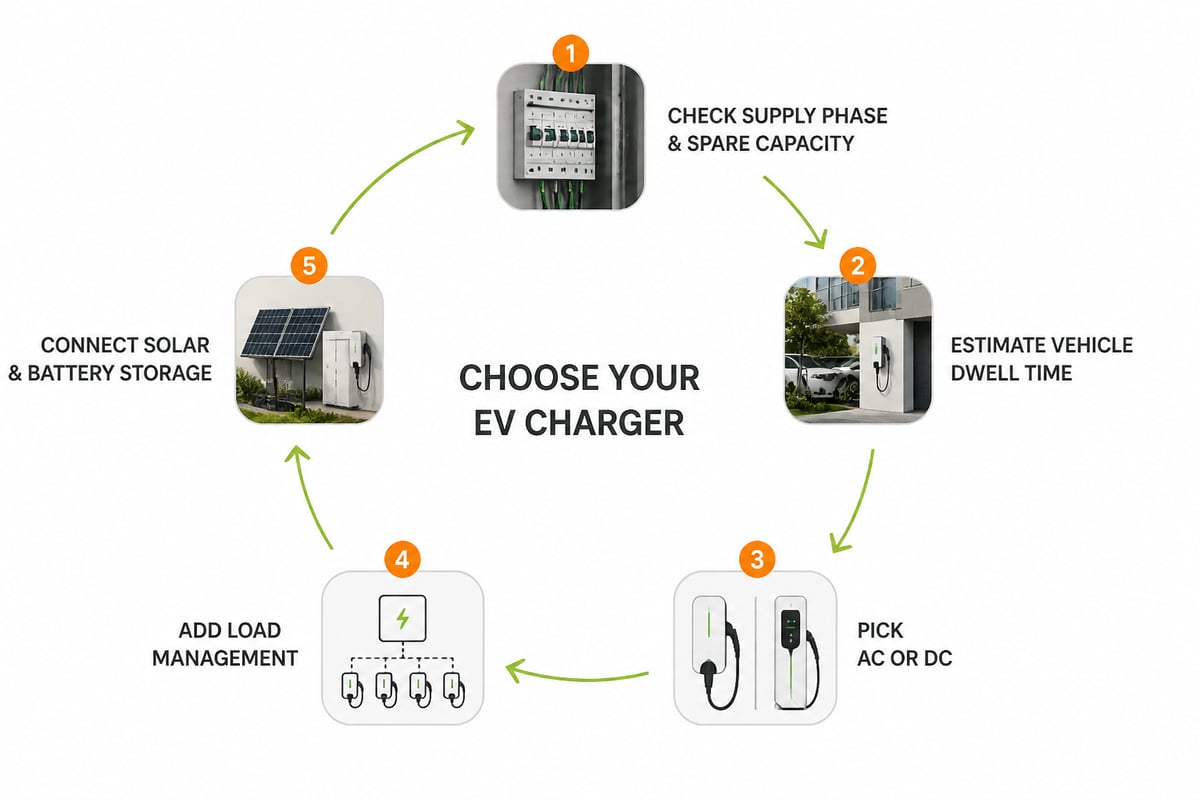
Choose by supply, dwell time and use case, in that order. Work through these checks before comparing hardware:
- Electrical supply: confirm whether the site is single-phase or three-phase and how much spare capacity exists. A 22 kW charger on a constrained supply may force a costly upgrade.
- Dwell time: vehicles parked for four hours or more rarely need DC. A 7.4 kW unit adds up to roughly 30 kWh over four hours, which covers a substantial commute.
- Vehicle compatibility: onboard AC charger limits vary by model, so a 22 kW station will not always charge at 22 kW.
- User type: staff, visitors, tenants and fleet vehicles each need different access control and billing.
- Metering and payment: if you want to recover costs or earn revenue, the charger needs billing capability, which is covered in EV charging pricing.
Load management and solar: the cost lever
Pairing chargers with solar and load management is how a site keeps charging costs under control. Charging several vehicles at once can push up your maximum demand, and demand charges on a commercial tariff are costly. Dynamic load management caps the combined draw so that extra chargers do not require a larger supply connection.
Solar changes the economics further. Charging in daylight hours uses generation your site already produces. On a solar and battery storage setup, surplus midday energy can also be stored for evening use, and battery storage helps smooth the peaks created when several vehicles connect at once. Chargers such as the Wallbox Pulsar Plus are built to follow solar surplus, which suits this model.
Charging as a revenue stream
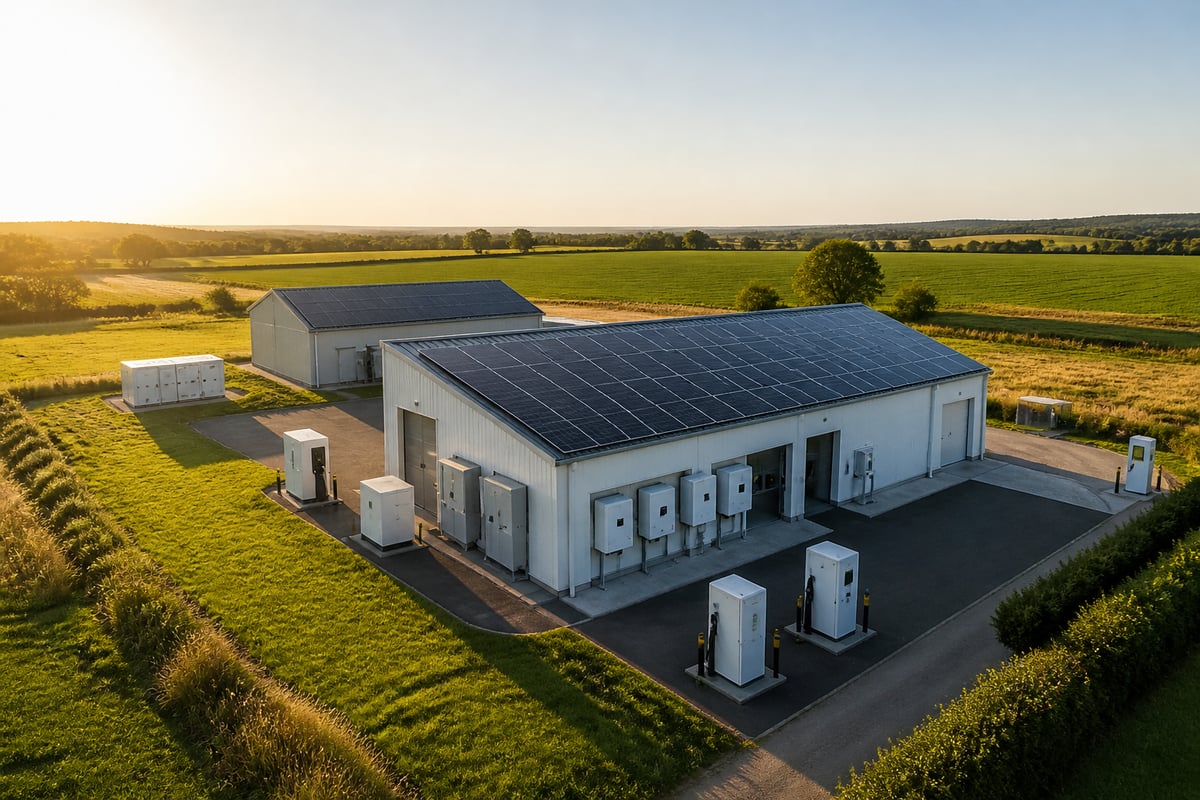
A charging station on commercial property can earn income as well as serve tenants. Retail sites, parking operators and fleet owners can bill per kWh or per session, and recover the cost of the charger and energy over time. The average session on Rubicon's network dispensed 21.58 kWh, according to the same CleanTechnica report, which gives a practical benchmark for estimating energy per visit. Network-wide, the report puts energy dispensed at 625 MWh in 2025, up from 258 MWh in 2024.
Revenue depends on a charger that supports metering and remote management, so confirm those features before buying. A more detailed look at the business case is in this guide to EV charging as a business.
Financing without capital outlay
Capital cost is the main barrier for many property owners, and it does not need to stop a project. INFOLED structures financing around the client's cash flow, with zero capital investment and five-year agreements, and manages solar, battery, EV charging and energy solutions through one provider. Its Electric Vehicle Charging Infrastructure service covers commercial chargers, fleet and workplace charging, DC fast charging, load management and charging-as-a-service. For sites that also want storage to manage peak demand, its Battery Energy Storage Systems service covers commercial and industrial batteries.
INFOLED has delivered large rooftop solar work, including a 1.947 MWp solar PV project at CTP Parow in Cape Town and a 266 kWp solar PV and 512 kWh battery storage project at Nutec Ink in Ottery. Each installation is tested and inspected by an in-house quality control team, and live monitoring and proactive maintenance support uptime. Performance data is turned into reports showing where energy is being lost and how to recover it. For specifications, site suitability and agreement terms, contact INFOLED directly through its product pages.
FAQ
Does a 22 kW charger always charge a vehicle at 22 kW?
No. The vehicle's onboard charger sets the limit, and many models accept less than 22 kW on AC. The Zaptec Go 22kW, for example, quotes up to 120 km of range per hour subject to vehicle and supply compatibility.
Is AC or DC better for a business car park?
AC suits most car parks because vehicles stay for several hours, and the units cost less to buy and connect. DC fast charging suits sites where drivers stop briefly and expect a quick turnaround.
What does an EV charging station cost in South Africa?
The AC units above range from about R9,980 to R22,000 as of November 2026, before installation and VAT. Costs rise with cabling distance, distribution board upgrades and any payment or monitoring systems.
Start by checking your site's supply phase and spare capacity, then match that to the dwell time of the vehicles you expect to serve. INFOLED can design, finance, install and monitor the charging, solar and battery systems as one managed package, and you can use Check Funding Eligibility to see whether a zero-capital, five-year agreement suits your property. Its Electric Vehicle Charging Infrastructure service is the place to begin.
Next Step
Need help with your energy strategy?
Speak to INFOLED about solar, storage, EV charging, service agreements or system performance.