Green energy sources are power supplies that generate electricity or heat with little or no greenhouse gas emissions, and for South African businesses the most practical options are solar PV, wind, hydropower, biomass and battery storage. Solar PV paired with storage delivers the strongest return for most commercial and industrial sites. This article ranks the main options by fit for Southern African operations, then lists the hybrid inverters that sit at the centre of most business systems.
The national picture explains the urgency. Renewable energy accounted for 9% of South Africa's locally generated electricity in 2024, up from 6% in 2021 and 2% in 2016, according to the South African Government News Agency. The same source reports that household solar installations reached 675,000 in 2025, an 86% increase over three years. Businesses are following the same path, and many now do so without spending capital.
What is green energy called, and how does it differ from renewable energy?
Green energy is often called clean energy or renewable energy, though the terms are not identical. Renewable energy describes sources that replenish naturally, such as sunlight, wind and flowing water. Green energy is the narrower subset with the lowest environmental impact. Clean energy is the broadest label, covering anything that produces minimal emissions at the point of use. For a business, the distinction matters mainly for ESG reporting, where the origin and emissions profile of each source must be stated accurately.
Is green energy increasing in South Africa?
Yes, green energy is increasing quickly in South Africa. The country had close to 16 GW of installed renewable capacity, with a further 32 GW of projects in the grid-connection process and expected to connect by 2030, according to the South African Government News Agency. The government's IRP 2025, approved by Cabinet on 15 October 2025, plans additions through 2030 of about 11,270 MW of solar PV and 7,340 MW of wind, as outlined by the International Trade Administration. By 2039 it envisions 34,000 MW of onshore wind, 25,000 MW of utility-scale solar PV, 16,000 MW of distributed generation and 8,500 MW of battery storage.
For a property owner, the distributed generation figure is the most relevant. It signals sustained policy support for rooftop and on-site systems.
How the green energy sources are ranked
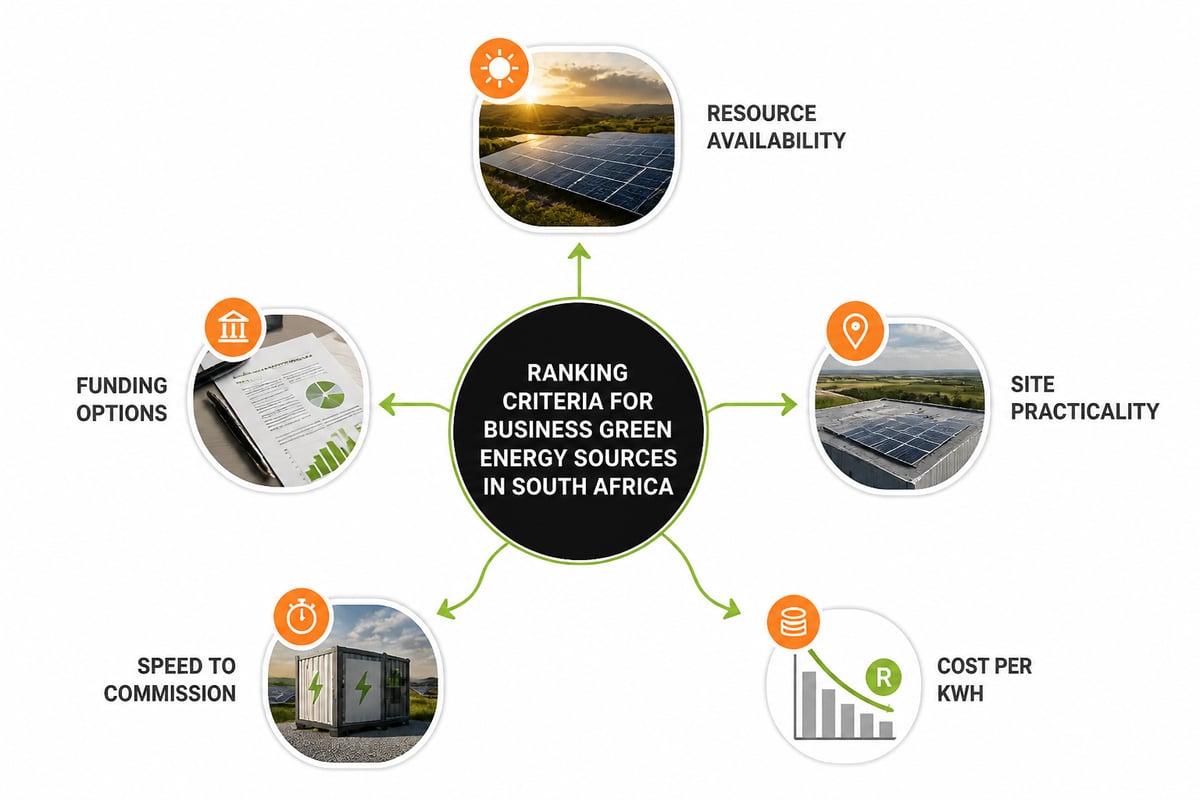
The ranking below weighs five criteria for commercial and industrial sites in South Africa:
- Resource availability: how reliably the source is available across Gauteng, the Western Cape, KwaZulu-Natal and the interior.
- Site practicality: whether it fits on a roof, a carport or a yard without special permissions.
- Cost per kWh: the likely reduction against Eskom and municipal tariffs.
- Speed to commission: months rather than years.
- Funding options: whether it can be financed without upfront capital.
1. Solar PV (rooftop, carport and ground mount)
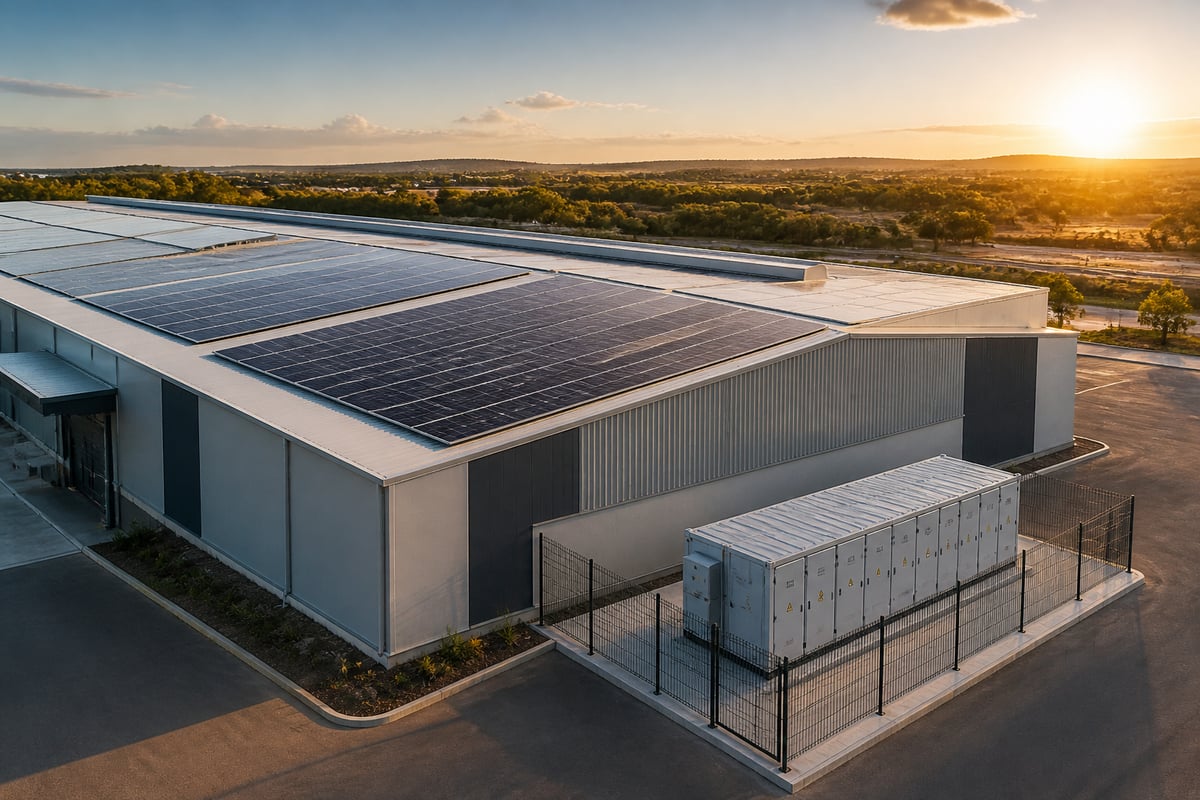
Solar PV is the highest-ranked of the green energy sources for South African businesses, because the country's sunshine is strong, rooftop space is plentiful and installation takes months rather than years.
- Key specs: scalable from tens of kWp to several MWp; rooftop, carport and ground-mount configurations; grid-tied, hybrid or off-grid.
- Approximate price: project-specific. For reference, a South African retailer listed installed kits at R74,500 to R90,500 for a 5 kW system with a 10 kWh battery, and R150,500 to R177,000 for a 12 kW system, per EnergyBee. Per-kW costs generally fall at larger scale.
- Suits: warehouses, factories, cold storage and distribution centres with large daytime loads and unshaded roofs.
- Verdict: the default starting point for almost every business.
Carports suit sites with limited roof area, such as retail centres in Sandton or Century City, because the panels also shade parked vehicles while generating power.
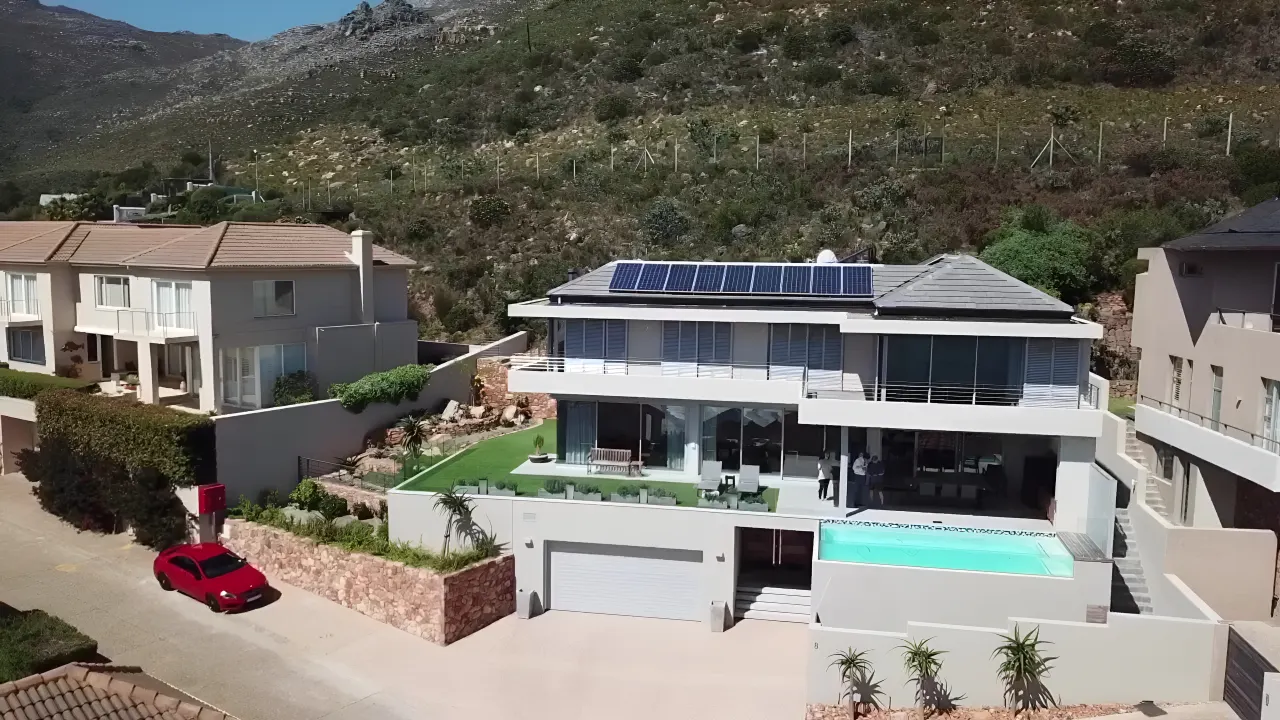
INFOLED has completed a 1.3 MWp rooftop project at UPD Rooftop in Lea Glen, and a 1.947 MWp project at CTP Parow in Cape Town, showing what is achievable at scale. Its solar PV services cover design, financing, maintenance and monitoring, and its guide to commercial solar PV explains the process in more detail.
2. Wind power
Wind power ranks second because it is excellent at utility scale along the Eastern and Western Cape coastlines, but it rarely suits a single business site.
- Key specs: utility turbines run to multiple megawatts; small and rooftop turbines produce far less and depend on steady local wind.
- Approximate price: varies widely by turbine size and site.
- Suits: large landholdings with proven wind resource, or businesses buying wind-backed power through a wheeling arrangement rather than owning turbines.
- Verdict: valuable for the grid, but a niche on-site option for most operators.
Turbulent air around buildings and trees in urban areas such as Johannesburg or Durban cuts output sharply, so a site needs at least a year of measured wind data before turbines are considered.
The IRP 2025 targets about 7,340 MW of new wind by 2030, so grid supply should become greener even where you cannot install turbines. For small installations, see this overview of a small wind turbine.
3. Battery energy storage systems (BESS)
Battery storage ranks third because it does not generate energy, but it makes solar usable after sunset and protects operations during outages.
- Key specs: modular capacity from tens of kWh to MWh scale; supports peak shaving, demand management, load shedding protection and backup power.
- Approximate price: depends on capacity and chemistry. The retailer kits cited above include a 10 kWh battery within the R74,500 to R90,500 range for a 5 kW system.
- Suits: sites with evening or night shifts, process loads that cannot stop, and tariffs with high demand charges.
- Verdict: the best partner for solar wherever downtime costs money.
Peak shaving works by discharging the battery during the half-hour when site demand would otherwise set the monthly maximum demand charge, which lowers that charge for the whole billing period.
INFOLED completed a 266 kWp solar PV and 512 kWh battery storage project at Nutec Ink in Ottery, and offers battery energy storage systems designed for peak shaving and demand management. Costs are covered in its guide to solar battery cost.
4. Hydropower
Hydropower ranks fourth because it is dependable and dispatchable, yet South Africa's limited river flows restrict where small schemes can work.
- Key specs: micro-hydro systems can run continuously where there is a steady water source and sufficient head.
- Approximate price: site-specific; civil works often dominate the cost.
- Suits: farms, estates or mines with a perennial stream or an existing water conduit.
- Verdict: excellent where the site exists, but few commercial properties have one.
Because many Southern African rivers are seasonal, a micro-hydro scheme also needs water-use authorisation and a flow assessment covering the dry months before any design work begins.
See this explanation of a micro hydro system for the basics.
5. Biomass and biogas
Biomass and biogas rank fifth because they convert waste into heat or electricity, but they need a consistent feedstock and more operational management.
- Key specs: boilers, digesters and combined heat and power units; output depends on feedstock volume.
- Approximate price: project-specific.
- Suits: agricultural processors, food producers and timber operations with a steady organic waste stream.
- Verdict: a strong circular-economy fit for the right waste producer.
A piggery, abattoir or sugar mill, for example, can feed manure or bagasse into a digester or boiler and use the heat on site, which often matters more than the electricity itself.
Which country has the most green energy?
China has the largest installed renewable capacity of any country, and Norway and Iceland generate almost all of their electricity from renewables on a per-capita basis. Country-level progress against 2030 ambitions can be compared in the IEA renewable energy progress tracker. For South African businesses, the more useful comparison is the national grid's own trajectory, which is moving steadily towards solar and wind.
The hybrid inverters behind a business solar system
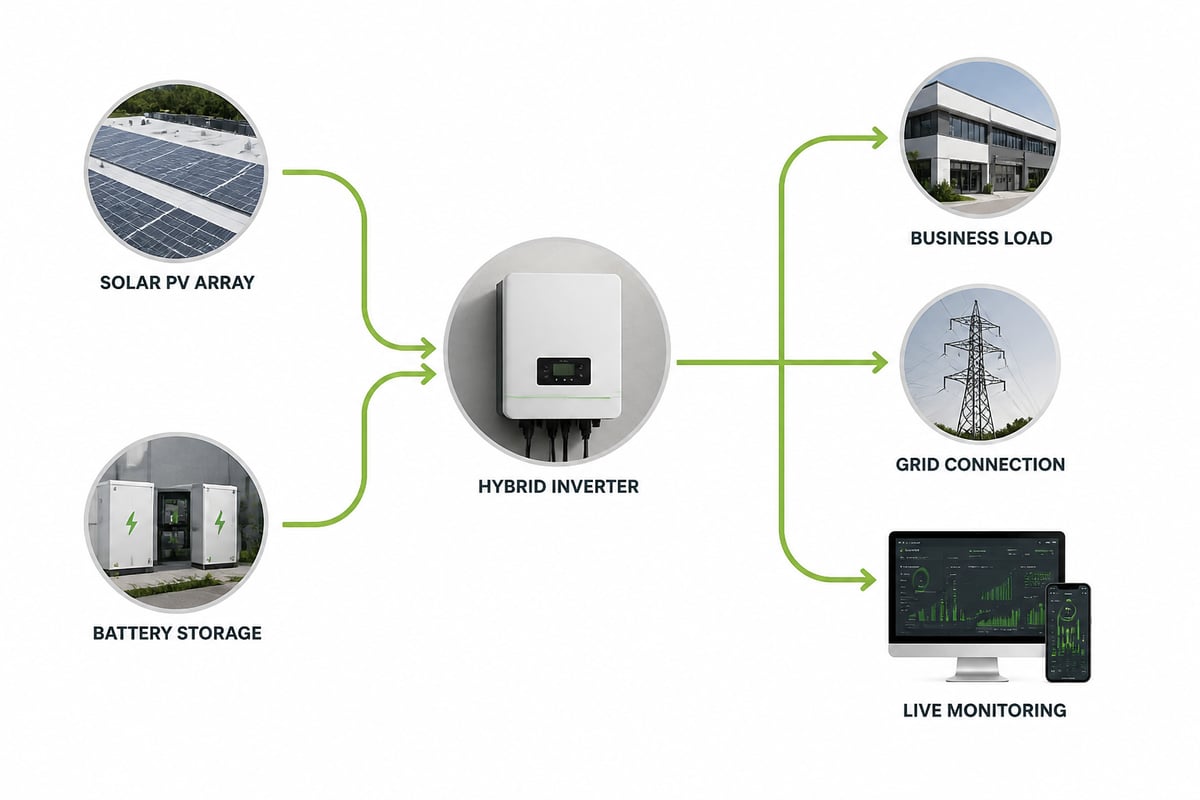
Hybrid inverters are the core hardware that links solar, batteries and the grid. The four below are real products commonly specified for commercial sites, ranked by suitability for mid-sized South African businesses. Sunsynk and Deye units share a similar architecture; the GoodWe and Victron options suit smaller loads.
1. Sunsynk 16kW 3-Phase (SYNK-16K-SG01HP3)
The Sunsynk 16kW three-phase hybrid inverter is a strong choice for sites that need balanced three-phase output.
- Key specs: 16kW three-phase balanced output; 24kWp PV input; 300A battery charge; 97.7% efficiency.
- Approximate price: not listed in the research available.
- Suits: factories, lodges, schools and commercial estates needing three-phase power.
- Verdict: high capacity and efficiency for larger three-phase loads.
The 24kWp PV input allows the array to be sized well above the inverter rating, which helps the unit reach full output earlier and later in the day.
2. Deye SUN-12K-SG01HP3
The Deye SUN-12K-SG01HP3 is a scalable three-phase hybrid inverter for motor-heavy businesses.
- Key specs: 12kW three-phase balanced output; 18kWp PV input; 240A battery charge; scalable to 96kW.
- Approximate price: not listed in the research available.
- Suits: businesses with irrigation pumps, cold rooms or three-phase motors.
- Verdict: the clearest growth path, because parallel units scale to 96kW.
A business can start with a single unit and add inverters in parallel as load grows, rather than replacing the original equipment.
3. GoodWe ET Series
The GoodWe ET Series is a hybrid inverter range for medium-to-large businesses that want long warranty cover.
- Key specs: 5 to 10kW range; three-phase options available; 10-year warranty option.
- Approximate price: about R22,000 to R42,000.
- Suits: medium-to-large businesses seeking a hybrid inverter with extended warranty.
- Verdict: good value where warranty length is a priority.
The three-phase variants fit workshops and small manufacturers, while the 10-year warranty option reduces replacement risk over a typical five-year finance term.
4. Victron MultiPlus-II (Victron Energy)
The Victron MultiPlus-II is a premium, modular inverter-charger built for reliability and off-grid capability.
- Key specs: 3 to 5kW range; off-grid capable; 5-year warranty; requires a separate MPPT solar charge controller.
- Approximate price: about R28,000 to R50,000.
- Suits: businesses prioritising premium reliability, modular design and off-grid capability.
- Verdict: excellent build quality, but the lowest capacity of the four.
Because the MPPT charge controller is a separate purchase, budget for it when comparing the quoted price against the all-in-one units above.
Comparison of the inverters
| Inverter | Output | PV input | Battery charge | Best suited to |
|---|---|---|---|---|
| Sunsynk 16kW 3-Phase | 16kW three-phase | 24kWp | 300A | Factories, estates |
| Deye SUN-12K-SG01HP3 | 12kW three-phase | 18kWp | 240A | Pumps, cold rooms |
| GoodWe ET Series | 5 to 10kW | Not listed | Not listed | Medium-to-large businesses |
| Victron MultiPlus-II | 3 to 5kW | Not listed | Not listed | Off-grid, modular sites |
Getting green energy without capital
Zero upfront cost is available through structured financing. INFOLED structures financing around a client's cash flow, with zero capital investment and five-year agreements, and manages solar, battery, EV charging and energy solutions through one provider. Every installation is tested and inspected by an in-house quality control team, and live monitoring plus proactive maintenance keep systems at maximum uptime. Performance data is turned into reports showing where energy is being lost and how to recover it. VAT treatment on solar equipment and finance should be confirmed with your tax adviser.
FAQ
Which country has to import 98% of its energy?
No single country is reliably documented at exactly that figure in the sources used here. Small island states and some city-states import almost all of their primary energy, which is why renewables and storage are strategic priorities for them.
How quickly can a business switch to green energy sources?
A rooftop solar system with storage can typically be designed and commissioned within months rather than years, depending on site size and approvals. Confirm exact timelines with your installer, and read the guide to switching to renewable energy for the steps involved.
Start by gathering your last twelve months of electricity invoices, because they show how much solar and storage your site can realistically offset. INFOLED can then design, finance, install and monitor the system, and its solar PV services cover the full cycle under one provider. To see whether your property qualifies for a zero-capital, five-year arrangement, contact INFOLED and check funding eligibility.
Next Step
Need help with your energy strategy?
Speak to INFOLED about solar, storage, EV charging, service agreements or system performance.