

Energy storage has become essential for South African businesses and homeowners seeking reliable power solutions amidst persistent grid challenges. Understanding solar battery cost is fundamental to making informed decisions about battery energy storage systems (BESS) that can safeguard operations, reduce electricity expenses, and support long-term sustainability goals. This comprehensive guide explores the pricing landscape, investment considerations, and value drivers that shape battery storage economics in Southern Africa's renewable energy sector.
Understanding Solar Battery Cost Components
The total solar battery cost encompasses multiple elements beyond the battery cells themselves. System pricing includes the battery modules, inverter or hybrid inverter integration, installation labour, electrical infrastructure upgrades, and system commissioning.
Battery chemistry significantly influences cost per kilowatt-hour. Lithium iron phosphate (LiFePO4) batteries dominate the commercial and industrial market due to superior safety profiles and cycle life, whilst lithium nickel manganese cobalt (NMC) chemistries offer higher energy density at competitive prices. Lead-acid alternatives remain available at lower upfront costs but deliver substantially fewer cycles and reduced depth of discharge.
Installation complexity varies considerably across applications:
- Rooftop installations requiring structural assessments and additional support
- Indoor installations demanding climate control and fire suppression systems
- Outdoor enclosures with environmental protection and security measures
- Grid integration and switchgear modifications for commercial systems
- Compliance documentation and municipal approvals
The National Laboratory of the Rockies System Advisor Model provides detailed cost modelling inputs that help contextualize these component expenses within total system economics.
Residential Solar Battery Cost Range
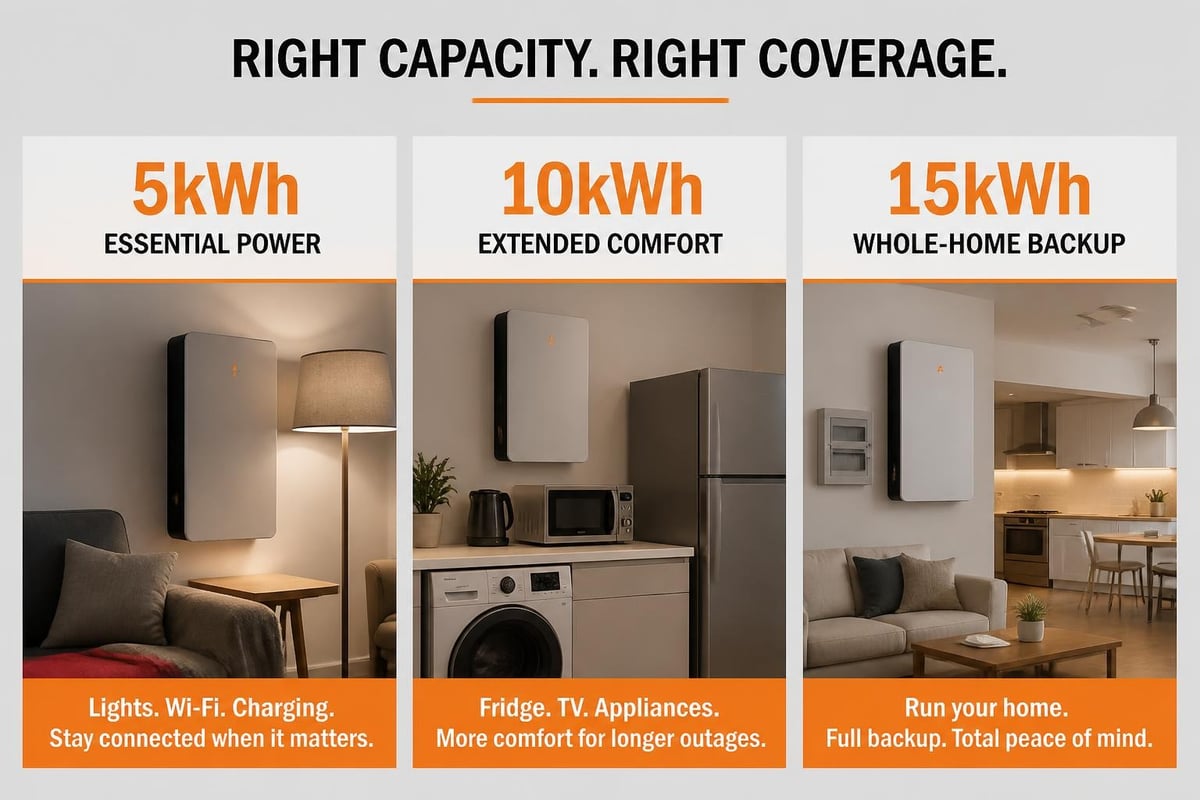
South African homeowners typically invest between ZAR 80,000 and ZAR 350,000 for residential battery storage systems in 2026. This range reflects capacity variations from compact 5 kWh units suitable for essential loads through to comprehensive 15-20 kWh systems supporting entire household consumption.
| Capacity | Typical Cost Range | Common Applications |
|---|---|---|
| 5 kWh | ZAR 80,000 - ZAR 120,000 | Essential circuits, load shedding backup |
| 10 kWh | ZAR 140,000 - ZAR 220,000 | Full home backup (4-6 hours), peak shifting |
| 15-20 kWh | ZAR 250,000 - ZAR 350,000 | Extended autonomy, off-grid capability |
Premium brands with proven Southern African track records command higher prices but typically include superior warranties, local technical support, and advanced battery management systems that optimize performance across South Africa's diverse climate zones.
Commercial and Industrial Battery Investment
Commercial battery energy storage systems represent substantially larger investments, with solar battery cost ranging from ZAR 500,000 for small business installations to several million rand for industrial-scale deployments. These systems deliver immediate returns through demand charge reduction, time-of-use optimization, and operational continuity during grid failures.
Peak shaving applications generate rapid payback. Commercial facilities on Megaflex or Ruraflex tariffs face substantial demand charges based on monthly peak consumption. Strategic battery discharge during peak periods reduces these charges, with typical payback periods of 3-5 years for facilities with pronounced demand peaks.
Industrial installations require sophisticated energy management:
- Load profiling to identify consumption patterns and optimization opportunities
- Tariff analysis comparing standard, time-of-use, and seasonal rate structures
- System sizing balancing capital expenditure against operational savings
- Integration planning with existing solar PV, generators, and backup systems
- Revenue modelling incorporating demand reduction, energy arbitrage, and resilience value
Commercial battery storage solutions in manufacturing, agriculture, and retail sectors demonstrate compelling economics when properly engineered to match operational requirements and tariff structures.
Cost Per Kilowatt-Hour Benchmarks
Industry benchmarks for installed solar battery cost in South Africa currently range between ZAR 5,500 and ZAR 12,000 per kilowatt-hour of usable capacity. This metric provides useful comparison across different system sizes and configurations.
Several factors influence per-kWh pricing:
- System scale with larger installations achieving lower per-unit costs through economies of scale
- Brand positioning reflecting warranty terms, performance guarantees, and technical support
- Integration complexity including electrical upgrades and existing infrastructure modifications
- Warranty coverage with premium systems offering 10-15 year performance guarantees
- Installation environment affecting enclosure requirements and labor intensity
The Pacific Northwest National Laboratory's Energy Storage Cost Database offers component-level cost breakdowns that illuminate these variations across different battery technologies and applications.
Financing and Ownership Models
Capital constraints need not prevent battery adoption. Multiple financing pathways enable businesses and homeowners to implement storage solutions whilst preserving working capital and managing cash flow.
Purchase Options
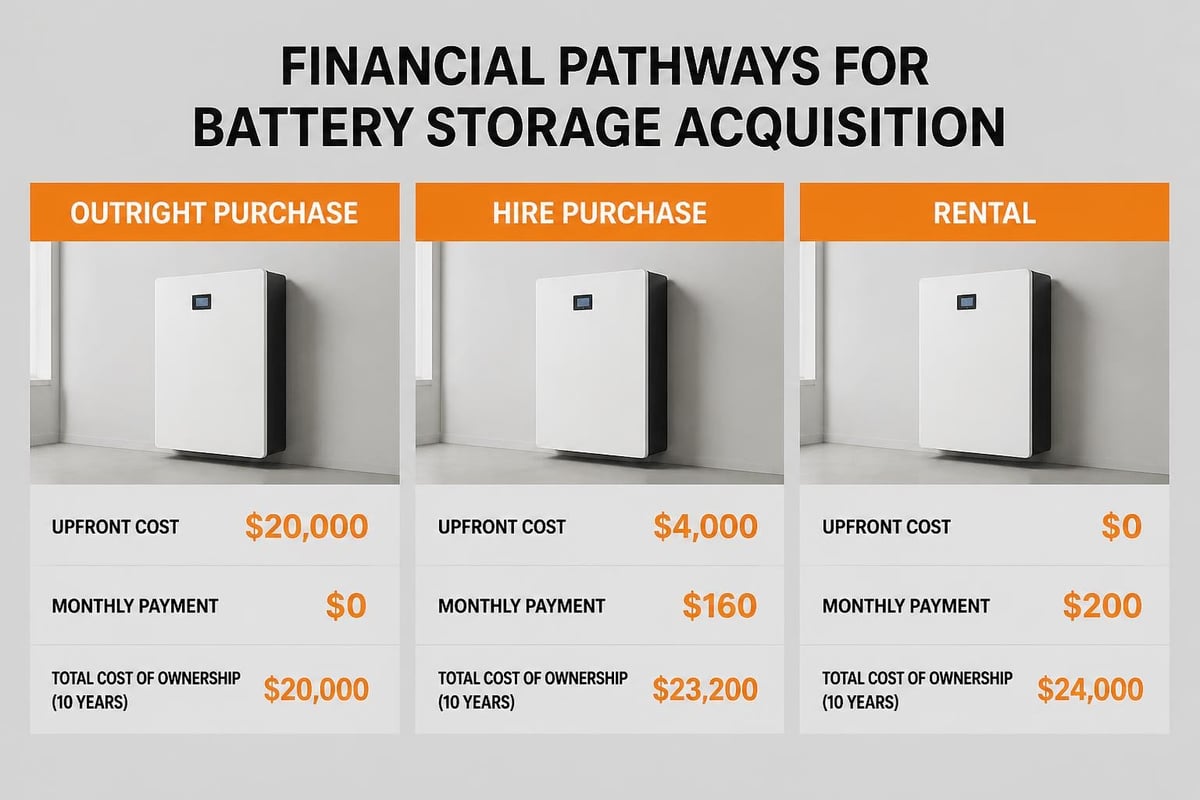
Outright purchase provides maximum long-term value and full ownership of system warranties, tax benefits, and energy savings. Many businesses leverage existing credit facilities or allocate capital budgets to energy infrastructure investments that deliver measurable returns.
Hire purchase agreements distribute solar battery cost across 12-60 month terms, with ownership transferring upon final payment. Interest rates typically range from prime plus 2-4%, making this accessible for established businesses with solid credit profiles.
Rental and subscription models eliminate upfront capital requirements entirely. Monthly fees cover equipment, installation, maintenance, and monitoring, with agreements typically spanning 5-10 years. Whilst total cost exceeds outright purchase, operational expense treatment suits certain tax planning strategies.
| Ownership Model | Upfront Cost | Monthly Cost | Long-term Value |
|---|---|---|---|
| Outright purchase | 100% | Minimal (maintenance) | Highest |
| Hire purchase | 10-30% | Medium | High |
| Rental | None | Higher | Lower |
The U.S. Department of Energy's analysis of storage innovation highlights how financing availability influences adoption rates and total installed capacity across different markets.
Return on Investment Calculations
Accurately projecting battery system returns requires comprehensive analysis of multiple value streams. Solar battery cost must be evaluated against tangible savings, risk mitigation benefits, and operational improvements that systems deliver.
Quantifiable Savings
Demand charge reduction represents the most significant commercial value driver. Facilities can achieve 30-60% reductions in monthly demand charges through strategic peak shaving, translating to annual savings of ZAR 150,000 to over ZAR 1 million depending on facility size and tariff structure.
Time-of-use arbitrage captures value by charging batteries during off-peak periods (10 PM - 6 AM) when electricity costs 60-120 cents per kWh, then discharging during peak periods (7 AM - 10 AM and 6 PM - 9 PM) when rates reach 250-400 cents per kWh. The differential creates immediate operational savings.
Load shedding protection avoids:
- Production downtime costs in manufacturing environments
- Refrigeration losses in cold chain operations
- Point-of-sale disruptions in retail environments
- Equipment damage from uncontrolled shutdowns
- Customer service degradation and revenue losses
The revenue analysis for energy storage systems provides frameworks for quantifying these diverse value streams within total project economics.
Operational and Strategic Value
Beyond direct financial returns, battery systems deliver strategic benefits that enhance business resilience and market positioning. Uninterrupted operations during grid failures protect brand reputation and customer relationships in ways balance sheets cannot fully capture.
ESG reporting and Net Zero commitments increasingly influence corporate procurement decisions and investor relations. Battery storage enables higher renewable energy utilization by addressing solar PV's intermittency, accelerating progress toward carbon reduction targets and sustainability reporting requirements.
INFOLED's Battery Energy Storage Systems integrate advanced energy management platforms that optimize multiple value streams simultaneously, maximizing returns whilst supporting environmental objectives through intelligent dispatch algorithms and predictive analytics.
Factors Affecting Long-Term Costs
Total cost of ownership extends beyond initial solar battery cost to encompass operational expenses, performance degradation, and eventual replacement considerations.
Maintenance and Monitoring
Professional battery systems require minimal hands-on maintenance but benefit substantially from continuous remote monitoring. Modern battery management systems track:
- Cell voltage and temperature parameters
- State of charge and state of health metrics
- Cycle counting and degradation trending
- Alarm conditions and fault diagnostics
- Energy throughput and financial performance
Annual maintenance contracts typically cost 0.5-1.5% of system capital cost, covering thermal imaging inspections, connection integrity verification, software updates, and performance reporting. This preventative approach identifies developing issues before they impact system availability or warranty compliance.
Warranty structures vary considerably across manufacturers and influence long-term cost projections. Premium batteries offer 10-year warranties with specific throughput guarantees (often 6,000-10,000 cycles or total energy throughput), whilst economy options may provide 5-7 years with more limited coverage.
Performance Degradation
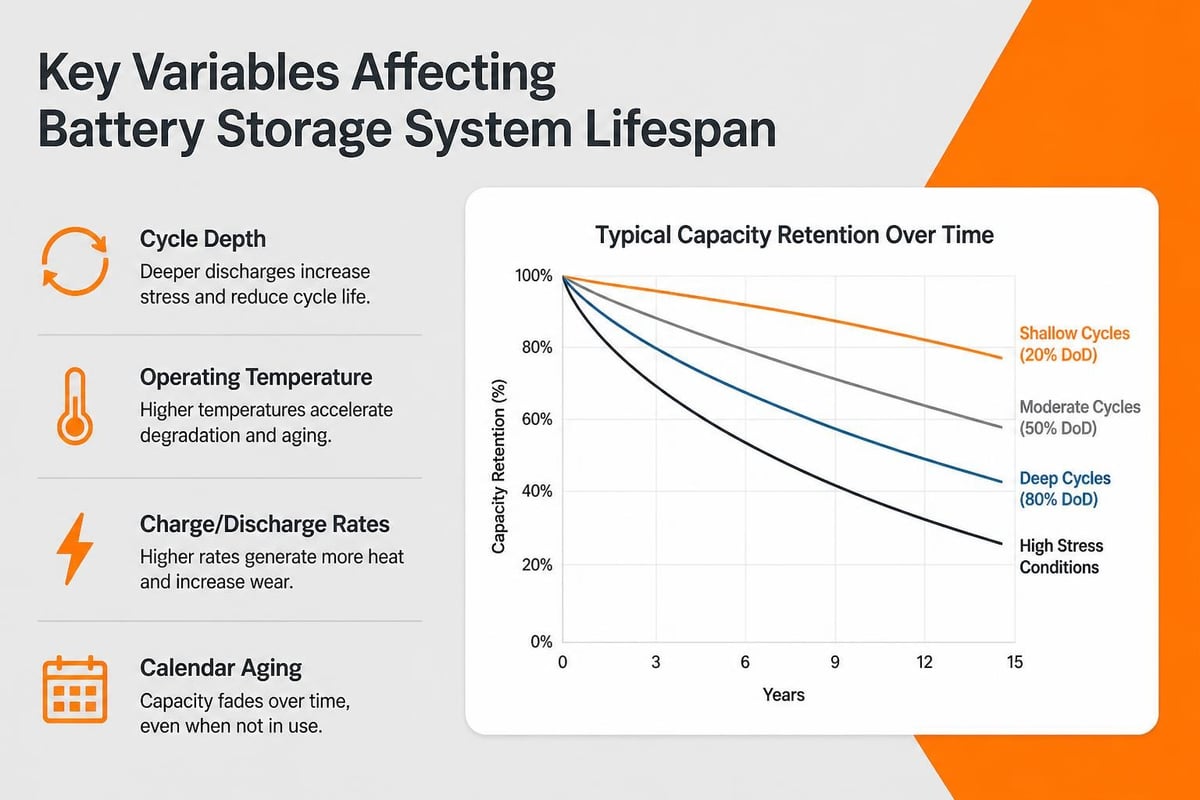
Battery capacity naturally declines with cycling and calendar aging. Lithium iron phosphate batteries typically retain 80% of original capacity after 6,000-8,000 cycles under proper operating conditions, whilst lithium NMC chemistries may reach this threshold after 3,000-5,000 cycles.
Temperature management critically affects degradation rates:
- Batteries operating at 25°C show minimal accelerated aging
- Systems above 35°C experience 15-25% faster capacity fade
- Extreme heat above 45°C can halve expected service life
Proper system design accounts for South Africa's climate diversity, from coastal humidity to Highveld temperature extremes, ensuring thermal management systems maintain optimal operating conditions year-round.
System Sizing and Scalability
Matching battery capacity to actual requirements optimizes solar battery cost against delivered value. Undersized systems fail to capture available savings, whilst oversized installations lock capital in underutilized assets.
Load Analysis Methodology
Professional system sizing begins with detailed consumption analysis examining:
- Historical billing data revealing seasonal patterns and growth trends
- Interval meter data showing 30-minute demand profiles
- Production schedules identifying operational patterns and shift structures
- Critical load inventories quantifying essential backup requirements
- Future expansion plans accommodating anticipated growth
This evidence-based approach ensures battery systems align with actual operational requirements rather than generic assumptions or rule-of-thumb calculations that often prove inaccurate.
Modular architectures provide scalability as requirements evolve. Commercial systems can typically expand in 50-100 kWh increments, adding capacity as energy consumption grows or as additional value streams emerge. This phased approach manages capital expenditure whilst maintaining flexibility for future optimization.
Regional Cost Variations
Solar battery cost exhibits geographical variation across Southern Africa driven by logistics, installation expertise, and local market dynamics. Metropolitan areas with established renewable energy ecosystems typically offer more competitive pricing and broader technology choices.
Gauteng and Western Cape Markets
Johannesburg, Pretoria, and Cape Town demonstrate the most mature battery storage markets, with numerous qualified installers and comprehensive product availability. Competition among suppliers and installation companies creates downward price pressure whilst raising quality standards through differentiation.
These markets benefit from concentrated technical expertise, shorter supply chains, and established service networks that reduce total system costs and simplify ongoing maintenance requirements.
Rural and Remote Installations
Agricultural and mining operations in remote locations face higher solar battery cost due to:
- Extended logistics chains increasing equipment delivery costs
- Travel time and accommodation for installation teams
- Limited local technical support requiring remote service arrangements
- Potentially more robust environmental protection requirements
However, these same locations often experience the most severe grid reliability issues and highest value from energy storage systems, with backup power preventing production losses that far exceed installation premiums.
Energy management systems become particularly valuable in remote deployments, providing visibility and control that maximize system performance despite distance from technical support infrastructure.
Technology Trends Affecting Pricing
Battery technology advances continuously, with innovation cycles driving performance improvements and cost reductions that reshape market economics.
Chemistry Evolution
Second-generation lithium iron phosphate cells deliver 15-20% higher energy density than earlier iterations, reducing enclosure size and installation costs. Improved cathode formulations extend cycle life whilst maintaining safety advantages that make LiFePO4 chemistry preferred for stationary storage applications.
Sodium-ion batteries emerging in 2026 promise lower material costs through abundant feedstock availability, potentially reducing per-kWh pricing by 20-30% over the next 3-5 years. Early commercial deployments target specific applications where energy density matters less than cost per cycle.
The Lazard Levelized Cost of Energy analysis tracks these technology trends and their impact on levelized cost of storage, helping buyers understand where pricing trajectories are heading.
Smart Integration Capabilities
Modern battery systems incorporate sophisticated energy management that optimizes multiple objectives simultaneously. Artificial intelligence algorithms learn facility consumption patterns, weather correlations, and tariff structures to maximize economic returns automatically.
Grid services capabilities enable battery systems to participate in ancillary service markets where they exist, generating additional revenue streams beyond on-site savings. Whilst South Africa's market structures currently limit these opportunities, regulatory evolution may open new value pathways for battery asset owners.
Procurement Best Practices
Making informed battery investment decisions requires systematic evaluation of technical specifications, financial terms, and vendor capabilities that extend beyond simple solar battery cost comparison.
Vendor Selection Criteria
Qualified vendors demonstrate:
- Accredited engineering teams with relevant electrical and energy credentials
- Proven track record in systems of comparable size and complexity
- Manufacturer certifications authorizing warranty service and technical support
- Financial stability ensuring long-term service capability
- Comprehensive proposals addressing technical, financial, and operational considerations
Request detailed quotations that unbundle component costs, installation labor, commissioning, training, and ongoing service agreements. This transparency facilitates meaningful comparison across competing proposals.
Performance guarantees provide confidence in projected returns. Leading vendors stand behind energy savings calculations with contractual commitments, demonstrating confidence in system design and operational assumptions.
Contract Considerations
Review agreements carefully for:
- Equipment specifications including exact battery models and capacities
- Warranty terms covering both equipment and installation workmanship
- Service level agreements defining response times and uptime commitments
- Payment schedules tied to installation milestones and commissioning
- Training provisions ensuring operational staff understand system operation
Engage legal and financial advisors to review contract terms, particularly for large commercial installations representing substantial capital commitments.
Tax Incentives and Policy Support
South African renewable energy incentives can significantly reduce net solar battery cost through accelerated depreciation and other mechanisms.
Section 12B Allowances
The Income Tax Act's Section 12B provisions allow accelerated depreciation on qualifying renewable energy assets. Whilst primarily targeting generation equipment, battery systems integral to renewable energy installations may qualify for favorable tax treatment.
Consult qualified tax professionals to structure installations optimally, as eligibility depends on specific system configurations and integration with solar PV or other renewable generation sources.
Carbon Tax Implications
South Africa's carbon tax creates economic incentives for emissions reduction. Battery storage that displaces diesel generator operation or increases renewable energy utilization reduces carbon tax liability whilst supporting corporate sustainability objectives.
Accurate quantification requires detailed emissions modeling accounting for grid emission factors, displaced fossil generation, and operational patterns specific to each facility.
Making the Investment Decision
Solar battery cost represents a significant commitment that warrants thorough due diligence and professional guidance. The most successful implementations balance technical performance, financial returns, and strategic alignment with broader energy and sustainability goals.
Start with comprehensive energy auditing to understand current consumption patterns, identify inefficiencies, and establish baseline metrics against which storage benefits can be measured. Energy consumption monitoring provides the data foundation for accurate system sizing and realistic financial projections.
Compare multiple proposals from qualified vendors, evaluating total value rather than simply selecting the lowest price. The cheapest system frequently proves most expensive over its lifecycle through higher maintenance costs, shorter service life, or underperformance against projections.
Consider phased implementation for large commercial installations. Initial deployment validates assumptions, demonstrates value to stakeholders, and provides operational experience that informs subsequent expansion. This de-risks major capital commitments whilst beginning to capture available savings immediately.
Solar battery cost continues declining as technology matures and Southern African markets expand, making energy storage increasingly accessible across residential, commercial, and industrial applications. Strategic battery investments deliver immediate operational benefits whilst positioning organizations for long-term energy resilience and sustainability success. INFOLED brings comprehensive expertise in battery energy storage system design, financing, installation, and ongoing optimization, helping clients across Southern Africa implement intelligent storage solutions that reduce electricity costs, improve energy security, and support ESG objectives through proven engineering and integrated technology platforms.
Next Step
Need help with your energy strategy?
Speak to INFOLED about solar, storage, EV charging, service agreements or system performance.