The different types of wind turbines fall into two groups by rotor orientation: horizontal-axis turbines, which dominate the market, and vertical-axis turbines, which suit small, turbulent sites. Beyond that split, turbines are classed by size and location, from small units of a few kilowatts to utility-scale machines and offshore giants. For a South African business trying to cut electricity costs, the right choice depends on wind resource, site layout and how much capital you are prepared to commit.
This guide sets out each design, what it costs you in practical terms, and where wind makes sense against solar for commercial and industrial properties.
What Are the Two Main Types of Wind Turbines?
The two main types are horizontal-axis wind turbines (HAWTs) and vertical-axis wind turbines (VAWTs), distinguished by the direction of the rotor's axis. According to the U.S. Energy Information Administration, nearly all operating turbines are horizontal-axis designs.
| Feature | Horizontal-axis (HAWT) | Vertical-axis (VAWT) |
|---|---|---|
| Rotor orientation | Blades rotate around a horizontal shaft | Blades rotate around a vertical shaft |
| Typical scale | Small to very large | Small |
| Needs to face the wind | Yes, via a yaw mechanism | No |
| Efficiency in steady wind | High | Lower |
| Performance in turbulence | Weaker | Better |
| Maintenance access | Gearbox and generator at height | Equipment often near ground level |
The sections below take each in turn.
How Horizontal-Axis Turbines Work
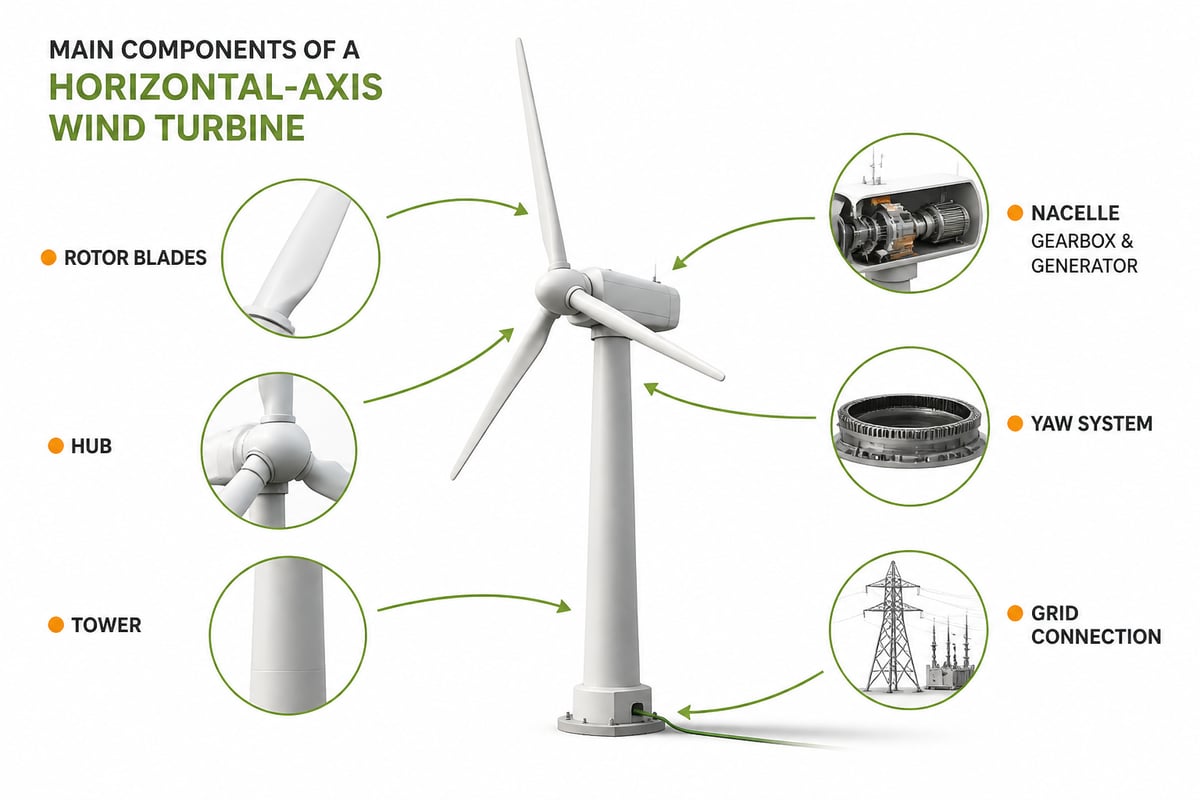
Horizontal-axis turbines capture wind with propeller-style blades mounted on a tall tower, and they are the standard for commercial power generation. Most carry three blades. A yaw system turns the rotor to face the wind, while the blades pitch to control speed and protect the machine in storms.
The strengths are well established:
- Higher efficiency. Tall towers reach faster, steadier wind than ground-level sites.
- Proven technology. Decades of operation have refined reliability and bankability.
- Scalability. The design works from a few kilowatts up to multi-megawatt units.
The drawbacks matter for a business site. The towers are tall, so planning approval, structural engineering and visual impact all need attention. Gearboxes and generators sit high up, which raises maintenance cost. They also perform poorly in turbulent air created by buildings, which is the reality of most urban and industrial parks in Johannesburg, Durban or Cape Town.
How Vertical-Axis Turbines Differ
Vertical-axis turbines spin around an upright shaft, so they accept wind from any direction without needing to turn. The U.S. Department of Energy's Small Wind Guidebook identifies two types of vertical-axis small wind turbines: Savonius and Darrieus.
- Savonius. A drag-based design with scoop-shaped blades. It starts easily in light wind but converts relatively little of the wind's energy.
- Darrieus. A lift-based design with curved, eggbeater-style blades. It is more efficient but often needs help to start turning.
The appeal for a commercial property is practical. Generators and gearing sit close to the ground, which simplifies servicing, and the units are generally quieter and more compact. The trade-off is lower energy yield per unit of swept area, and fewer certified, field-proven models than the horizontal-axis market offers.
For a deeper look at compact options, INFOLED's articles on the small wind turbine and the rooftop wind turbine cover what building-mounted units can realistically deliver.
Different Types of Wind Turbines by Size and Location
Beyond rotor design, turbines are grouped by scale and setting, and this is the grouping that matters most when budgeting. The practical categories are:
- Small-scale (distributed) wind. The Department of Energy's guide places small turbines in the range of tens of watts to about 100 kilowatts. A turbine of about 10 kilowatts can power a single home, per the Energy Information Administration. These suit farms, remote sites and facilities that want to offset a portion of their load.
- Utility-scale onshore wind. Land-based machines feeding the grid. The National Renewable Energy Laboratory's 2025 technology baseline lists representative future land-based turbines rated at 3.3 to 8.3 megawatts, with rotor diameters of 148 to 196 metres and hub heights of 100 to 140 metres.
- Offshore wind. Larger again, mounted on fixed or floating foundations at sea. The largest operating turbines are very large machines, with capacity measured in megawatts.
For most South African businesses, only the first category is realistic on site. Utility-scale wind is developed by independent power producers on the Eastern and Western Cape coasts and sold through wheeling or power purchase arrangements, rather than installed behind a company's own meter.
Is a Wind Turbine AC or DC?
A wind turbine's generator produces alternating current, but what reaches your distribution board is always AC at grid frequency, regardless of the generator type. Many modern turbines generate variable-frequency AC, convert it to DC through a rectifier, and then use an inverter to produce clean 50 Hz AC for South Africa's grid. Small turbines used with batteries often keep the DC stage so that storage can charge directly.
The practical point for a business is the inverter. It governs power quality, grid compliance and how a turbine integrates with solar and battery storage. INFOLED's guide to the PV inverter explains the equipment that sits between generation and your load.
What Is a Type 3 Wind Turbine?
A Type 3 wind turbine is a grid-integration classification for a doubly fed induction generator (DFIG), in which the generator's stator connects directly to the grid while the rotor connects through a partial-scale power converter. This arrangement lets the turbine run at variable speed while the converter handles only a fraction of the total power, which reduces cost and losses.
It is one of four standard grid-connection types used by utilities and engineers:
- Type 1. Fixed-speed squirrel-cage induction generator.
- Type 2. Wound-rotor induction generator with variable rotor resistance.
- Type 3. Doubly fed induction generator with a partial converter.
- Type 4. Full-converter design, with all power passing through the converter.
Type 3 and Type 4 dominate modern installations. For a business, the classification matters mostly when you are assessing a grid-connected project, because it affects the studies a utility or municipality will request.
What Are the Advantages of Windmills and Wind Turbines?
The main advantages of wind turbines are free fuel, low operating emissions and the ability to generate at times when solar cannot. In practical terms for a commercial site:
- No fuel cost. Once built, the wind itself costs nothing, which shields part of your energy spend from tariff increases.
- Night-time and winter output. Wind often blows when the sun is down, so it can complement solar generation.
- Low operating emissions. A turbine supports ESG reporting and Net Zero targets without combustion on site.
- Land use. On farms and large industrial sites, the ground around a tower remains usable.
The limitations are equally real. Output depends entirely on the local wind regime, towers need planning approval and structural work, and small turbines often have a longer payback than solar on the same budget. Wind rewards sites with proven, consistent resource, so a measured wind assessment should come before any commitment.
Choosing Between Wind, Solar and a Hybrid System
For most commercial and industrial properties in South Africa, solar PV delivers the most predictable return, with wind added only where the site has a strong, verified resource. South Africa has strong solar irradiation, rooftops are plentiful, and the technology has no moving parts to maintain.
A sensible decision sequence looks like this:
- Measure your load profile. Understand when your site uses power, and what it pays per kilowatt-hour.
- Assess the resource. Solar yield can be modelled from satellite data; wind needs on-site or nearby measurement.
- Check site constraints. Roof space, height limits, neighbours, zoning and municipal approval all shape what is feasible.
- Add storage where it pays. Batteries shift generation to peak tariff periods and provide resilience during load shedding.
- Consider a hybrid. Combining sources can smooth supply, as explained in INFOLED's article on a wind-solar hybrid system.
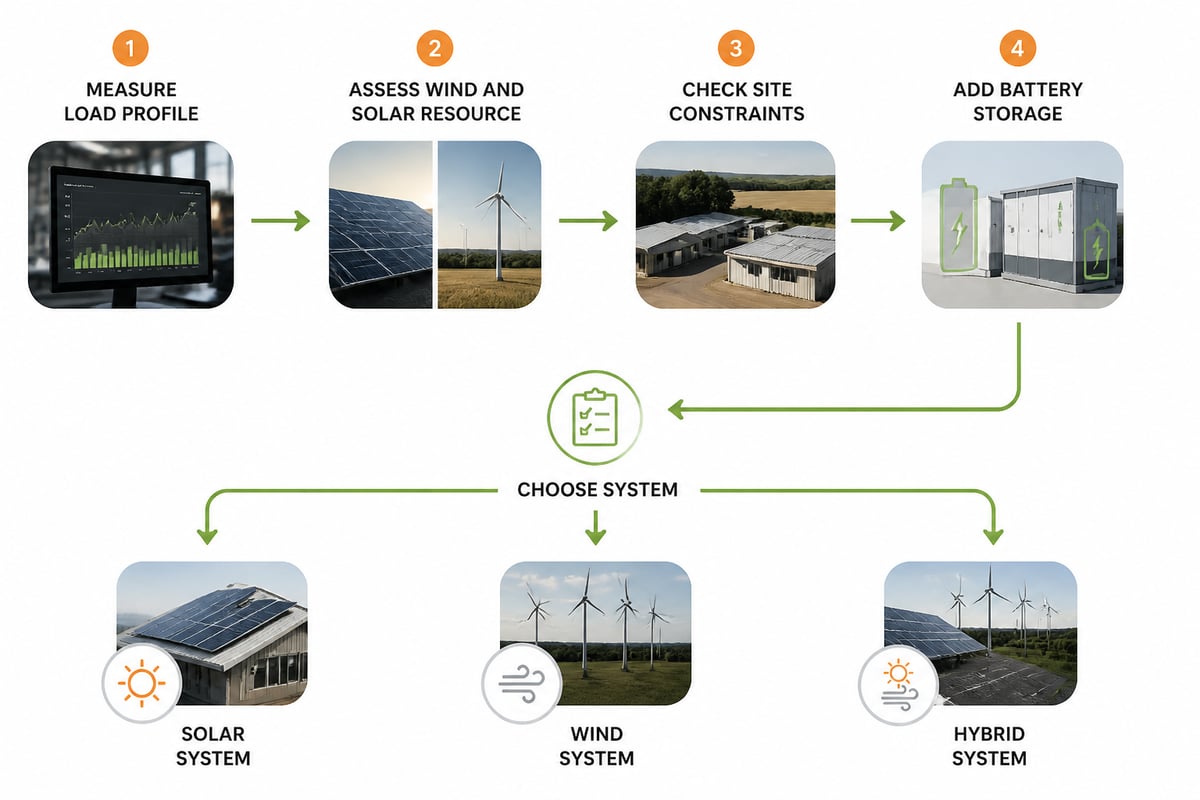
If your site does have workable wind, the Department of Energy's small community wind handbook covers project planning, turbine certification and grid-connection configurations, which are useful reference points before you approach suppliers.
Funding Wind and Solar Without Capital Outlay
You can fund on-site generation without spending capital by using a structured agreement in which the provider designs, installs and maintains the system, and you pay from the savings. INFOLED structures financing around the client's cash flow, with zero capital investment and five-year agreements.
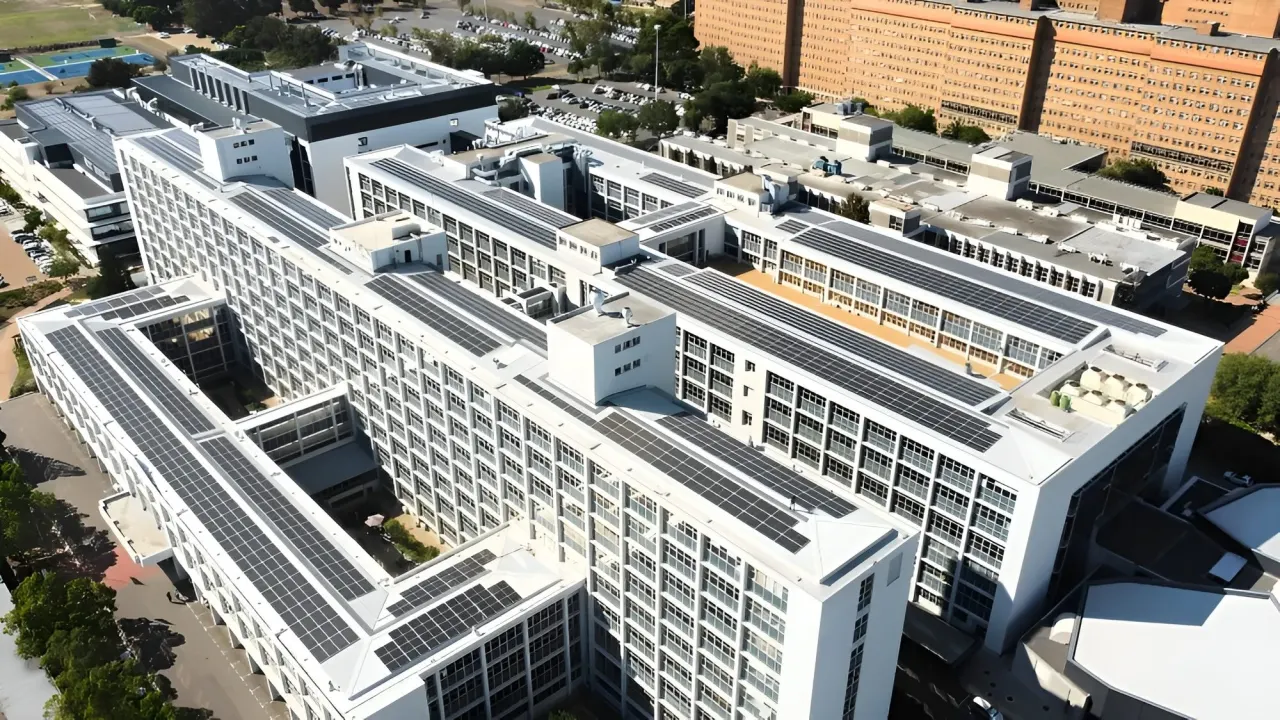
This is where solar usually has the edge. INFOLED has completed projects such as a 1.3 MWp rooftop solar PV installation at UPD Rooftop in Lea Glen, a 1.947 MWp project at CTP Parow in Cape Town, and a 266 kWp solar PV and 512 kWh battery storage project at Nutec Ink in Ottery. Each installation is tested and inspected by an in-house quality control team, and live monitoring and proactive maintenance keep systems running at maximum uptime.
Performance data is also turned into reports that show where energy is being lost and how to recover it, which matters whichever generation source you choose. Because solar, batteries, EV charging and smart metering are managed by one provider, you avoid coordinating several contractors. If you want to see what that looks like for a rooftop, read about commercial solar PV and commercial battery storage, or review how energy consumption monitoring exposes waste.
On tax, remember that VAT applies to solar and storage equipment, and that eligible renewable investments may qualify for a Section 12B allowance. Confirm the current treatment with your tax adviser before committing.
FAQ
How many blades does a wind turbine have?
Most modern horizontal-axis turbines have three blades, which balances efficiency, smooth rotation and cost. Small turbines sometimes use more blades to start in lighter wind, while vertical-axis designs vary by type.
Can a wind turbine power a whole business?
Only a small turbine's output is realistic for most sites, and it usually offsets part of the load rather than all of it. A small residential-scale turbine can power a single home, so a commercial building typically needs a larger or combined solution. Pairing generation with storage and monitoring gives a more dependable result.
Do wind turbines work during load shedding?
A standard grid-tied turbine shuts down when the grid fails, for safety reasons. To keep supplying power during load shedding, it must be paired with a battery system and an inverter that can operate in island mode.
Your next step is to gather twelve months of electricity bills and half-hourly interval data for your site, because every sizing and financing decision starts with how and when you use power. With that in hand, INFOLED can model solar, storage and, where the wind resource justifies it, a hybrid configuration, then structure it around your cash flow with no capital outlay. To find out what is possible for your property, INFOLED can help you check funding eligibility and move towards lower bills and greater energy resilience.
Next Step
Need help with your energy strategy?
Speak to INFOLED about solar, storage, EV charging, service agreements or system performance.