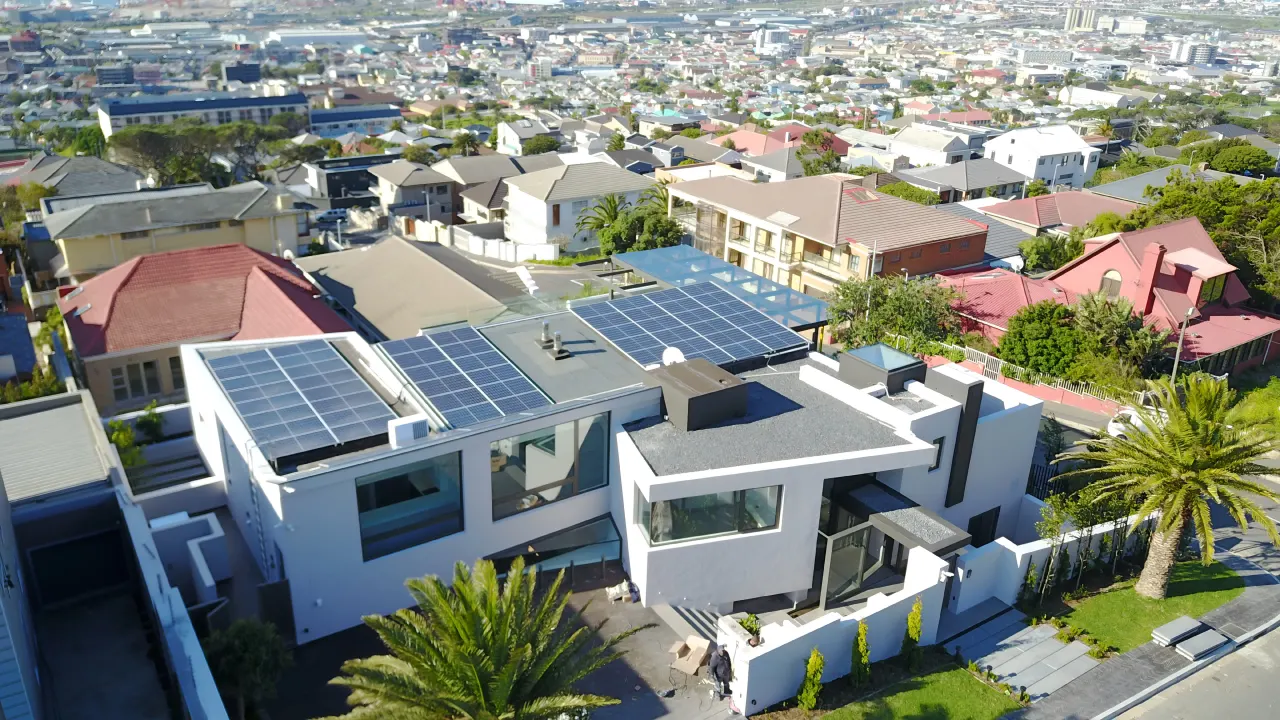
Power and sun come together through solar photovoltaic (PV) systems, which convert sunlight into electricity that a business can use on site, store in batteries or sell back to the grid. For South African commercial and industrial property owners, this is now one of the most dependable ways to reduce electricity costs, and it can be done without spending capital upfront.
This guide explains how solar PV works, what it saves, how financing removes the capital barrier, and how parking areas and fleets can turn EV charging into income.
How Solar PV Turns Sunlight Into Usable Business Power
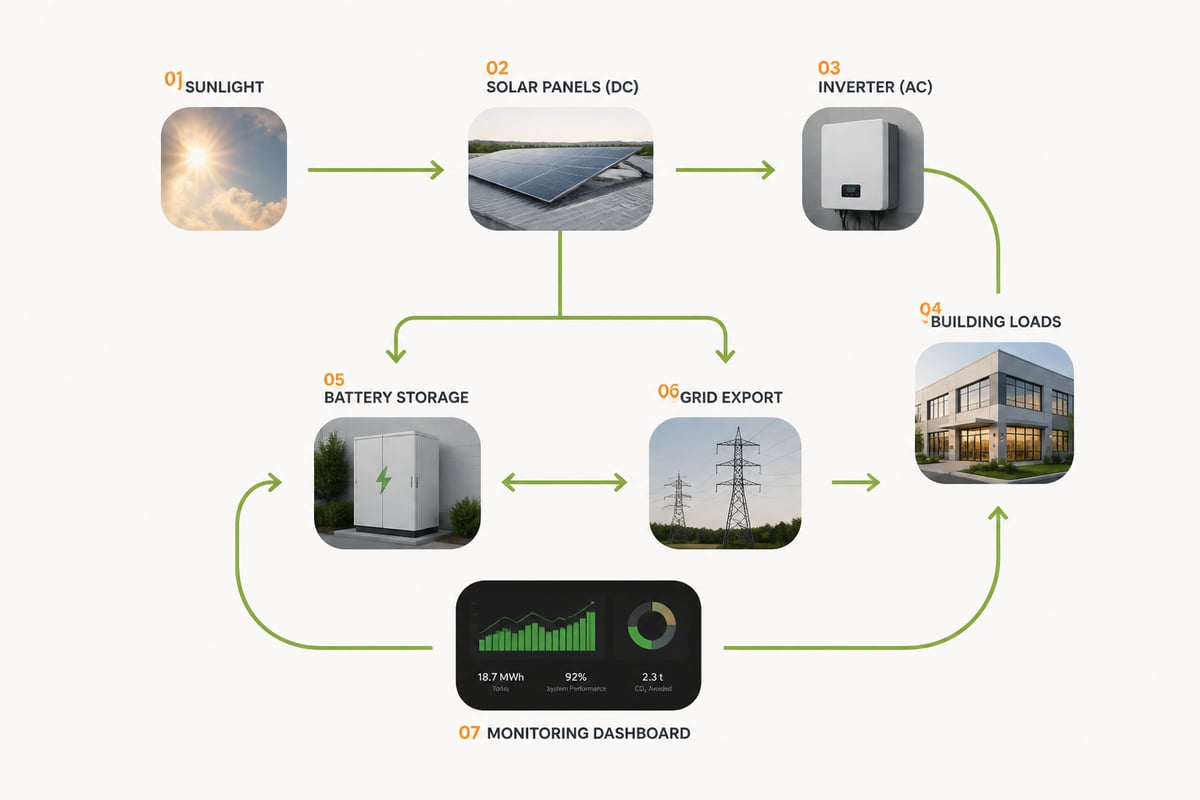
A solar PV system generates direct current (DC) electricity from sunlight, and an inverter converts it into the alternating current (AC) that runs lights, machinery, refrigeration and air conditioning.
The main components are straightforward:
- Solar panels capture sunlight and produce DC power.
- Inverters convert DC to AC and synchronise the system with the building's supply.
- Mounting structures hold panels on a roof, over a carport or on the ground.
- Monitoring equipment records production and consumption in real time.
- Batteries (optional) store surplus energy for evenings, peak periods or load shedding.
South Africa has some of the strongest solar resources in the world, and the Northern Cape, Free State, Gauteng and the Western Cape all offer production levels that make commercial systems viable. A well-designed array on a factory roof in Johannesburg or a distribution centre in Cape Town will typically generate the bulk of its output during working hours, which is when most businesses consume the most electricity. That alignment between daytime generation and daytime demand is the main reason commercial solar performs so well financially.
For a deeper technical grounding, INFOLED's article on solar power photovoltaic systems covers cell technology and system sizing in more detail.
Why Electricity Costs Make the Case for Solar in South Africa
Rising tariffs are the strongest financial argument for solar, because every rand of grid electricity displaced is a rand the business no longer pays at an escalating rate.
According to Eskom, direct-customer tariffs increased by 12.74% from 1 April 2025, while municipal bulk-purchase tariffs rose by 11.32% from 1 July 2025. Municipalities then add their own mark-ups before billing commercial customers, so the increase many businesses actually experience can differ from these headline figures. Tariff applications and public consultation notices are published on the NERSA consultation page, which is worth monitoring if your budget depends on electricity forecasts.
Solar helps in three practical ways:
- Energy cost reduction. Self-generated electricity replaces grid kilowatt-hours at a fixed, predictable cost.
- Demand and peak management. Combined with batteries, solar reduces the maximum demand charges that inflate many industrial bills.
- Budget certainty. A solar system's output cost does not move with annual tariff decisions.
Eskom has also indicated that registered rooftop-solar customers on its Homeflex tariff can receive energy credits for excess electricity exported to the grid. Commercial sites should confirm export rules with their municipality or distributor before assuming any credit for surplus power. Many commercial systems are sized to consume everything they generate, which avoids the question entirely.
Rooftop, Carport and Ground-Mount Systems Compared
The right mounting approach depends on available space, roof condition and how much shade or parking cover the property needs.
| Option | Best suited to | Main advantage | Main consideration |
|---|---|---|---|
| Rooftop | Warehouses, factories, retail centres | Uses unused roof space, lowest installation cost per kWp | Roof must be structurally sound and in good repair |
| Carport | Retail parking, office parks, fleet depots | Generates power and shades vehicles | Higher structural cost than rooftop |
| Ground-mount | Large sites, agricultural land, industrial yards | Optimal panel angle and easy maintenance | Requires land that has no better use |
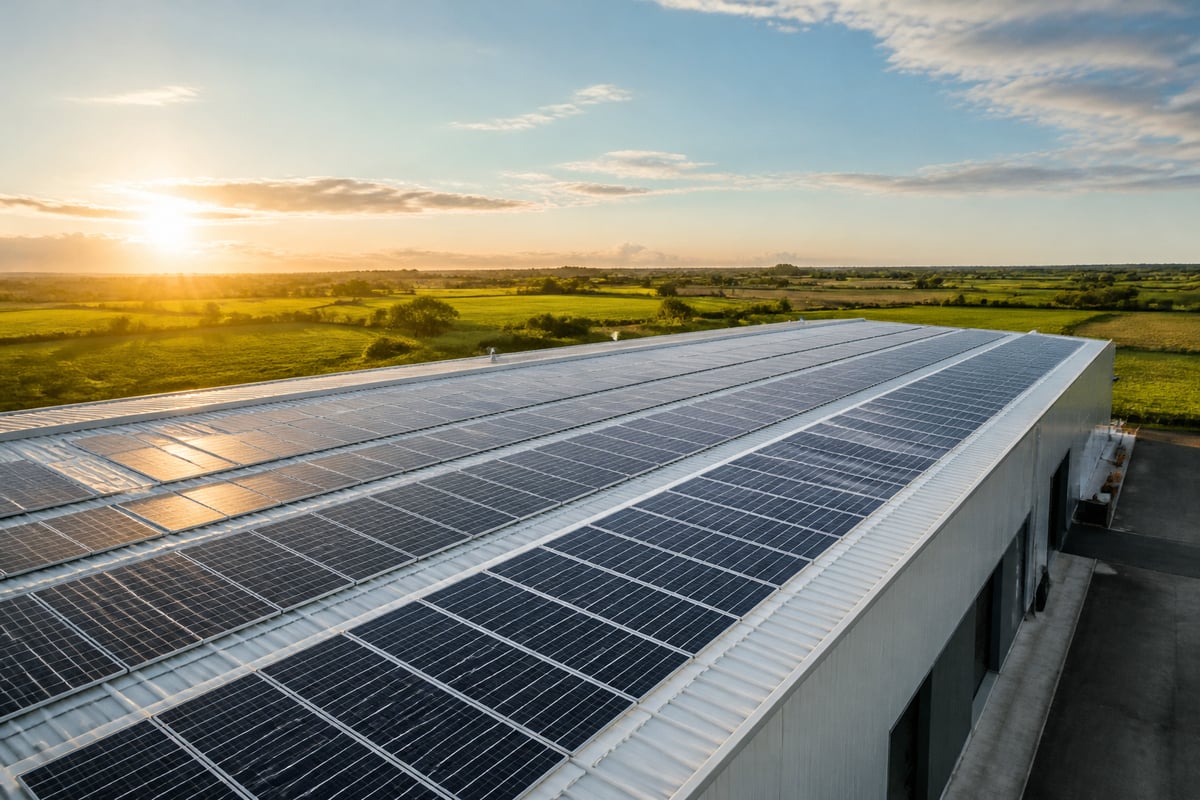
Rooftop installations dominate the commercial market because they cost less and disturb nothing on the ground. INFOLED's completed projects illustrate the scale this can reach: a 1.3 MWp rooftop solar PV project at UPD Rooftop, Lea Glen, and a 1.947 MWp installation at CTP Parow in Cape Town. At the larger end of that range, a single roof can supply a significant share of a tenant's daytime load.
Carports suit sites where parking is a feature of the business. They protect customers' vehicles from heat and hail, and they create a natural home for EV chargers, which is covered below. Ground-mount arrays are well suited to farms, packhouses and industrial sites with spare land. The article on solar power ground mounted systems explains layout and tracking options.
Adding Batteries for Resilience and Load Shedding Protection
A battery energy storage system (BESS) stores surplus solar energy so that a business can keep operating through outages and reduce its reliance on grid power at peak times.
For businesses with cold chains, production lines, data equipment or security systems, even short interruptions are expensive. Batteries bridge those gaps automatically. They also allow a business to shift stored solar energy into the evening, when tariffs are often higher and the sun is no longer shining.
INFOLED's 266 kWp solar PV and 512 kWh battery storage project at Nutec Ink in Ottery shows how the two technologies are paired in practice, with solar covering daytime consumption and storage providing resilience and peak support. Sizing is the critical decision: a battery that is too small fails to carry critical loads, while one that is too large ties up money that could have funded more panels. A load profile study, based on actual half-hourly consumption data, is the sound basis for that decision.
For further reading, see INFOLED's guides to solar and battery storage and commercial battery storage.
Getting Solar With No Capital Outlay
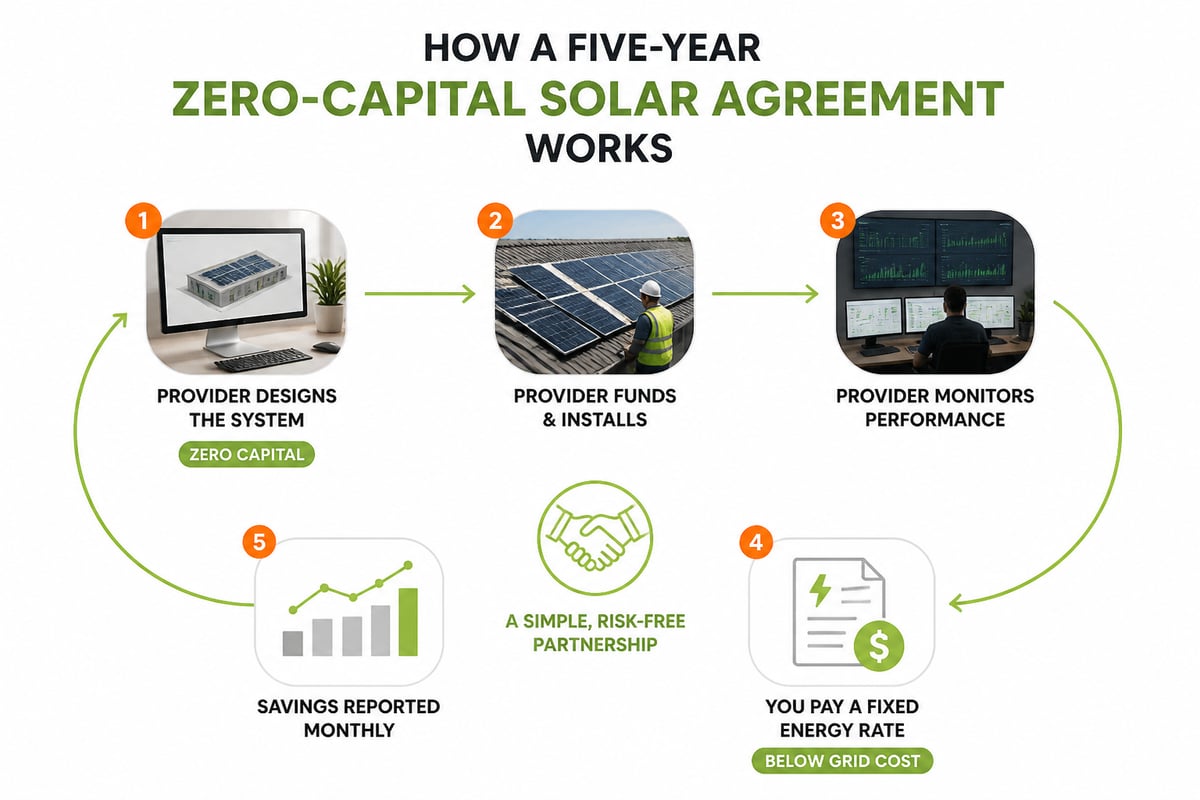
Zero-capital solar is possible when the system is financed and owned by the energy provider and the client pays for the energy or service through a fixed-term agreement.
This model addresses the most common objection to solar, which is that capital is better spent on core operations. Under a structured arrangement, the provider designs, funds, installs and maintains the system, and the business pays a predictable amount that is lower than its current grid cost. INFOLED structures financing around the client's cash flow with zero capital investment under fixed-term agreements.
Before signing any financing agreement, check these points:
- Savings guarantee. Is the effective tariff lower than the current grid rate, and how does it escalate?
- Maintenance responsibility. Who pays for repairs, inverter replacement and cleaning?
- Performance reporting. Will you receive production and savings data?
- End-of-term options. Can you buy the system, extend the agreement or have it removed?
- Roof and landlord consents. Tenants need the owner's written approval before installation.
What about tax incentives?
The South African Revenue Service previously ran a solar incentive that required qualifying panels to have a generation capacity of at least 275 W each, while batteries, inverters, installation costs and portable panels did not qualify. Incentive rules change, so confirm current eligibility with your tax adviser. Remember also that VAT applies to most solar equipment and installation services, and VAT-registered businesses can generally claim input VAT on commercial installations. Any quotation should state clearly whether prices include or exclude VAT.
Monitoring and Maintenance: Keeping a System Earning
A solar system only delivers its projected savings if it is monitored, maintained and corrected quickly when output drops.
Dust, bird fouling, shading from new structures, failing connectors and inverter faults all reduce production, often silently. Without live data, a business can lose weeks or months of output before anyone notices. Live monitoring flags underperformance as it happens, and proactive maintenance fixes the causes before they accumulate into lost income.
Quality at the start matters just as much. INFOLED's installations are tested and inspected by an in-house quality control team, and performance data is turned into reports that show where energy is being lost and how to recover it. That reporting also feeds into ESG and Net Zero disclosures, which a growing number of corporate tenants and lenders now request from property owners.
Industry terms worth knowing when reading a monitoring report:
- Performance ratio: actual output compared with the theoretical output for the sunlight received.
- Specific yield: kilowatt-hours generated per kWp installed, a useful benchmark between sites.
- Self-consumption rate: the share of generated power used on site rather than exported.
The guide to energy consumption monitoring describes how sub-metering helps identify waste before solar is even installed, which often reduces the size of system a business needs.
Turning Parking Areas and Fleets Into EV Charging Income
Solar-powered EV charging allows owners of parking areas, retail sites and fleets to earn revenue from vehicles while reducing the cost of the electricity those vehicles consume.
Electric vehicle ownership in South Africa is growing from a small base, but retail centres, office parks and logistics depots are already installing chargers to attract drivers and prepare for fleet electrification. There are two main ways to generate value:
- Public or tenant charging. Drivers pay per kilowatt-hour or per session, creating a new revenue line alongside parking.
- Fleet charging. Delivery vans, staff vehicles and company cars charge on site at a cost per kilometre that is well below petrol or diesel, particularly when the energy comes from your own solar array.
Pairing chargers with a carport array is especially effective. Cars are shaded, panels generate power during the hours vehicles are parked, and a battery can supply charging after sunset.
Choosing One Provider to Manage Everything
Working with a single provider for solar, batteries, EV charging and energy management reduces the coordination risk that arises when separate contractors are responsible for linked systems.
When an inverter, battery and charger come from different suppliers, a fault can trigger disputes over responsibility, and data sits in separate platforms. A fully managed arrangement places design, installation, monitoring and maintenance under one accountable party. INFOLED manages solar, battery, EV charging and energy solutions as a single service, which suits property owners who want predictable outcomes rather than technical oversight.
INFOLED's commercial, industrial, agricultural and residential solar PV service covers rooftop, carport, ground-mount, grid-tied, hybrid and off-grid designs, along with financing, maintenance, monitoring and asset management.
When evaluating any provider, ask for:
- Completed projects of comparable size, with measured performance
- A written quality control process
- Details of monitoring platforms and reporting frequency
- Clear terms on ownership, maintenance and end-of-agreement options
- Evidence that structural, electrical and municipal approvals are handled on your behalf
Practical Steps Before You Request a Quote
Preparing a few documents in advance speeds up design and produces more accurate savings estimates.
- Gather twelve months of electricity bills, including any half-hourly interval data from your municipality or supplier.
- Confirm roof details: age, material, structural condition and any warranty restrictions.
- Identify critical loads that must keep running during an outage.
- Check lease terms if you are a tenant, and obtain landlord consent early.
- List future needs, such as planned expansion, fleet electrification or ESG reporting targets.
- Decide on funding preference: capital purchase or a zero-capital agreement.
With these in hand, a competent provider can model generation, savings and payback, and compare the options on a like-for-like basis. For businesses wondering where the process begins, the guide to commercial solar PV provides a useful overview of project stages.
Your next step is to pull together your last twelve months of electricity bills and your site's roof and parking layout, since these two items allow an accurate savings model to be built. From there, INFOLED can design, finance, install, monitor and maintain the system, and its solar PV service covers rooftop, carport and ground-mount options for commercial and industrial sites. To see whether a zero-capital, five-year arrangement suits your cash flow, INFOLED can help you check funding eligibility before you commit to anything.
Next Step
Need help with your energy strategy?
Speak to INFOLED about solar, storage, EV charging, service agreements or system performance.