
Solar installations across South Africa face unique challenges-from partial shading caused by jacaranda trees in Johannesburg suburbs to dust accumulation in the arid Northern Cape. Traditional string inverter systems often underperform in these conditions, losing valuable energy yield when individual panels are compromised. The solar SolarEdge solution addresses these limitations through module-level power electronics (MLPE) that transform how photovoltaic systems harvest and convert sunlight into usable electricity. For commercial, industrial, and residential clients seeking maximum return on investment, understanding the solar SolarEdge architecture and its practical advantages in Southern African conditions has become essential for informed decision-making.
Understanding the Solar SolarEdge Architecture
The solar SolarEdge system represents a fundamental departure from conventional string inverter topology. Rather than relying solely on a central inverter to perform maximum power point tracking (MPPT) across an entire string of series-connected panels, the architecture places a power optimizer at each individual module.
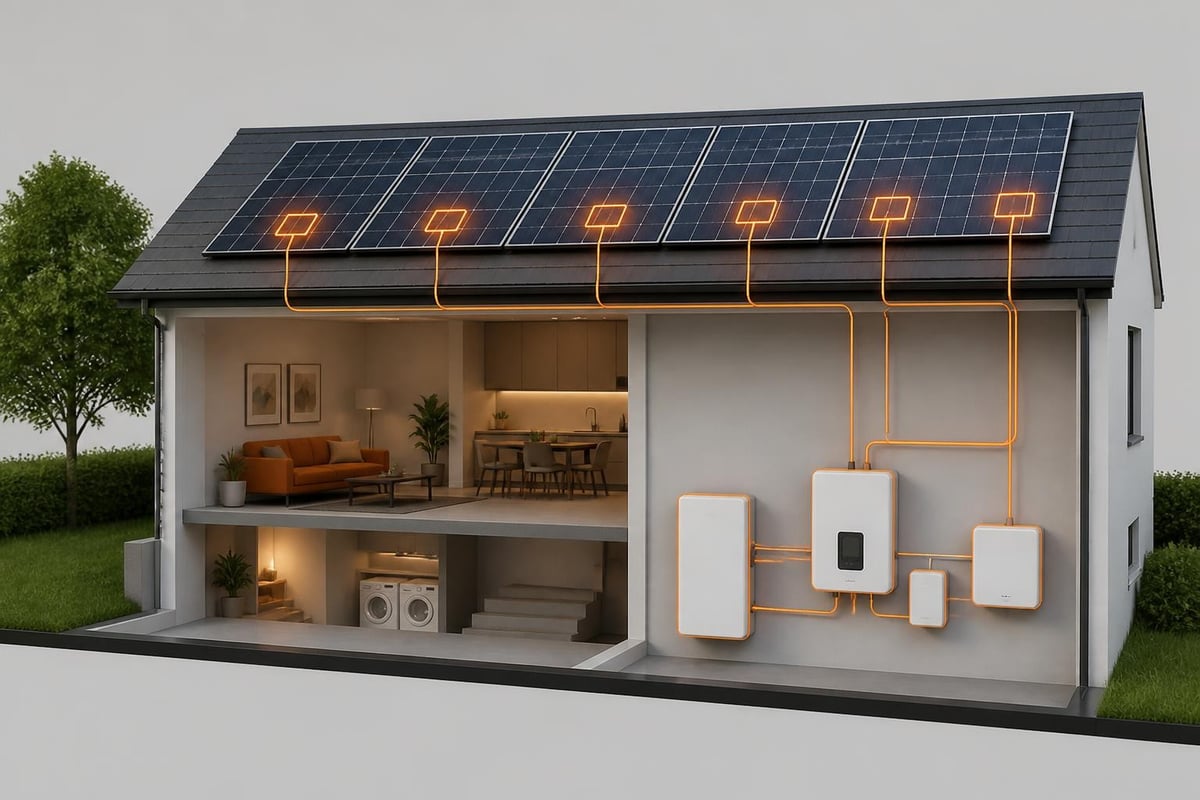
This distributed approach delivers several technical advantages:
- Module-level MPPT: Each panel operates at its individual maximum power point, regardless of shading, soiling, or manufacturing tolerances affecting neighbouring modules
- Fixed DC voltage: Power optimizers condition the output to a safe, fixed string voltage, improving safety and enabling longer string lengths
- Real-time monitoring: Every panel reports performance data individually, enabling rapid fault detection and precise maintenance interventions
- Enhanced safety: Automatic module-level shutdown (SafeDC™) reduces DC arc-flash risks during maintenance or emergency situations
The official SolarEdge product documentation outlines how this topology has evolved through multiple generations, with current HD-Wave inverter technology delivering weighted efficiency exceeding 99% across residential and commercial product lines.
Independent Validation and Performance Claims
Industry claims require independent verification, particularly when specifying equipment for multi-million rand commercial installations. The solar SolarEdge performance advantage gained third-party validation in 2025 through VDE Renewables testing.
According to the VDE Renewables independent assessment, the power optimizer-based topology demonstrated up to 10.5% energy yield advantage compared to conventional string inverter systems under real-world mismatch conditions. The testing protocol evaluated safety, cybersecurity resilience, and energy harvest across scenarios typical of Southern African installations-partial shading, module degradation, and temperature coefficient variations.
This validation carries particular weight for engineered commercial systems where performance guarantees and financial models depend on accurate yield predictions. When evaluating solar SolarEdge against competing technologies, the independently verified performance data provides a credible foundation for feasibility studies and long-term return calculations.
Market Position and Manufacturing Scale
The solar SolarEdge brand has established significant market presence since entering the distributed generation sector. PV Tech industry reporting indicates the company shipped over 1GW of inverter capacity in a single quarter for the first time since 2023, signalling recovery from earlier supply chain constraints and market corrections.
Manufacturing scale matters for Southern African buyers for several practical reasons:
- Product availability: High-volume production supports reliable delivery timelines for project schedules
- Warranty support: Established manufacturing operations and global service networks underpin long-term warranty commitments
- Technology development: Revenue scale funds ongoing R&D for new features, grid support functions, and integration capabilities
- Spare parts: Volume production ensures availability of replacement optimizers and inverter components throughout system lifecycle
Wood Mackenzie market analysis tracks competitive dynamics across distributed solar and storage segments, positioning solar SolarEdge among the leading suppliers in residential and commercial segments globally. For South African installers and end users, this market position translates to competitive pricing through economies of scale and established local distribution channels.
Integration with Battery Energy Storage Systems
The solar SolarEdge ecosystem extends beyond PV generation into integrated energy storage. The company's battery inverter products and battery management systems enable DC-coupled storage configurations that maximize round-trip efficiency and simplify system design.
| Feature | SolarEdge Integration | Benefit for SA Market |
|---|---|---|
| DC-coupled architecture | Direct DC connection reduces conversion losses | Higher usable capacity during load-shedding events |
| Single inverter platform | One device manages both PV and battery | Lower hardware costs and simplified installation |
| Intelligent backup | Automatic islanding and backup transitions | Seamless operation during grid failures |
| Energy arbitrage | Time-based charging and discharging | Maximise TOU tariff savings with Eskom Megaflex |
The EnergySage independent review of SolarEdge Home Battery systems highlights the ecosystem approach as a key advantage-existing solar SolarEdge PV installations can add storage through inverter upgrades or battery-optimized inverter additions without replacing the entire system architecture.
For commercial and industrial clients across Southern Africa, this modularity supports phased investment strategies. An initial PV installation can be deployed with solar SolarEdge optimizers and an HD-Wave inverter, with battery capacity added later as capital becomes available or as electricity tariffs and load-shedding patterns justify the investment. This flexibility aligns with how energy management systems evolve over time in response to operational data and changing grid conditions.
Safety Standards and Grid Compliance
Solar installations must satisfy multiple safety and grid interconnection requirements before energisation. The solar SolarEdge rapid shutdown functionality addresses National Electrical Code (NEC) requirements adopted by many jurisdictions, though South African installations follow SANS 10142 and related standards.
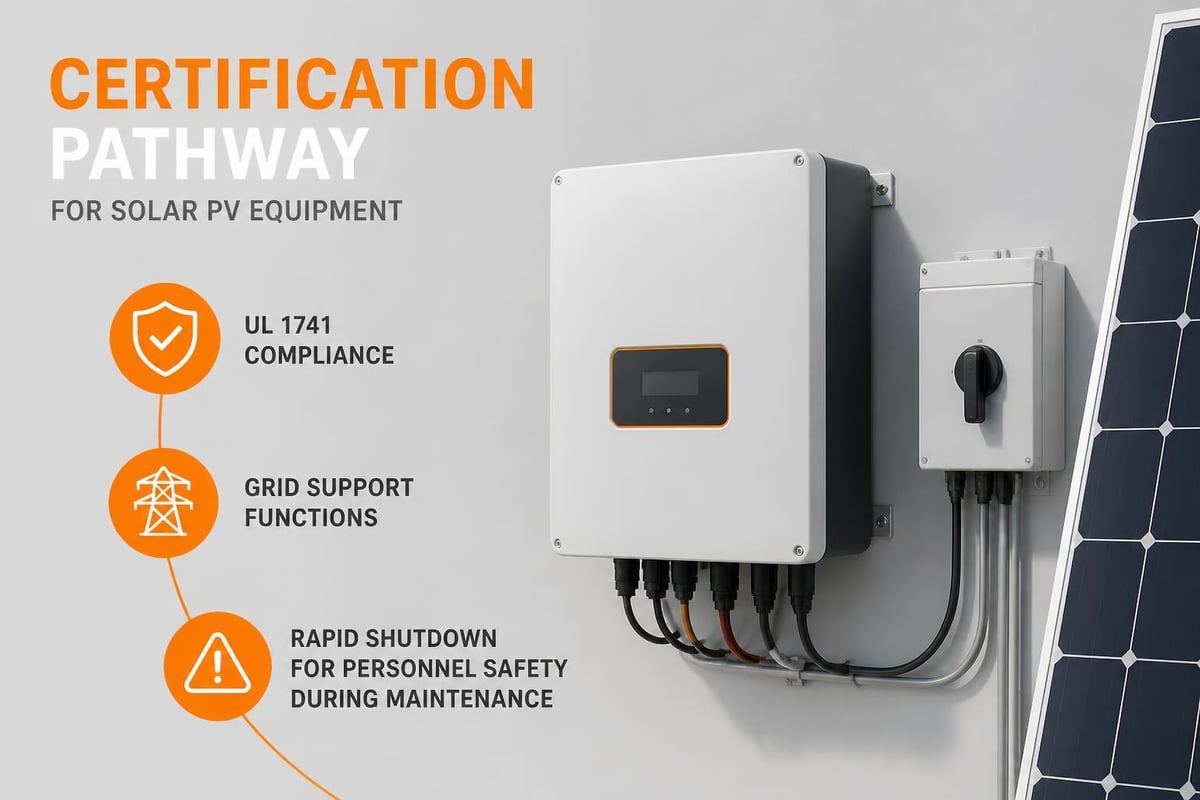
Key safety certifications include:
- UL 1741: Standard for inverters, converters, controllers and interconnection system equipment
- UL 1741 SA: Supplement covering advanced grid support functions (voltage/frequency ride-through, reactive power control)
- IEC 62109: Safety of power converters for use in photovoltaic power systems
The UL Solutions PV certification framework establishes testing protocols that solar SolarEdge products undergo to demonstrate compliance with safety and performance requirements. For South African installations, equipment must additionally satisfy SANS specifications and municipal approval processes, which typically reference international standards while adding local requirements.
The module-level shutdown capability inherent in the solar SolarEdge optimizer architecture reduces DC voltage to safe levels (typically <1V per optimizer) within 30 seconds of AC disconnect or emergency stop activation. This functionality protects emergency responders and maintenance personnel from arc-flash hazards during rooftop work or fire suppression activities.
Commercial and Industrial Applications
The solar SolarEdge value proposition strengthens considerably in commercial and industrial contexts where system complexity, performance optimization, and operational visibility justify the incremental cost of power optimizers.
Manufacturing Facilities
Manufacturing operations in Gauteng, KwaZulu-Natal, and Western Cape industrial zones face several solar deployment challenges:
- Large roof areas with multiple roof angles, skylights, and ventilation equipment creating shading
- Process equipment generating harmonics that impact power quality
- Demand charges making time-of-use energy management critical
- 24-hour operations requiring high reliability and rapid fault response
The solar SolarEdge monitoring platform delivers panel-level performance data accessible through web and mobile interfaces. Maintenance teams can identify failing optimizers, soiled panel sections, or wiring faults without manual inspection of thousands of modules. This operational intelligence reduces downtime and maintenance costs over system lifetime.
For facilities pursuing ISO 50001 energy management certification or requiring detailed ESG reporting, the granular data from solar SolarEdge systems supports verification of renewable generation claims and enables optimization of battery dispatch strategies. Companies implementing Operations & Maintenance programmes benefit from the diagnostic capabilities built into the monitoring infrastructure.
Agricultural Solar Installations
Agricultural solar deployments face unique environmental stresses-dust in harvesting seasons, bird droppings, and potential shading from windbreaks or packing sheds. The module-level optimisation of solar SolarEdge systems minimises energy losses from partial soiling or shading that would significantly impact string inverter performance.
Ground-mounted arrays in agricultural applications can leverage the longer string lengths enabled by the fixed DC voltage architecture. Standard string inverters limit string lengths due to voltage considerations; solar SolarEdge power optimizers condition the DC output to enable strings exceeding 20 modules while maintaining safe operating voltages. This flexibility reduces balance-of-system costs in large ground-mount installations.
Residential Applications and Retrofit Potential
While commercial installations represent the highest-value segment, residential solar adoption continues accelerating across South African suburbs. The solar SolarEdge residential inverter range (3–10 kW single-phase) addresses the typical household load profile while enabling future expansion.
Retrofit scenarios demonstrate particular advantage:
- Complex roof geometry: Homes with multiple roof planes, dormers, or chimneys that create shading patterns
- Future expansion: Initial installation on the north-facing primary roof, with later additions to east/west sections as budget permits
- Battery integration: Add storage to existing solar SolarEdge PV system without replacing the inverter infrastructure
- EV charging coordination: Intelligent load management coordinates solar generation, battery discharge, and EV charging to minimize grid import
The monitoring visibility appeals to residential users managing electricity consumption actively. Homeowners can track individual panel performance, identify when tree trimming is needed to reduce shading, and verify cleaning effectiveness after maintenance visits. This transparency builds confidence in the investment and supports data-driven decisions about system expansion or battery storage additions.
Design Considerations for Southern African Conditions
Specifying solar SolarEdge equipment for installations across Southern Africa requires attention to environmental and operational factors specific to the region.
Temperature and Derating
Ambient temperatures in provinces like Limpopo and North West regularly exceed 35°C during summer months. All inverter equipment experiences temperature-related derating-reduced output capacity at high operating temperatures to maintain safe component temperatures.
| Inverter Type | Temperature Derating Threshold | Typical Derated Capacity at 50°C |
|---|---|---|
| HD-Wave (standard cooling) | 40°C ambient | 85–90% of rated capacity |
| HD-Wave (enhanced cooling) | 45°C ambient | 90–95% of rated capacity |
| Outdoor-rated enclosures | 50°C ambient | 80–85% of rated capacity |
Proper inverter placement-shaded locations, ventilated enclosures, or indoor installation when possible-mitigates temperature derating. The solar SolarEdge specifications provide derating curves that enable accurate sizing during the engineering phase, ensuring the inverter capacity matches the DC array under realistic operating conditions rather than nameplate ratings.
Lightning Protection and Surge Suppression
Highveld regions experience frequent lightning activity during summer thunderstorm seasons. While solar SolarEdge equipment includes internal surge protection, comprehensive system design requires:
- Type I+II SPDs (surge protective devices) at the main distribution board
- Type II SPDs at the inverter AC and DC terminals
- Equipotential bonding of all metallic components
- Proper grounding electrode system per SANS 10142-1
The distributed architecture of solar SolarEdge systems with optimizers at each module requires careful consideration of optimizer-to-optimizer DC wiring and grounding. Follow manufacturer installation guidelines precisely to maintain warranty coverage and ensure surge protection effectiveness.
Monitoring Platforms and System Intelligence
The solar SolarEdge monitoring platform represents a significant differentiator from basic string inverter systems. Cloud-based data aggregation provides multi-site visibility for installers managing commercial portfolios and residential fleet installations.
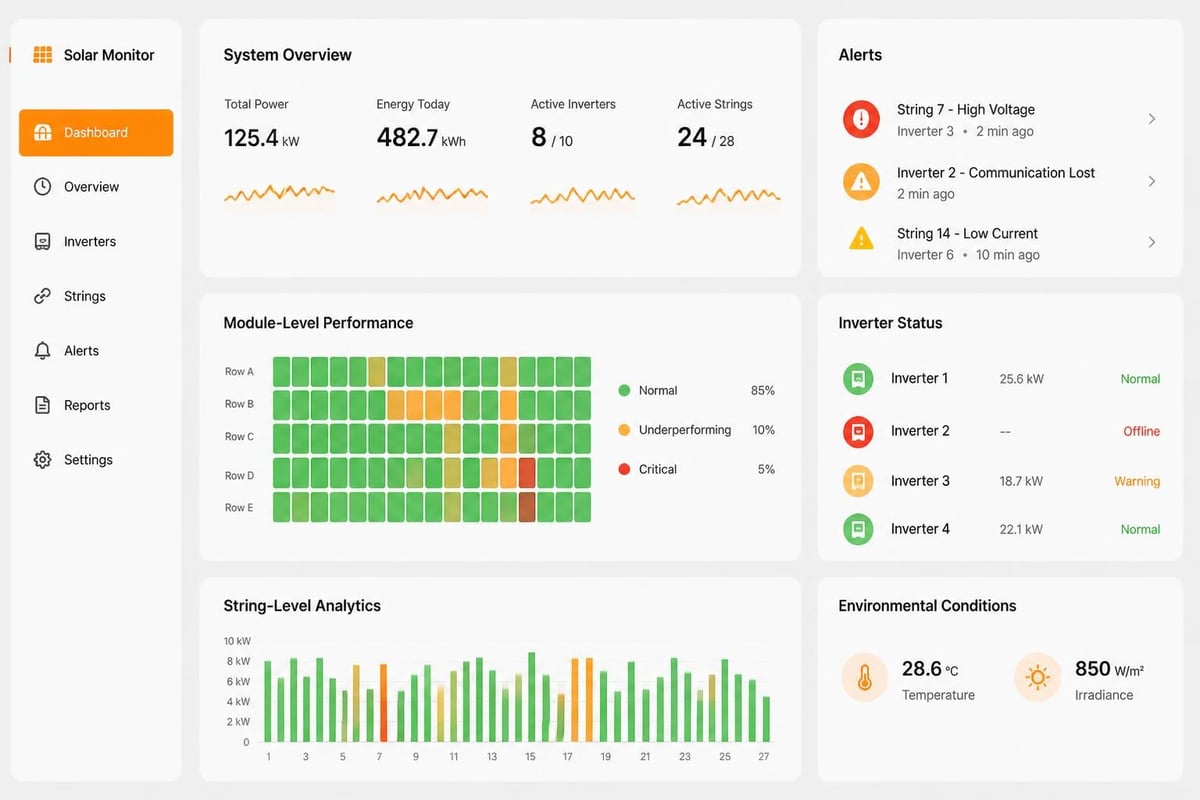
Platform capabilities include:
- Module-level visibility: Individual panel voltage, current, power, and energy production with historical trending
- String analysis: String voltage and current with automatic detection of damaged bypass diodes or poor connections
- Inverter performance: Real-time and historical efficiency, temperature, and grid voltage/frequency
- Automated alerts: Email and SMS notifications for optimizer failures, inverter faults, or grid disconnections
- Energy reporting: Daily, monthly, and annual production summaries with CO₂ offset calculations
- Financial tracking: Energy cost savings based on utility tariff structures and time-of-use rates
For installers serving multiple clients, the commercial monitoring portal enables management of hundreds of sites through a single interface. Maintenance teams can prioritize service calls based on performance impacts-addressing complete optimizer failures immediately while scheduling routine cleaning interventions during low-priority windows.
Integration with building management systems (BMS) through Modbus TCP or RS485 enables larger commercial facilities to incorporate solar generation data into comprehensive energy management strategies. This integration supports demand response programmes, automated load shifting, and verification of energy performance contracts.
Financial Modelling and Return on Investment
Investment decisions require accurate financial projections. The solar SolarEdge yield advantage validated by independent testing directly impacts return on investment calculations for commercial buyers.
Consider a 500 kWp commercial installation in Johannesburg with estimated annual production of 750,000 kWh under standard test conditions:
Traditional string inverter scenario:
- Actual yield after mismatch losses: 712,500 kWh (5% reduction)
- Annual savings at ZAR 2.85/kWh: ZAR 2,030,625
- System cost: ZAR 5,500,000
- Simple payback: 2.71 years
Solar SolarEdge optimizer scenario:
- Actual yield with MLPE optimization: 742,500 kWh (1% reduction)
- Annual savings at ZAR 2.85/kWh: ZAR 2,116,125
- System cost: ZAR 5,850,000 (6.4% premium)
- Simple payback: 2.76 years
The 4.2% yield advantage (30,000 kWh annually) generates ZAR 85,500 additional value each year. Over a 25-year system lifetime, this compounds to over ZAR 2.1 million in additional savings, far exceeding the incremental capital cost. Financial models must incorporate realistic yield predictions rather than theoretical STC ratings to support accurate decision-making.
For facilities pursuing solar funding through third-party financing structures, the higher verified yield from solar SolarEdge systems strengthens financial proposals and may secure more favourable financing terms from lenders familiar with the technology's track record.
Maintenance Requirements and Operational Lifecycle
Solar SolarEdge systems require preventive maintenance to achieve their 25-year design lifetime. The module-level monitoring dramatically simplifies maintenance planning by identifying specific optimizers requiring attention rather than necessitating manual inspection of entire arrays.
Typical maintenance interventions include:
- Quarterly visual inspections: Array condition, wiring integrity, optimizer LED status checks
- Bi-annual panel cleaning: Remove accumulated dust, pollen, and bird droppings (critical in dry provinces)
- Annual electrical testing: Insulation resistance, grounding continuity, string voltage verification
- Inverter filter replacement: Cooling fan filter cleaning or replacement per manufacturer schedule (typically 12–24 months)
- Optimizer replacement: Individual optimizer failures addressed as identified through monitoring alerts
The solar panel recycling considerations apply equally to optimizer-based systems. End-of-life management should incorporate optimizer recovery and responsible disposal of electronic components in accordance with environmental regulations.
Commercial operators implementing service level agreements for solar assets benefit from the diagnostic capabilities that enable condition-based maintenance rather than time-based schedules. This approach reduces maintenance costs while maintaining performance guarantees through targeted interventions.
Competitive Technology Comparisons
The solar SolarEdge MLPE approach competes against several alternative architectures in the South African market. Understanding the trade-offs informs technology selection for specific project requirements.
| Technology | Capital Cost | Monitoring Resolution | Shading Tolerance | Complexity |
|---|---|---|---|---|
| String inverter | Baseline | String-level | Poor | Low |
| String inverter + DC optimizers (SolarEdge) | +5–8% | Module-level | Excellent | Medium |
| Microinverters | +10–15% | Module-level | Excellent | Medium-High |
| Hybrid string (module + string MPPT) | +3–5% | String-level | Good | Low-Medium |
String inverters remain cost-effective for simple installations with minimal shading and uniform module orientation. The solar SolarEdge premium justifies itself in complex installations where the yield advantage, enhanced monitoring, and safety features offset the additional capital outlay.
Microinverter systems eliminate DC wiring entirely by converting to AC at each module. While this offers maximum granularity, the distributed AC wiring increases installation labour and introduces more potential failure points. The solar SolarEdge DC-optimized approach balances centralized inverter architecture with module-level intelligence.
Grid Support Functions and Utility Integration
Modern grid codes increasingly require solar installations to provide grid support services-reactive power compensation, frequency response, and voltage regulation. The solar SolarEdge inverter firmware includes advanced grid support features that satisfy these emerging requirements.
Capabilities include:
- Reactive power control: Adjustable power factor (cos φ) from 0.8 leading to 0.8 lagging
- Voltage ride-through: Continued operation during grid voltage excursions per IEEE 1547-2018
- Frequency-watt response: Automatic power curtailment during over-frequency events
- Volt-VAR curve: Dynamic reactive power injection based on grid voltage conditions
For commercial facilities connected to Eskom medium-voltage networks or municipal distribution systems, these functions may become mandatory requirements for new installations. The solar SolarEdge platform's built-in support for these features protects the investment against future regulatory changes and enables participation in grid services markets as they develop in South Africa.
Utility-scale projects (>1 MW) may require SCADA integration and remote dispatch capability. The solar SolarEdge commercial inverter range supports Modbus RTU and Ethernet protocols that facilitate integration with utility control systems, enabling centralized monitoring and control of distributed generation resources.
The solar SolarEdge technology delivers measurable advantages for Southern African solar installations through module-level power optimization, comprehensive monitoring, and system intelligence that maximize energy harvest under real-world conditions. The validated performance gains, enhanced safety features, and operational visibility support both commercial and residential investment decisions. INFOLED designs, installs, and maintains solar SolarEdge-based PV systems across Southern Africa, combining engineering expertise with ongoing performance monitoring to deliver long-term value for clients pursuing reduced electricity costs and improved energy resilience.
Next Step
Need help with your energy strategy?
Speak to INFOLED about solar, storage, EV charging, service agreements or system performance.